


2-Flute Carbide Ball Nose End Mill for Aluminium | AL
Shipping costs are not included in the price.
Shipping costs are not included in the price.
Ask about the product

The administrator of personal data is Kortools. We process it to respond to your inquiry. More information regarding the processing of personal data can be found in privacy policy.
Select a product variant:
Individual variants may differ in price
Product code: 40DA-44399
Product description
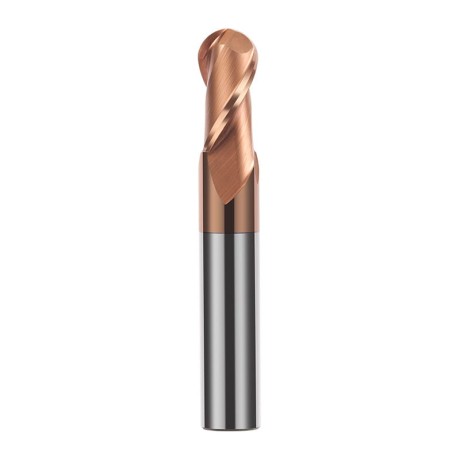
2-flute solid carbide ball nose end mill for aluminium — AL
Ball-shaped tip · radii R0.5–R10 mm · CNC machining
A solid carbide ball nose end mill with two cutting flutes, intended primarily for aluminium and its alloys. The ball-shaped cutting tip is specified by radius R. When selecting a size, distinguish between the radius, cutting diameter and shank diameter.
Match the geometry to the workpiece and the holder to shank diameter D. The variant designation also includes overall length L. Individual versions combine different dimensions, so compare the complete designation with the selected cutter card before ordering.
1. Applications and ball nose geometry
The cutter is intended for CNC machining centres, CNC milling machines and suitably equipped engraving machines. The cutting section has a ball-shaped tip and two helical flutes. Radius R refers to the tip; the cutting diameter is stated separately after the Ø symbol.
Ball nose geometry is used for machining surfaces and slots that require a rounded profile. The application range also includes side milling and hole milling. Match the tool path to the workpiece geometry and the capabilities of the machine.
2. Workpiece materials
Aluminium is the primary application. The table separates recommended materials from those requiring another tool family. Select cutting conditions for the specific material.
| Material | Application range |
|---|---|
| Aluminium and its alloys | The primary application; particularly suitable for this cutter family. |
| Copper alloys | Suitable for machining with this cutter. Match the cutting conditions to the specific alloy. |
| Acrylic | Particularly suitable for this family. |
| Wood | Suitable for machining with this cutter. |
| Materials outside the recommended range | Steels, stainless steel, cast iron, heat-resistant and titanium alloys, graphite and CFRP composites. Select another suitable cutter family for these materials. |
3. Construction and technical specifications
| Parameter | Value or description |
|---|---|
| Tool type | Shank-type end mill with a ball-shaped cutting tip |
| Tool material | VHM — solid micrograin carbide, grain size 0.6 µm |
| Number of flutes | 2 — identified by 2T in the specification |
| Cutting diameter Ø | From 1 to 20 mm, depending on the variant |
| Ball nose radius R | From 0.5 to 10 mm, depending on the variant |
| Shank diameter D | From 3 to 20 mm, depending on the variant |
| Overall length L | 50, 60, 75, 100 or 150 mm, depending on the variant |
| Unit of sale | 1 piece — one cutter of the selected variant |
These ranges describe the product family. Check the variant selector for specific combinations of radius, shank diameter and overall length. Not every diameter is offered in every length, and a stated range does not imply that any intermediate value can be selected.
4. Reading the designation and dimensions
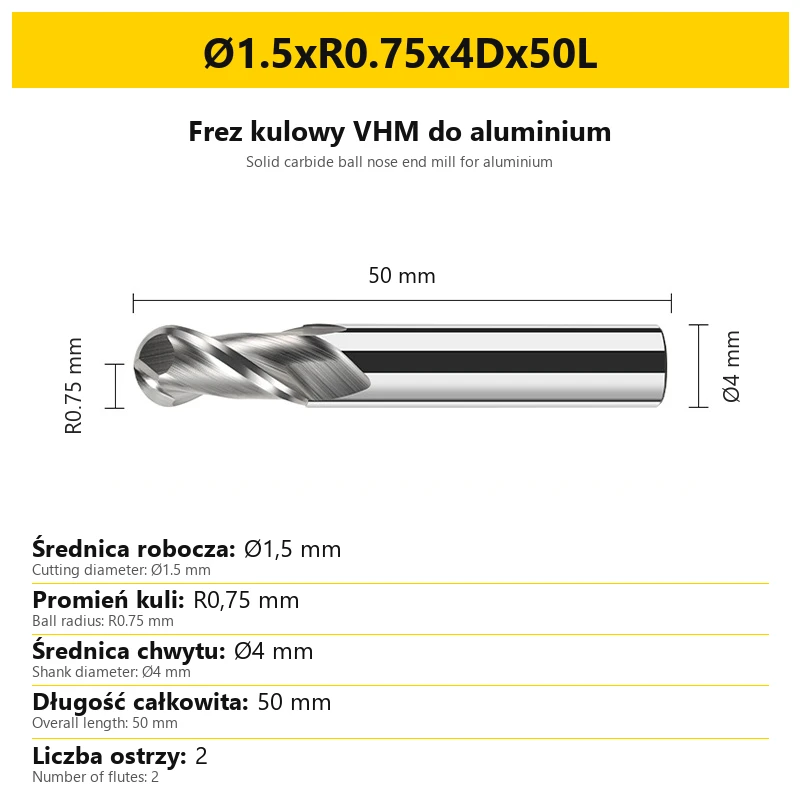
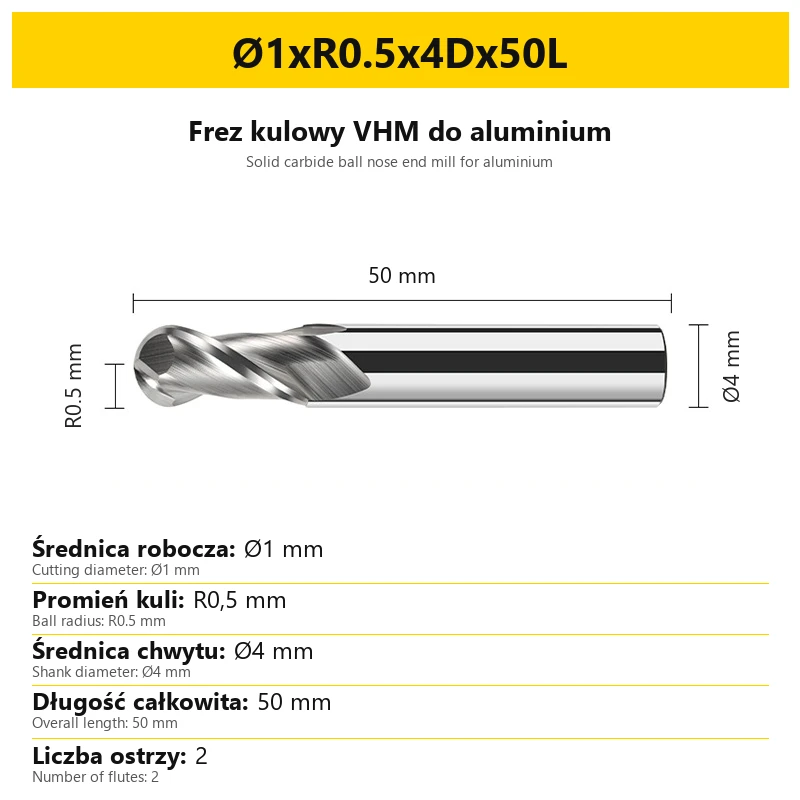
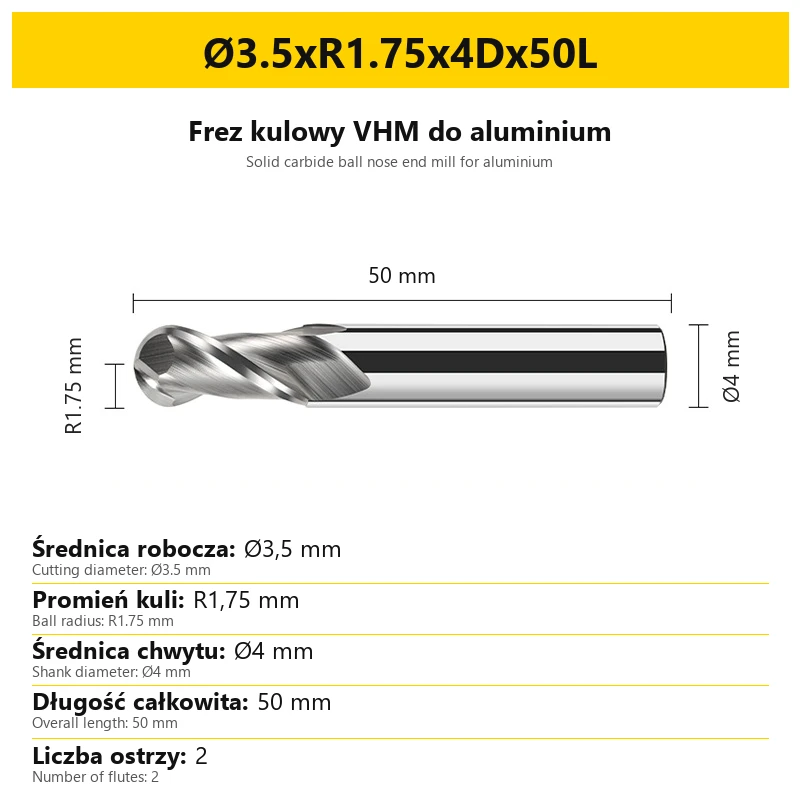
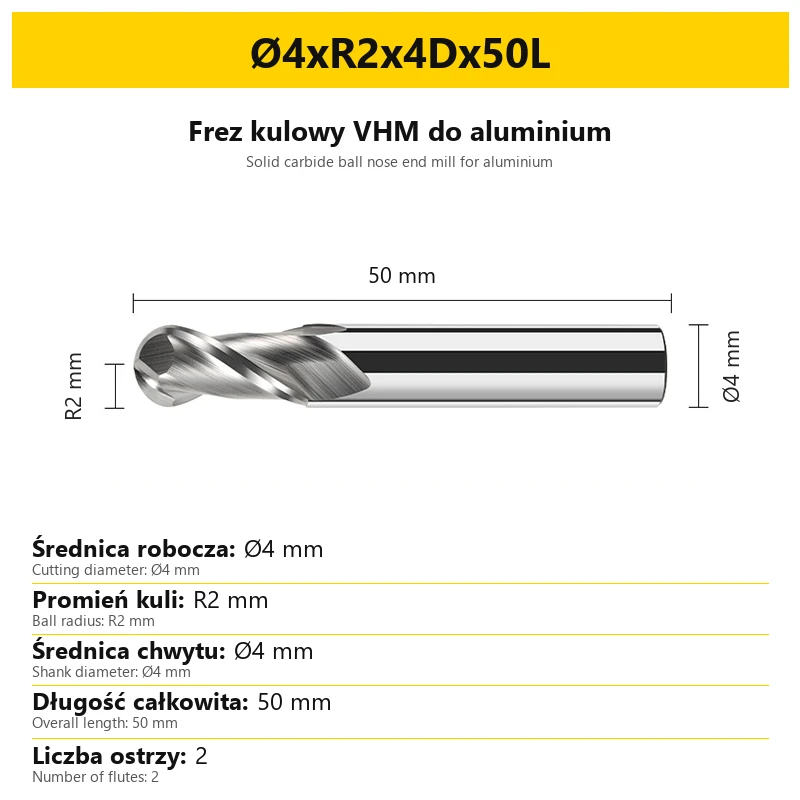
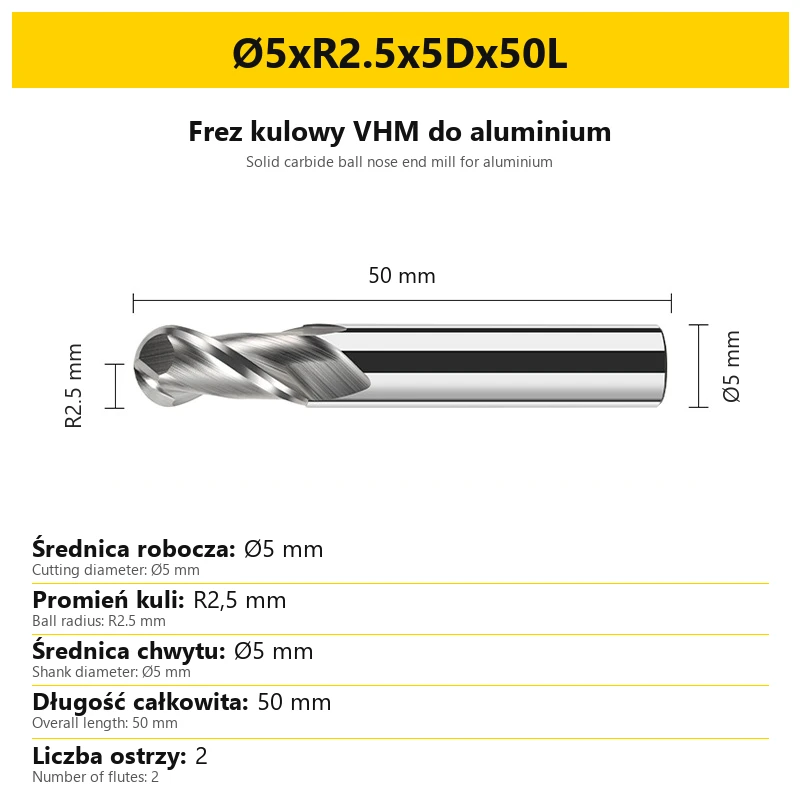
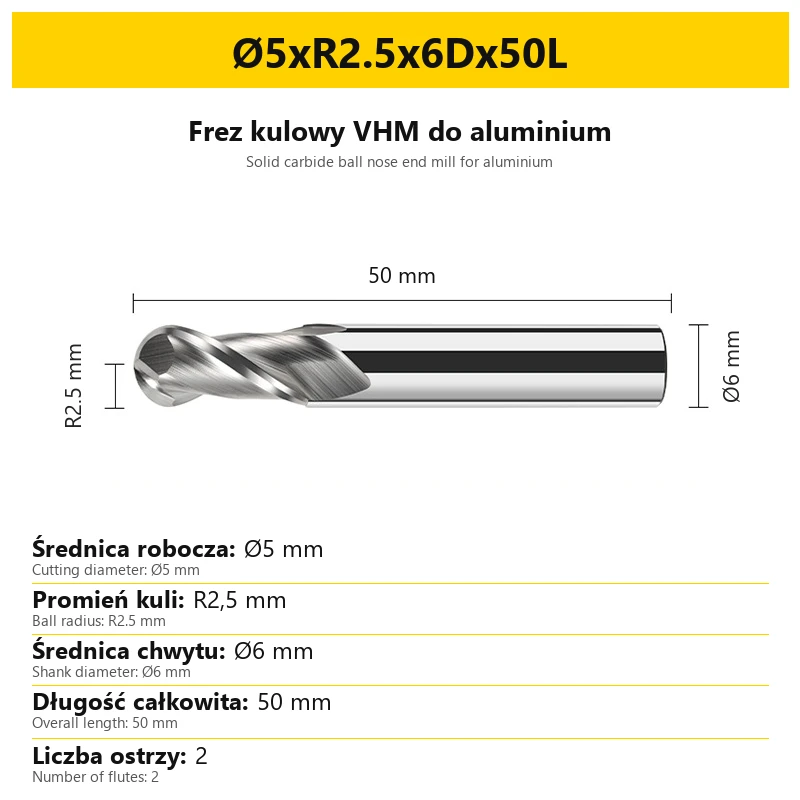
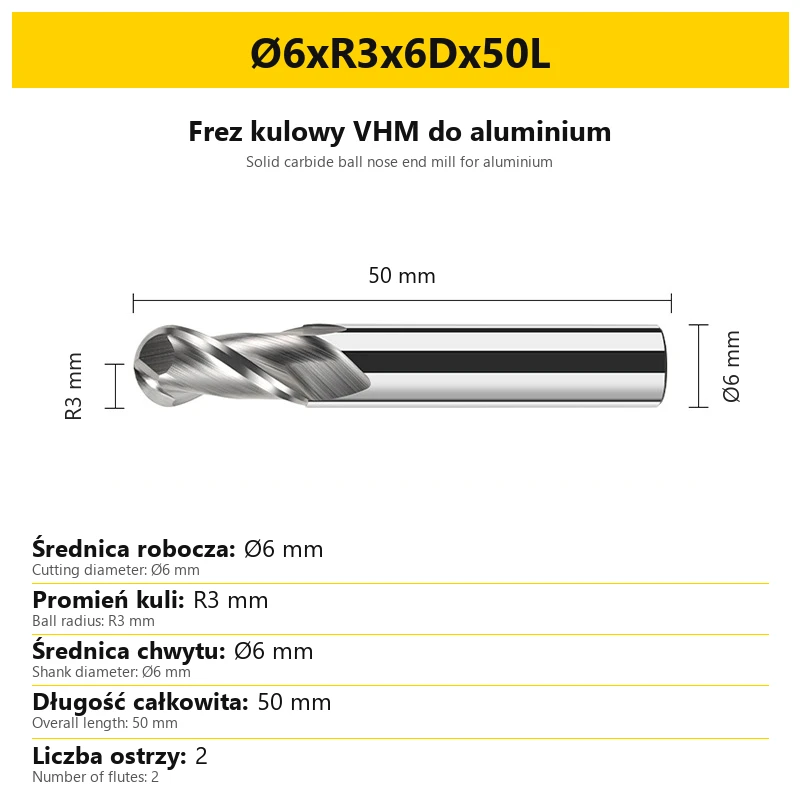
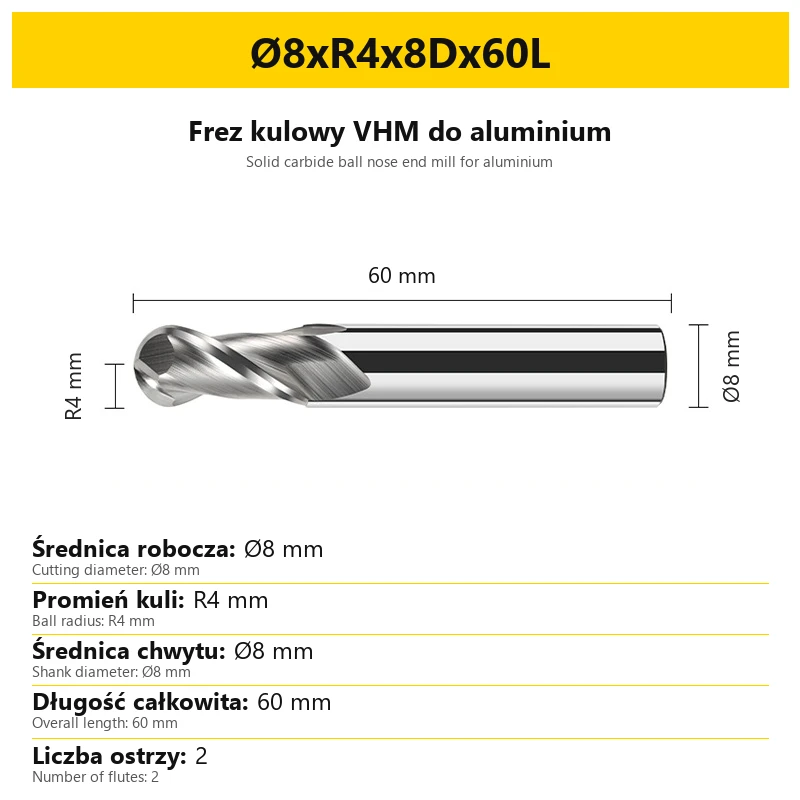
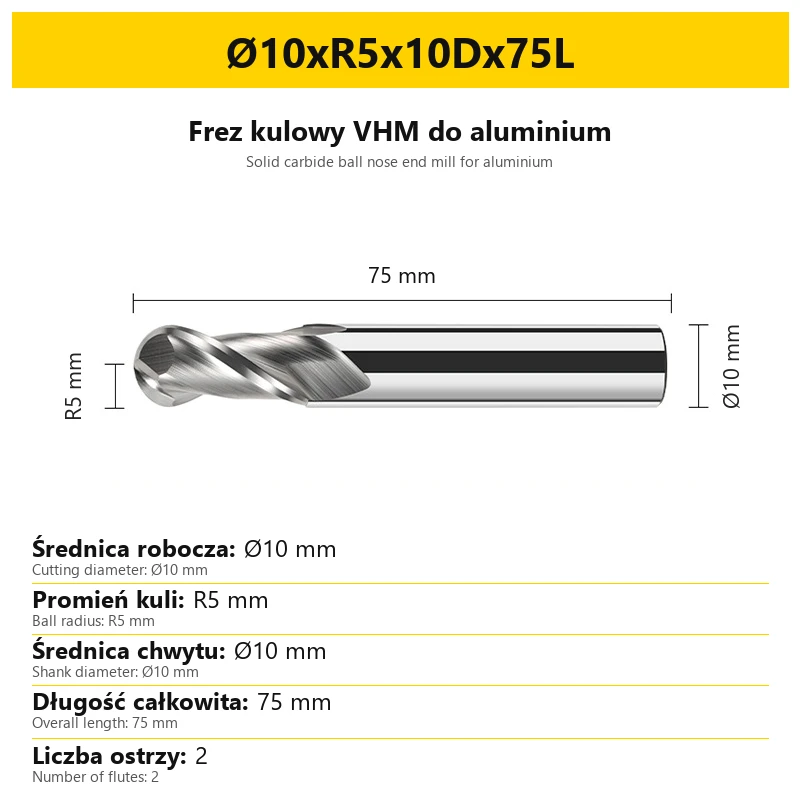
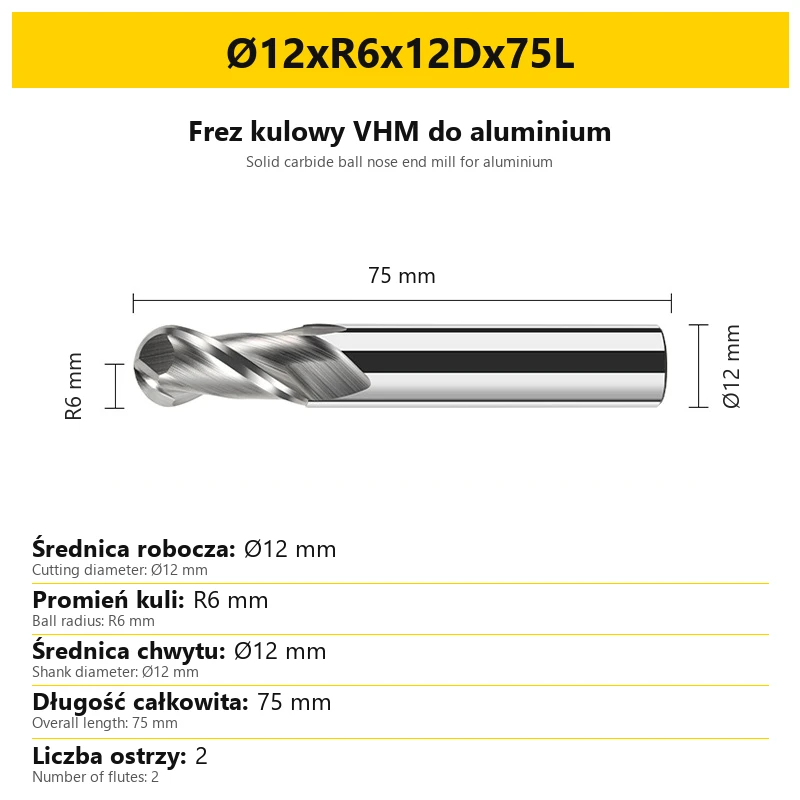
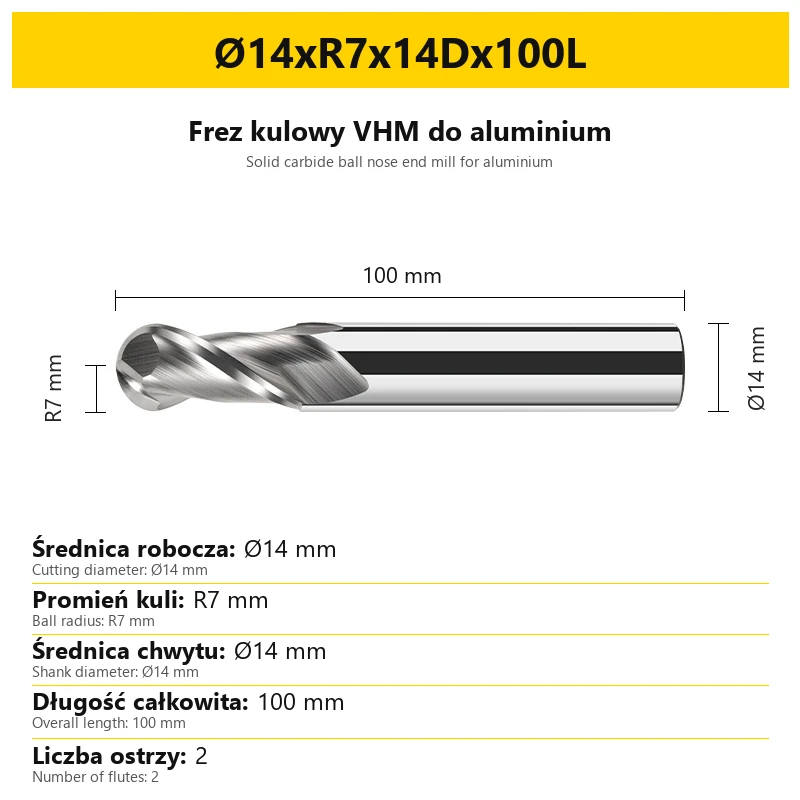
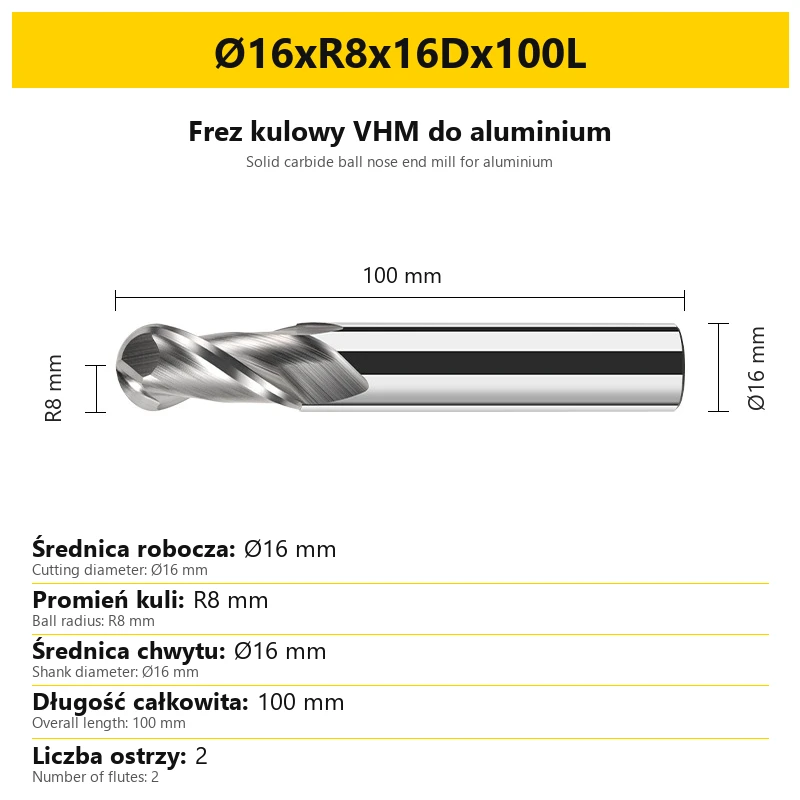
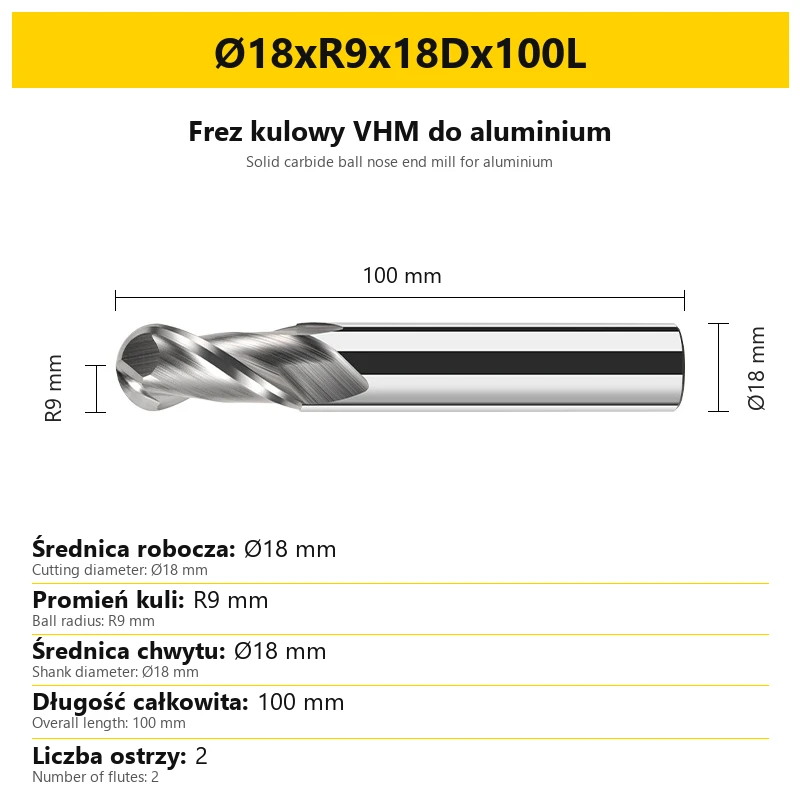
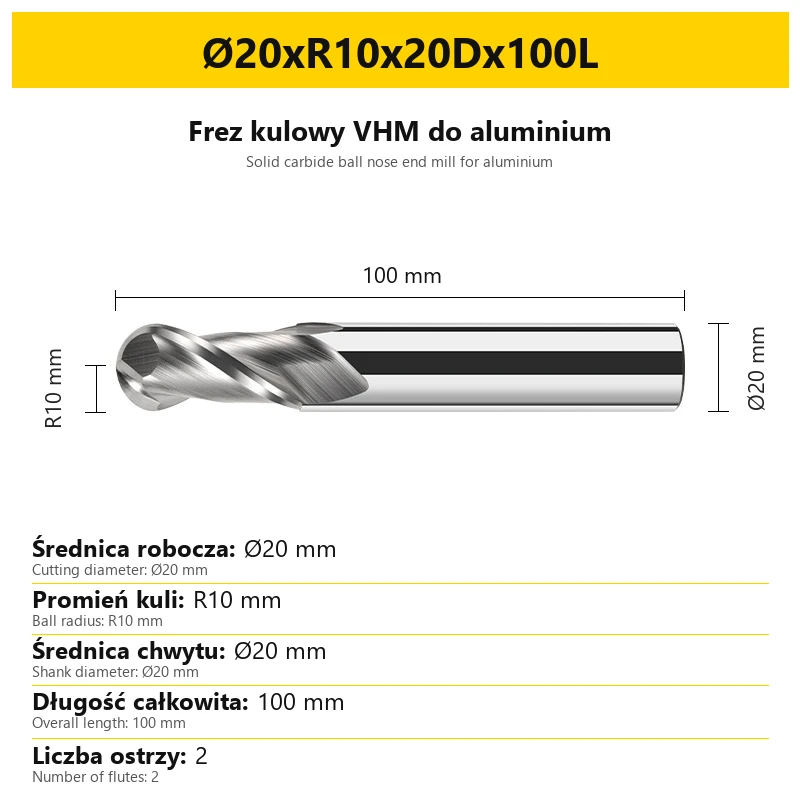
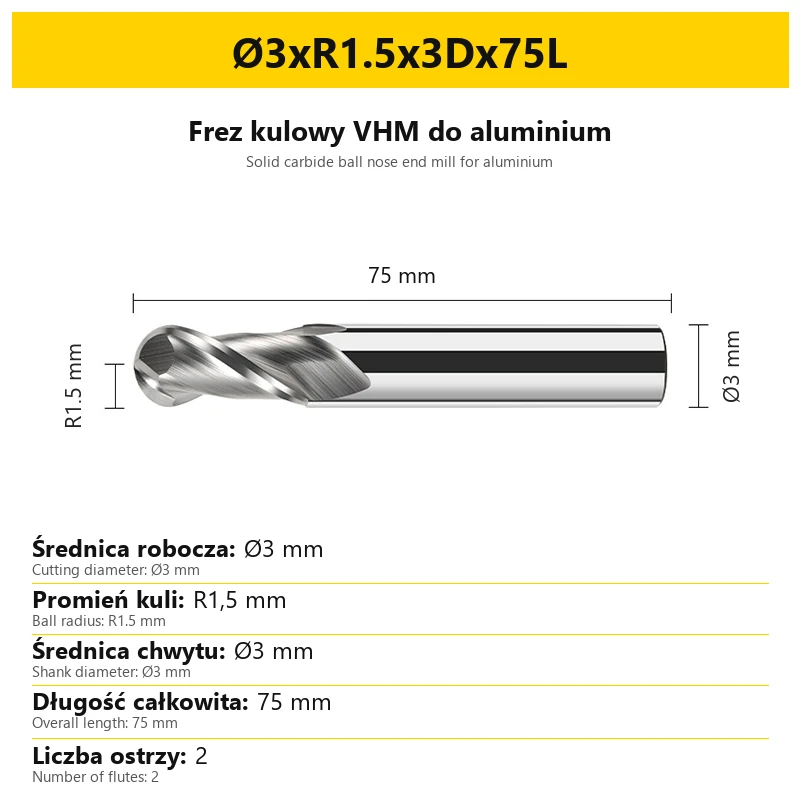
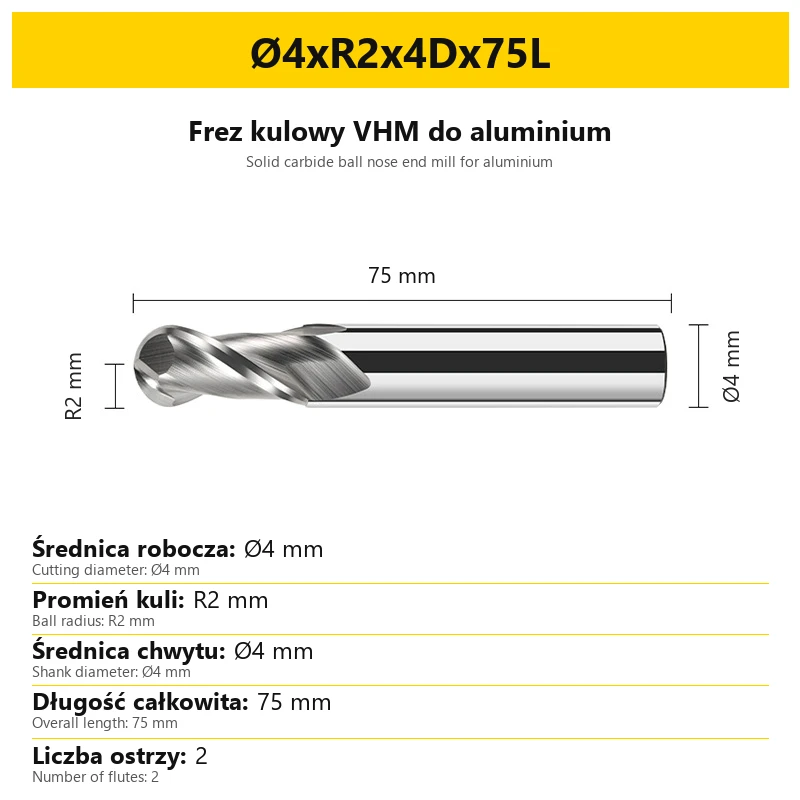
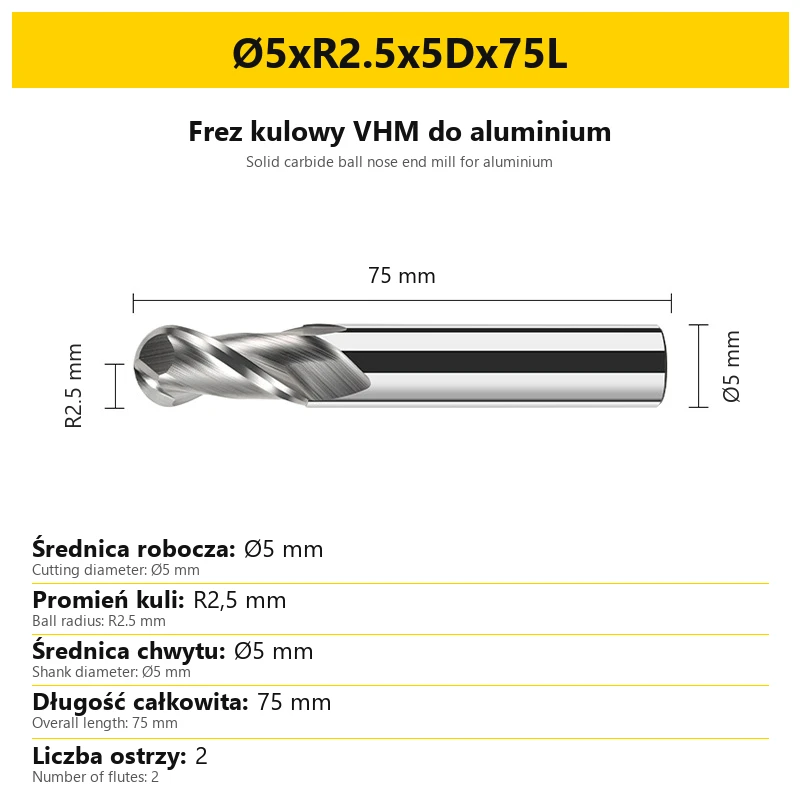
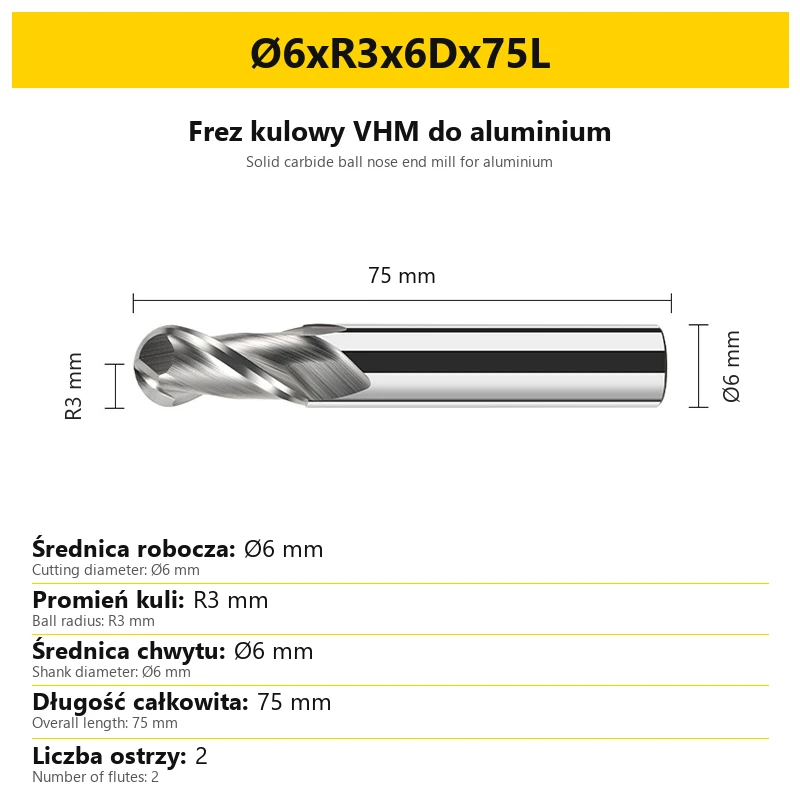
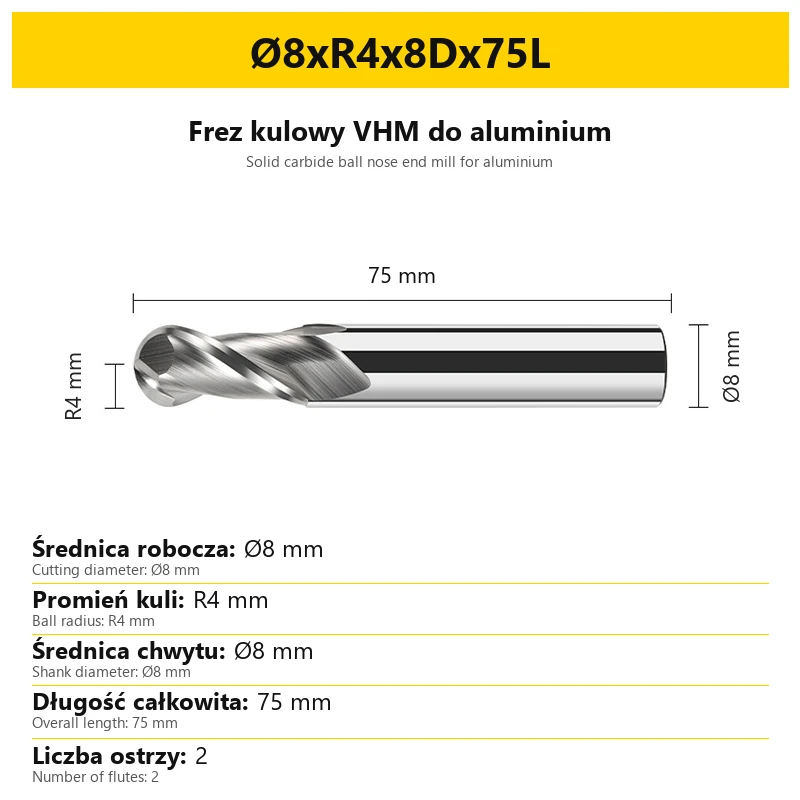
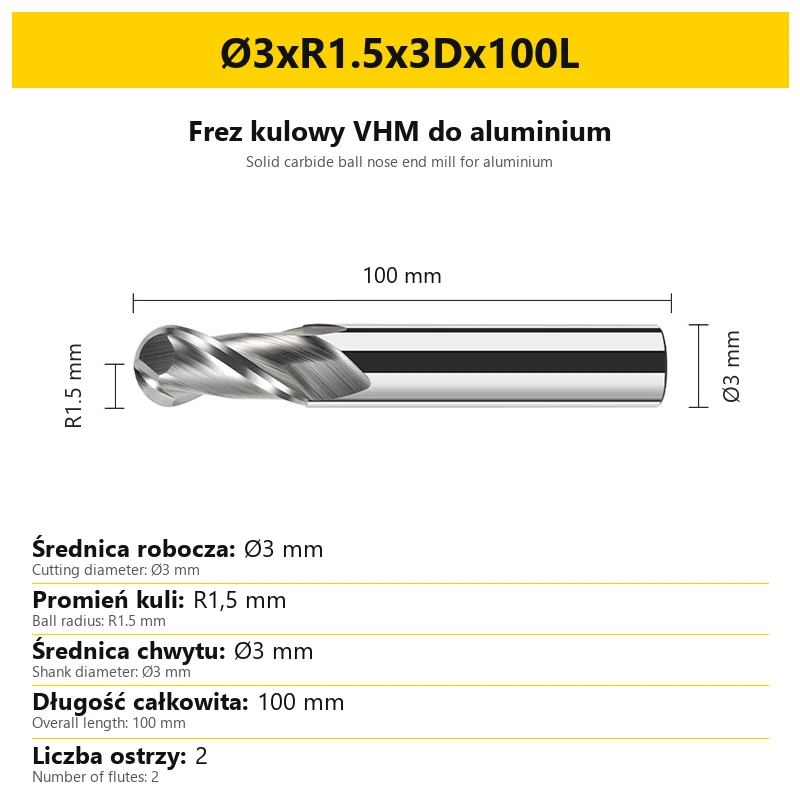
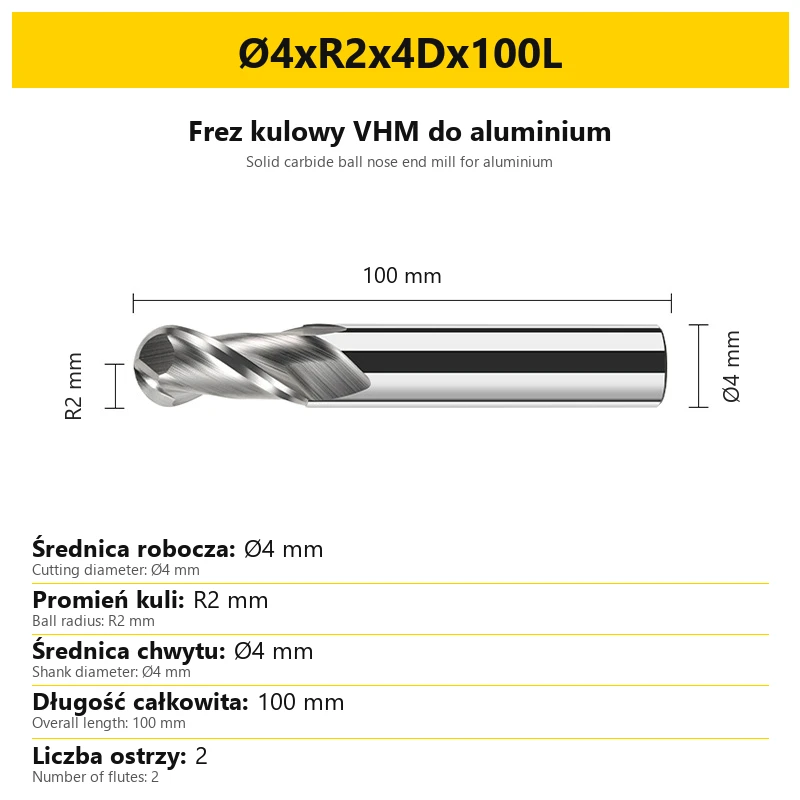
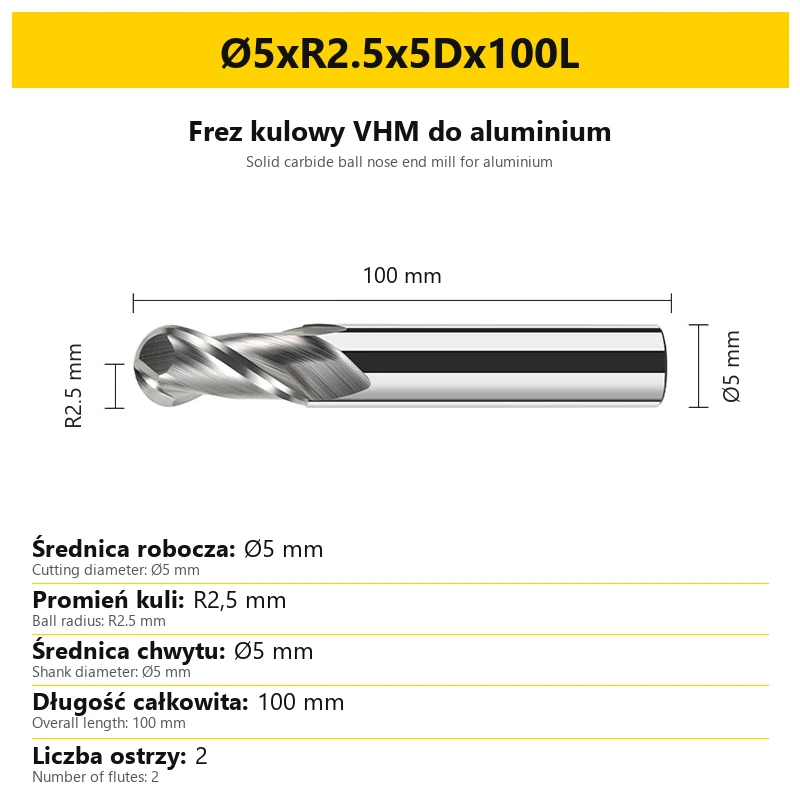
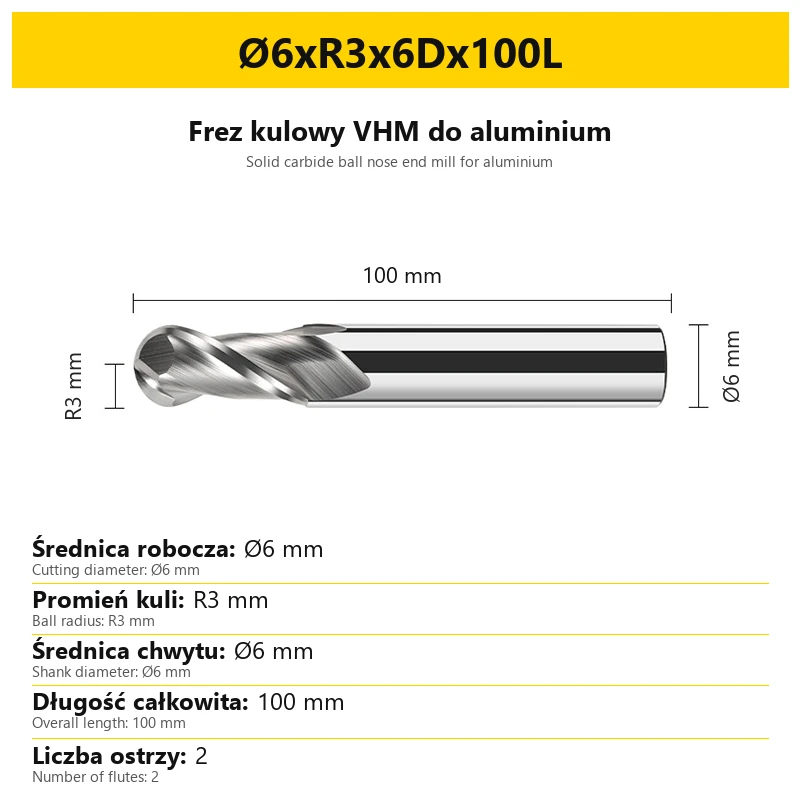
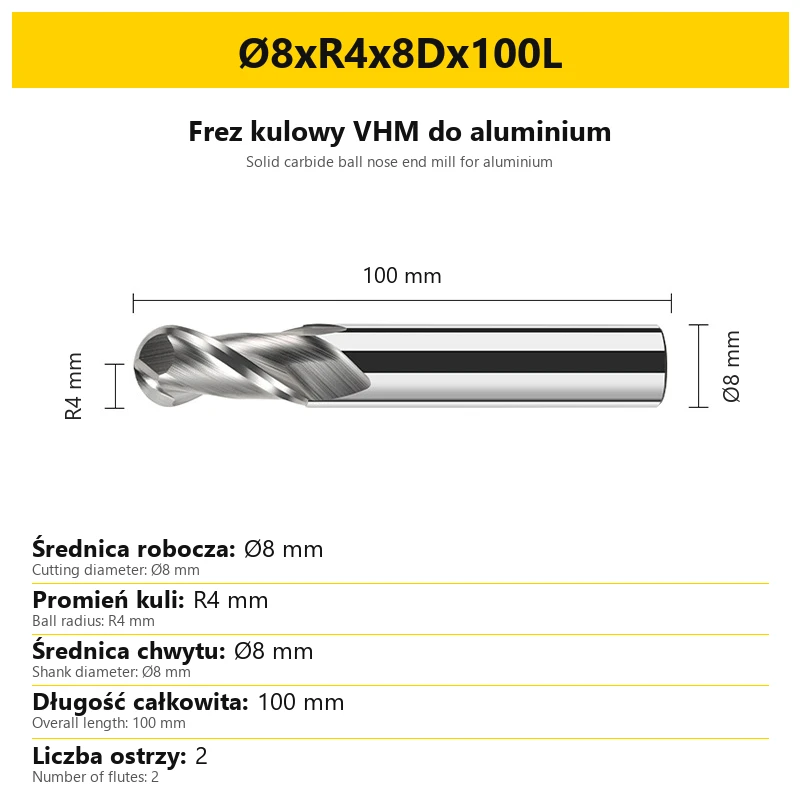
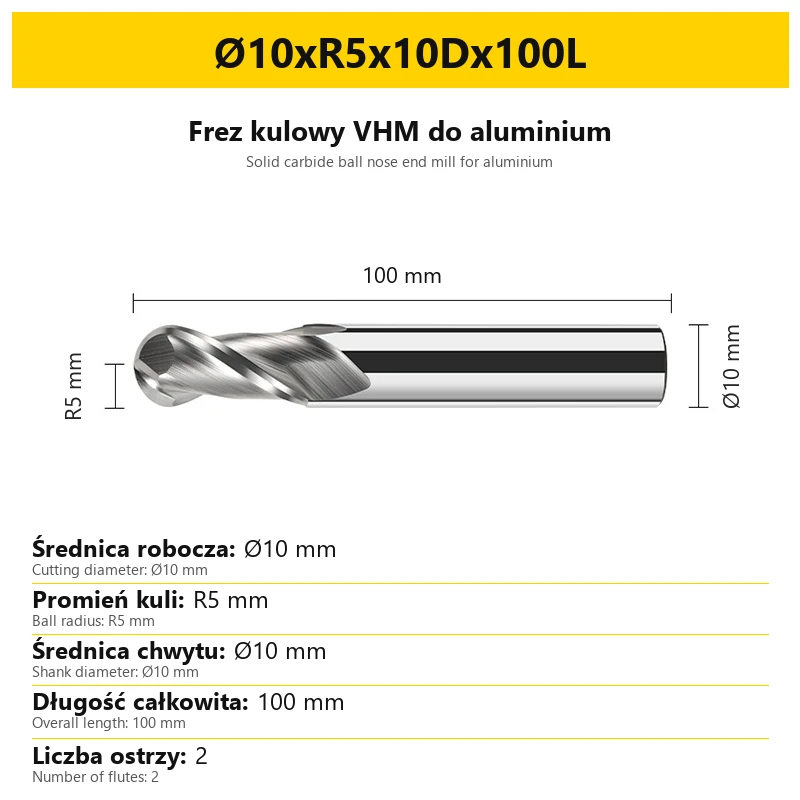
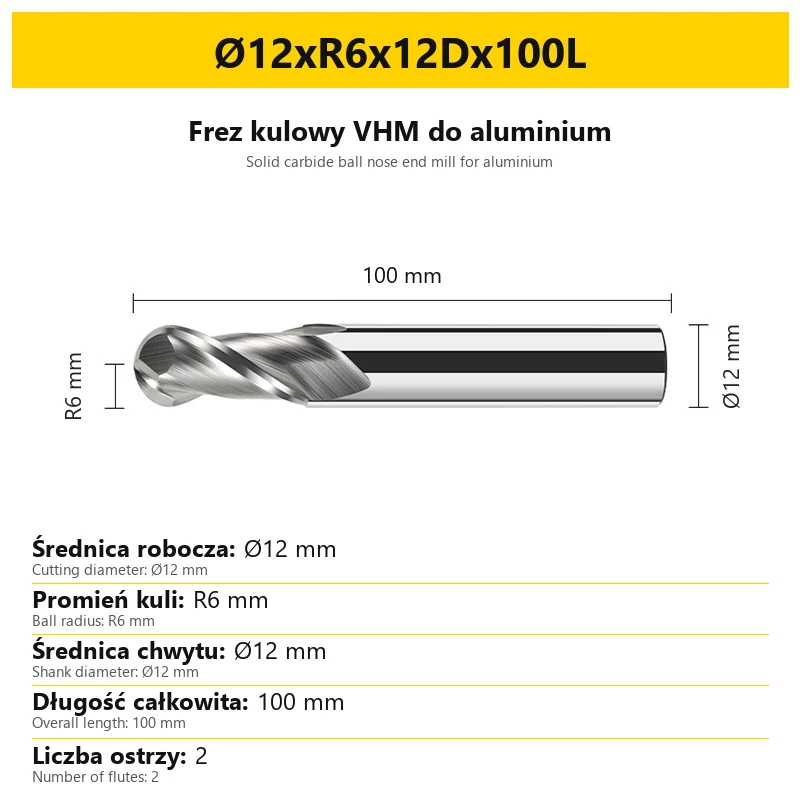
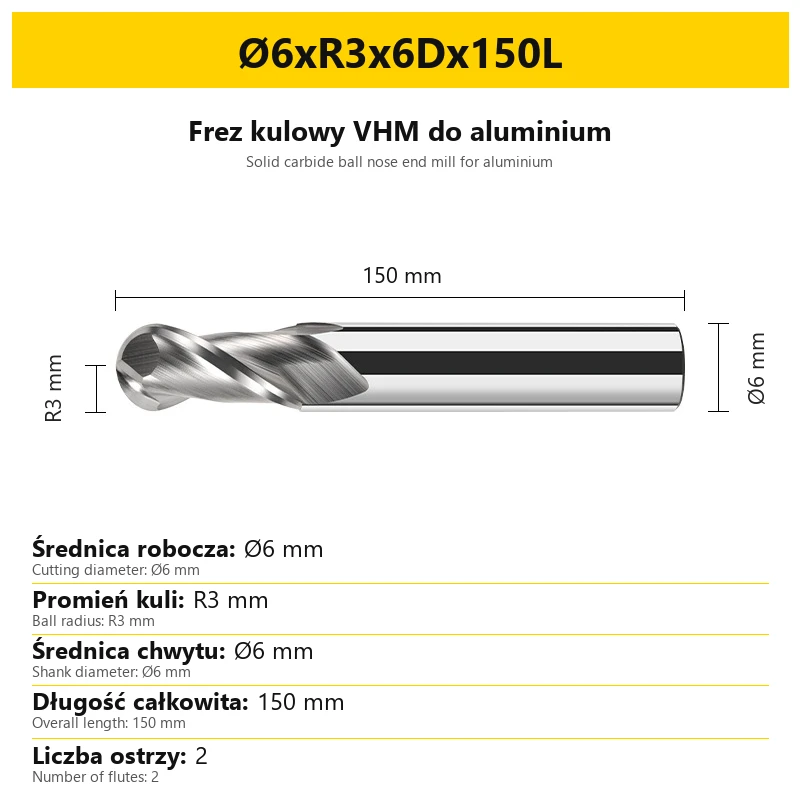
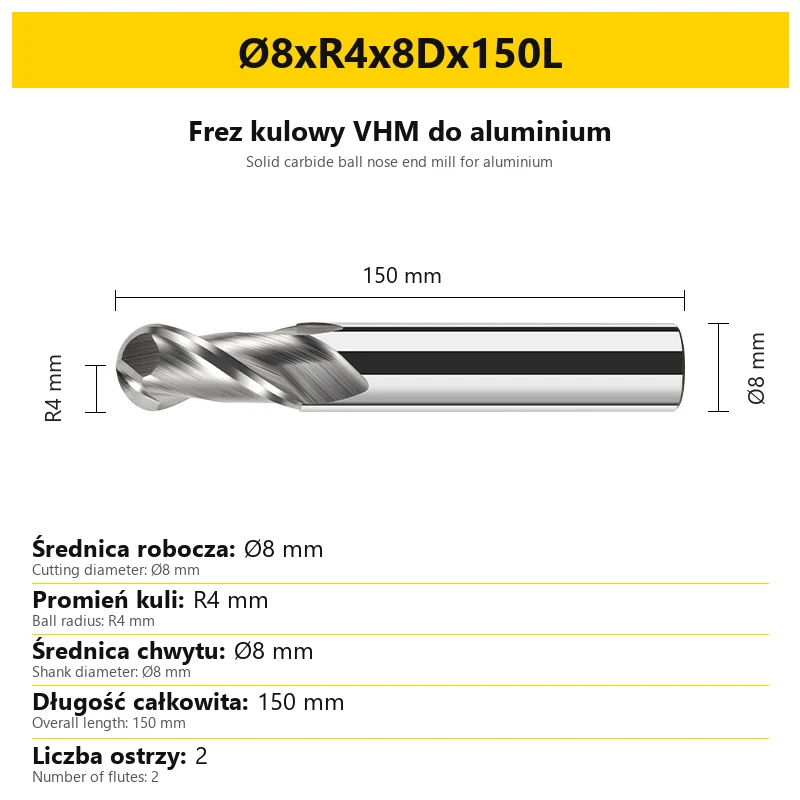
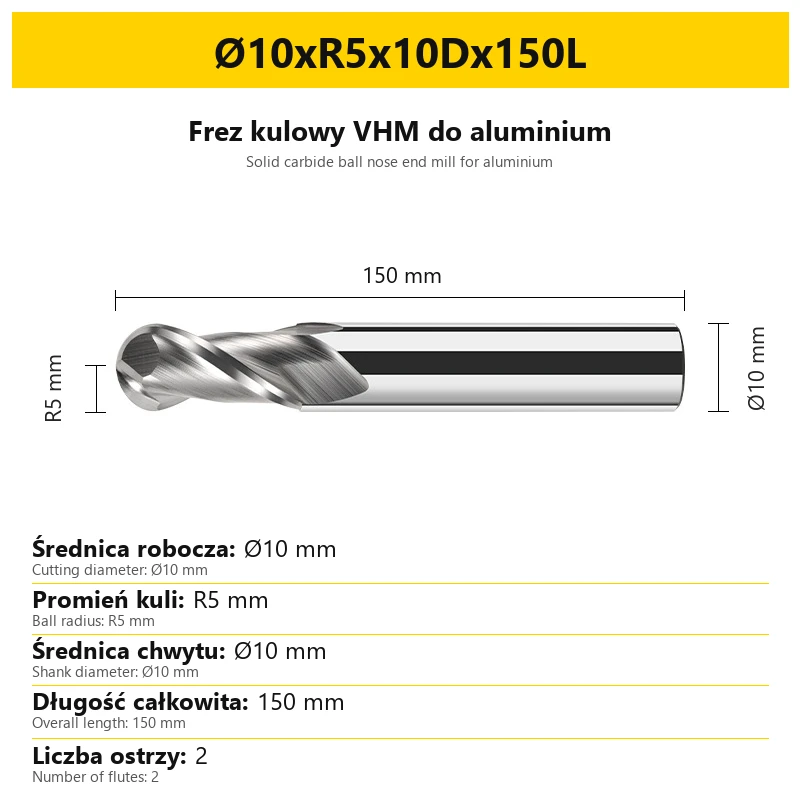
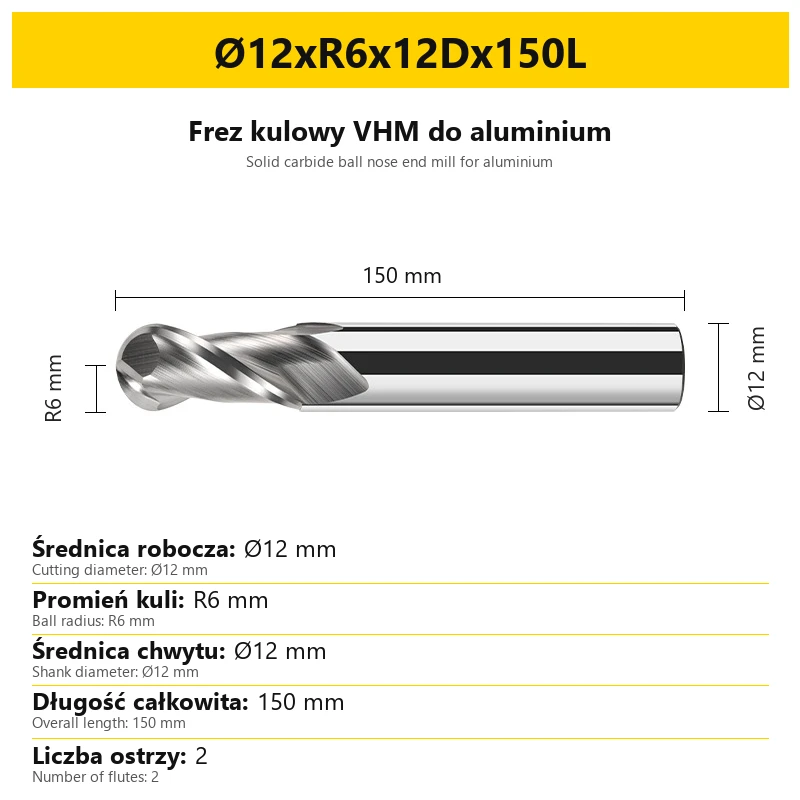
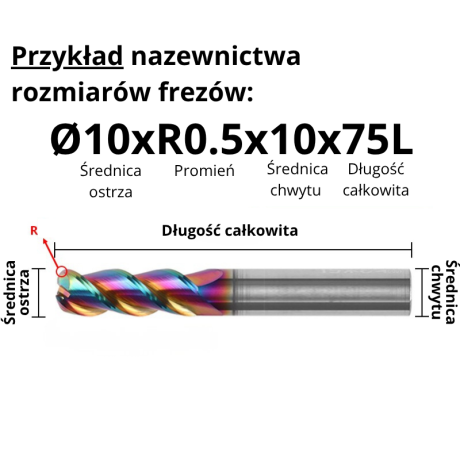
Example: Ø1xR0.5x4Dx50L means a cutting diameter of 1 mm, a tip radius of R0.5 mm, a Ø4 mm shank and an overall length of 50 mm. A decimal point in the code and a decimal comma in Polish text represent the same numerical value.
| Symbol | Meaning in this cutter family |
|---|---|
| Ø — cutting diameter | Diameter of the cutting section. In the example, it is 1 mm. It is not the shank diameter. |
| R — radius | Radius of the ball-shaped tip. For this geometry, the cutting diameter is twice R: a radius of 0.5 mm corresponds to a diameter of 1 mm. |
| D — shank diameter | Diameter of the cylindrical section held in the tool holder. Match the collet or other suitable holder to this dimension. |
| L — overall length | Length of the complete cutter, from the cutting tip to the end of the shank. It is neither the cutting length nor the depth of a single pass. |
| 2T — two flutes | The number of cutting flutes, not a dimension. It identifies the two-flute geometry of this family. |
Read the labelled values and the table instead of measuring the photograph. In particular, do not treat R as a diameter: R1 mm means a radius of 1 mm, not a diameter of 1 mm. The shank diameter may be larger than the cutting diameter.
5. Shorter and extended variants
Variants differ in tip radius, shank diameter and overall length. Overall lengths are 50, 60, 75, 100 and 150 mm. When selecting a longer cutter, also check the other dimensions: length alone does not identify the ball nose size or the shank diameter.
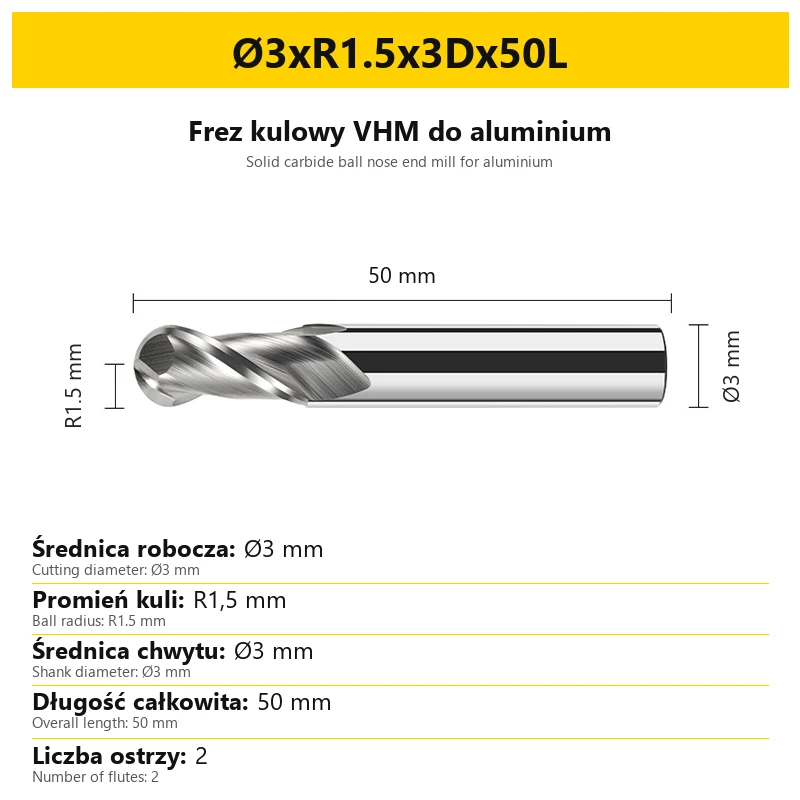
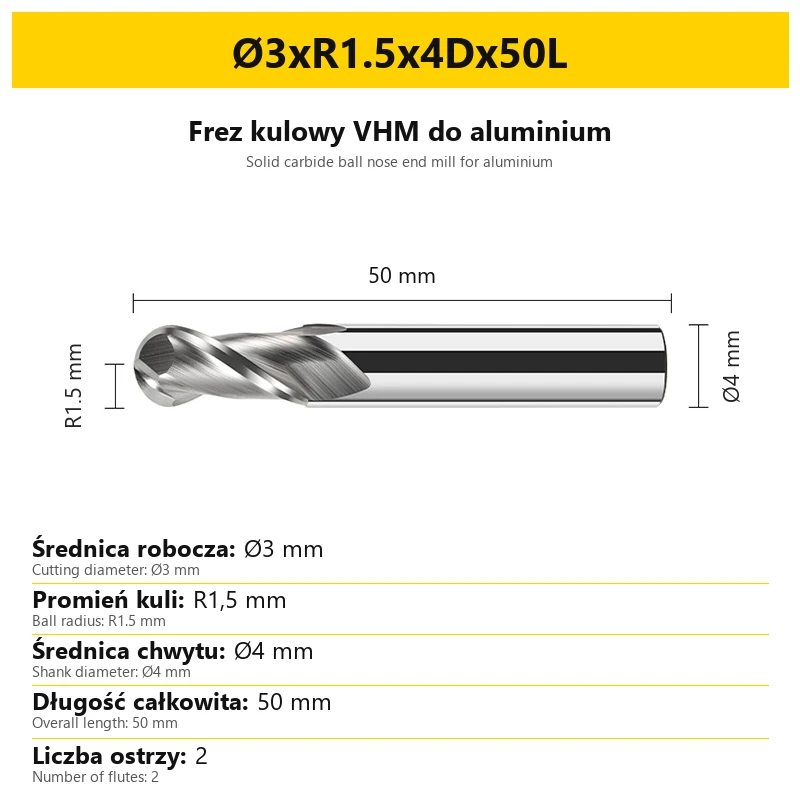
The same cutting diameter can be combined with a different shank. For example, a cutter with a cutting diameter of 3 mm and an R1.5 mm tip is offered at an overall length of 50 mm with either a 3 mm or a 4 mm shank. These are separate versions; the correct D value is needed when preparing the holder.
Overall length L does not specify cutting length. If your operation requires a particular cutting length or access depth, check that dimension separately before ordering. Do not estimate it from the photograph or by subtracting a shank section from L.
6. Selecting a variant for the workpiece and holder
| Selection point | What to check before ordering |
|---|---|
| Radius and cutting diameter | Compare R and Ø with the surface or slot geometry. Keep radius and diameter distinct when transferring dimensions from the workpiece drawing. |
| Shank diameter | Check D in the complete variant designation and select the matching holder. The cutting section size does not replace this information. |
| Overall length | Select an L value that provides access to the machining area with the shortest practical tool overhang. Also allow for the space occupied by the holder. |
| Material and machine | Compare the workpiece material with the application table. Prepare the cutter for a CNC machine or suitable engraving machine, with appropriate tool holding. |
Check the full set of dimensions before ordering. When selecting several cutters, compare each card with its corresponding variant.
7. Preparing the cutter for use
- Check runout after clamping. Measure tool runout before cutting. If it exceeds 0.01 mm, correct the setup and check again. This is a check on the mounted tool, not a stated tolerance for the cutter diameter.
- Limit overhang to what the operation requires. Keep the tool extension from the holder as short as practical. For greater overhang, reassess spindle speed, feed and cutting engagement for the actual setup.
- Select coolant and cutting conditions. Use a suitable cutting fluid and settings for the material and operation. If unusual vibration or noise occurs, check the holding arrangement and correct the cutting conditions before continuing.
This cutter is not intended for hand-held drills or low-speed drill presses. Use a machine and holder suitable for milling. Do not interpret overall length as a recommended tool overhang.
8. Frequently asked questions
Does R specify the diameter of the ball-shaped tip?
No. R identifies the radius. The cutting diameter is twice that value and follows the Ø symbol in the name. Shank diameter is a separate value identified by D.
Does every cutter in this family have two flutes?
Yes. This is a family of two-flute ball nose end mills. The 2T designation confirms the number of flutes; radius, shank diameter and length depend on the selected variant.
Does a larger L value mean a longer cutting section?
L alone does not confirm this. It describes the overall tool length. If cutting length determines your selection, check it separately before ordering.
Is the cutter intended only for aluminium?
Aluminium and its alloys are the primary application. The range also includes copper alloys, acrylic and wood. See the material application table above for the full distinction.
How can I check whether the cutter fits my collet?
Compare the holder size with D for the selected variant. Do not use radius R or cutting diameter Ø alone, as these can differ from shank diameter.
Bestsellers
-
Bestseller
JCD modular drill with replaceable tip - internal cooling, for deep holes | GrotXD
JCD C20-100-3D Ø10~10.9 JCD C20-110-3D Ø11~11.9 JCD C20-120-3D Ø12~12.9 JCD C20-130-3D Ø13~13.9 JCD C20-140-3D Ø14~14.9 + 61 morePrice €69.86Price €56.79without VAT -
Bestseller
Kortools Adhesive + Tape CNC Workholding Kit
Yellow tape 5cm x 50m; adhesive 100g Yellow tape 5cm x 50m; adhesive 500g Yellow tape 10cm x 50m; adhesive 100g Yellow tape 10cm x 50m; adhesive 500g Green tape 5cm x 50m; adhesive 100g + 7 morePrice €44.66Price €36.31without VAT -
Price €17.18Price €13.97without VAT
-
Price €7.10Price €5.77without VAT
-
Price €7.56Price €6.14without VAT
-
Bestseller
 Other Accessories 0.00
CNC Chip Fan / Chip Blower
Complete CNC chip fan Kit: blades, springs, pins and screwsPrice €53.82Price €43.76without VAT -
Bestseller
 Ball Nose End Mills 0.00
2-Flute Carbide Ball Nose End Mill - HYPERCUT
Ø1xR0.5x4Dx50L Ø1.5xR0.75x4Dx50L Ø2xR1x4Dx50L Ø2.5xR1.25x4Dx50L Ø3xR1.5x3Dx50L + 26 morePrice €10.14Price €8.25without VAT -
Bestseller
 2-Flute End Mills 0.00
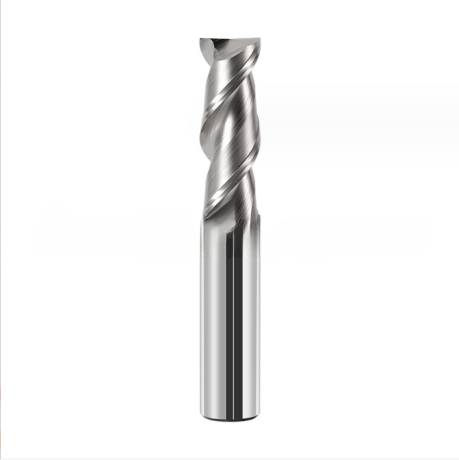
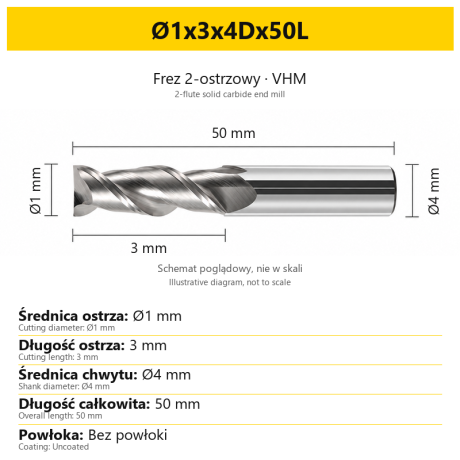
2-Flute Carbide End Mill for Aluminium
Ø1x3x4Dx50L Ø1.5x4x4Dx50L Ø2x6x4Dx50L Ø2.5x7.5x4Dx50L Ø3x9x3Dx50L + 31 morePrice €5.35Price €4.35without VAT -
Bestseller
 2-Flute End Mills 0.00
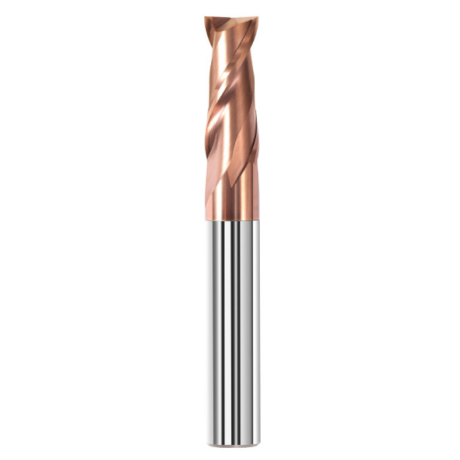
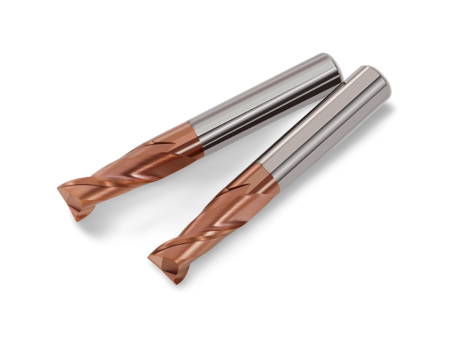
2-Flute Carbide End Mill for Steel 55 HRC - TiSiN - Solid Carbide
Ø6x24x6Dx75L Ø8x25x8Dx75L Ø4x20x4Dx100L Ø5x30x5Dx100L Ø6x30x6Dx100L + 31 morePrice €4.40Price €3.58without VAT -
Bestseller
 Ball Nose End Mills 0.00
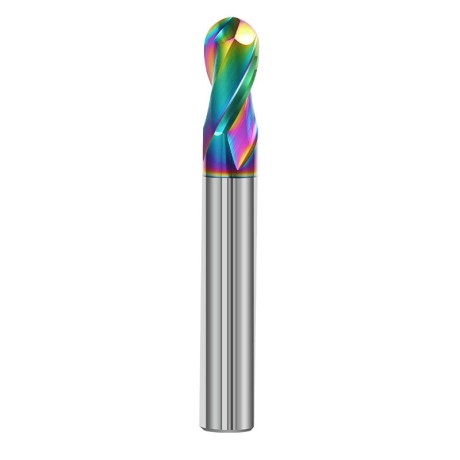
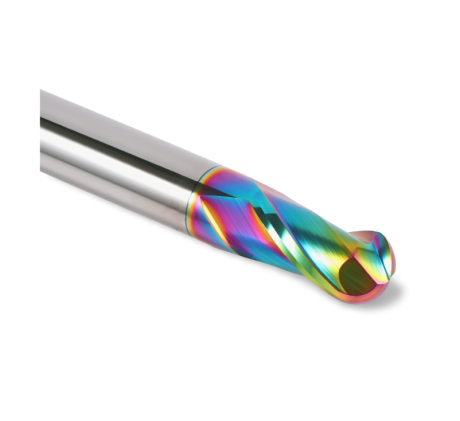
2-Flute DLC Coated Carbide Ball Nose End Mill| DuraEdge Alu
Ø1.0xR0.5x4Dx50L Ø1.5xR0.75x4Dx50L Ø2.0xR1x4Dx50L Ø2.5xR1.25x4Dx50L Ø3.0xR1.5x3Dx50L + 34 morePrice €7.89Price €6.41without VAT -
Bestseller
 2-Flute End Mills 0.00
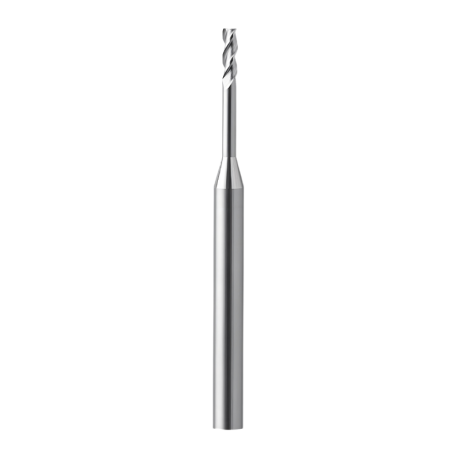
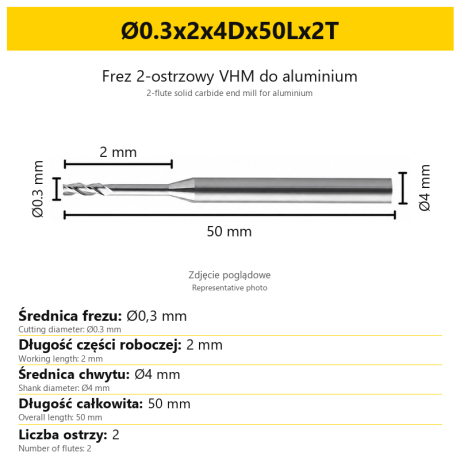
2-Flute End Mill for Aluminium | VHM | Miniature Ø0.3 - Ø0.9
Ø0.3x2x4Dx50Lx2T Ø0.3x3x4Dx50Lx2T Ø0.3x4x4Dx50Lx2T Ø0.4x2x4Dx50Lx2T Ø0.4x3x4Dx50Lx2T + 28 morePrice €7.99Price €6.50without VAT -
Bestseller
 Ball Nose End Mills 0.00
2-Flute TiSiN Coated Carbide Ball Nose End Mill
Ø1xR0.5x4Dx50L Ø1.5xR0.75x4Dx50L Ø2xR1x4Dx50L Ø2.5xR1.25x4Dx50L Ø3xR1.5x3Dx50L + 38 morePrice €7.28Price €5.92without VAT -
Bestseller
3-Flute Carbide Corner Radius End Mill for Aluminium| AL DLC
Ø1xR0.1x4Dx50L Ø1xR0.2x4Dx50L Ø1xR0.3x4Dx50L Ø1.5xR0.1x4Dx50L Ø1.5xR0.2x4Dx50L + 137 morePrice €4.96Price €4.04without VAT -
Bestseller
 3-Flute End Mills 0.00
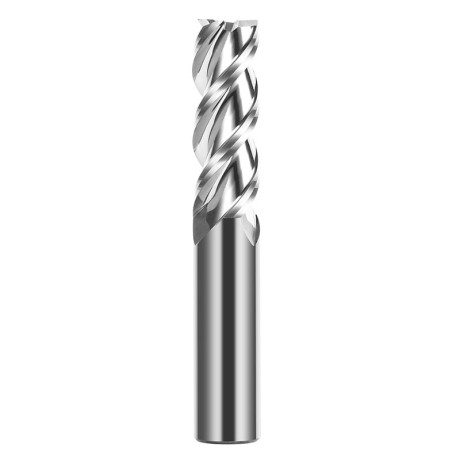
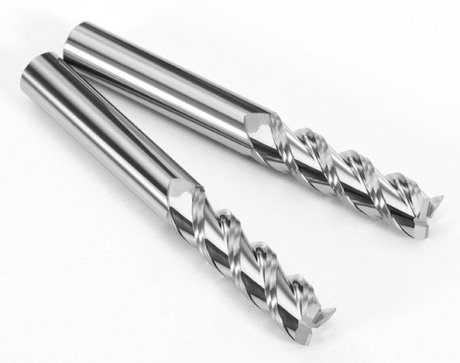
3-Flute Carbide End Mill VHM Z-3 for Aluminium| TriMill AL
Ø1x3xD4x50L Ø1.5x5x4Dx50L Ø2x6x4Dx50L Ø2.5x8x4Dx50L Ø3x9x3Dx50L + 41 morePrice €5.10Price €4.15without VAT -
Bestseller
 Countersinks 0.00
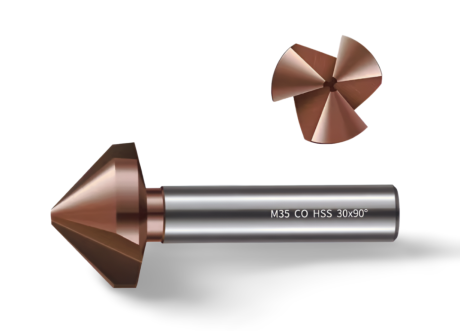
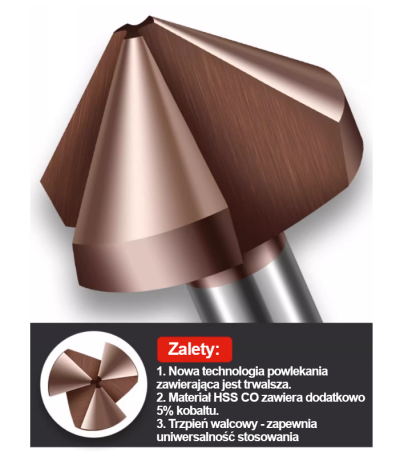
3-Flute Countersink Fi4.5-fi60, 90° - HSS-CO - 5% Kobaltu | Straight Shank
Ø4.5 x 4 x 90° x 40L Ø5 x 5 x 90° x 45L Ø6.3 x 5 x 90° x 45L Ø8.3 x 6 x 90° x 50L Ø10.4 x 6 x 90° x 50L + 12 morePrice €4.81Price €3.91without VAT -
Bestseller
 3-Flute End Mills 0.00
3-Flute DLC Coated Carbide End Mill | TriMill DLC AL
Ø1x3x4Dx50L Ø1.5x5x4Dx50L Ø2x6x4Dx50L Ø2.5x8x4Dx50L Ø3x8x3Dx50L + 38 morePrice €5.07Price €4.12without VAT