€705.27 incl. VAT
Lowest price in the 30 days before the reduction: €796.27
€573.39 excl. VAT
Choose variant


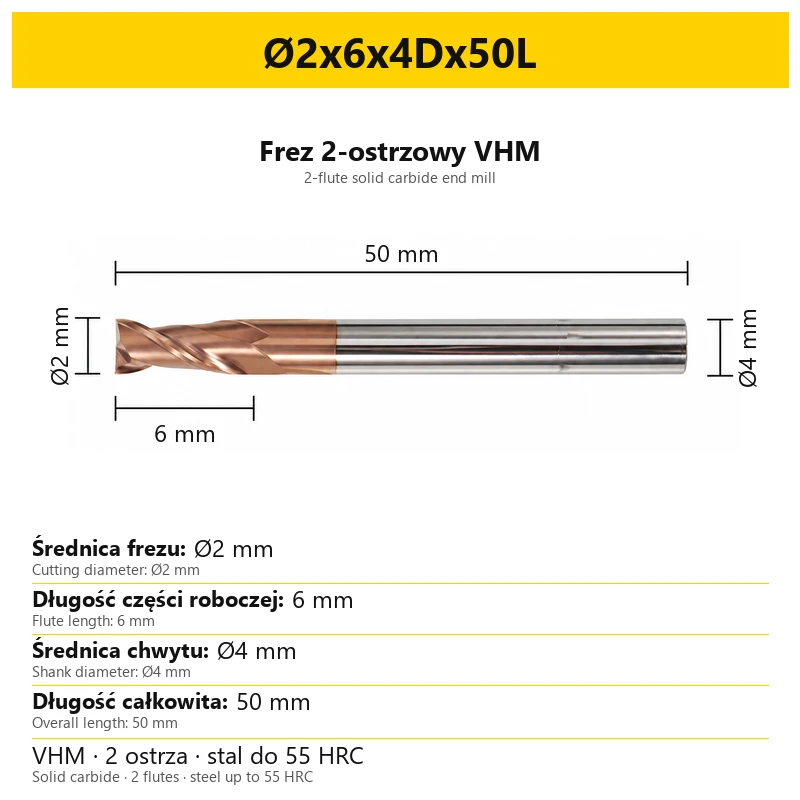
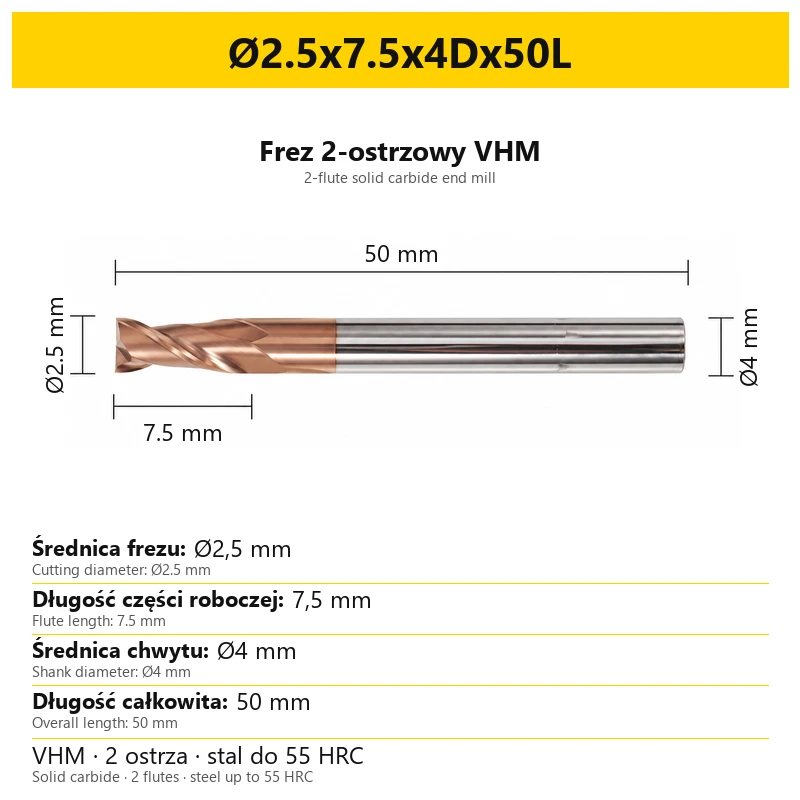
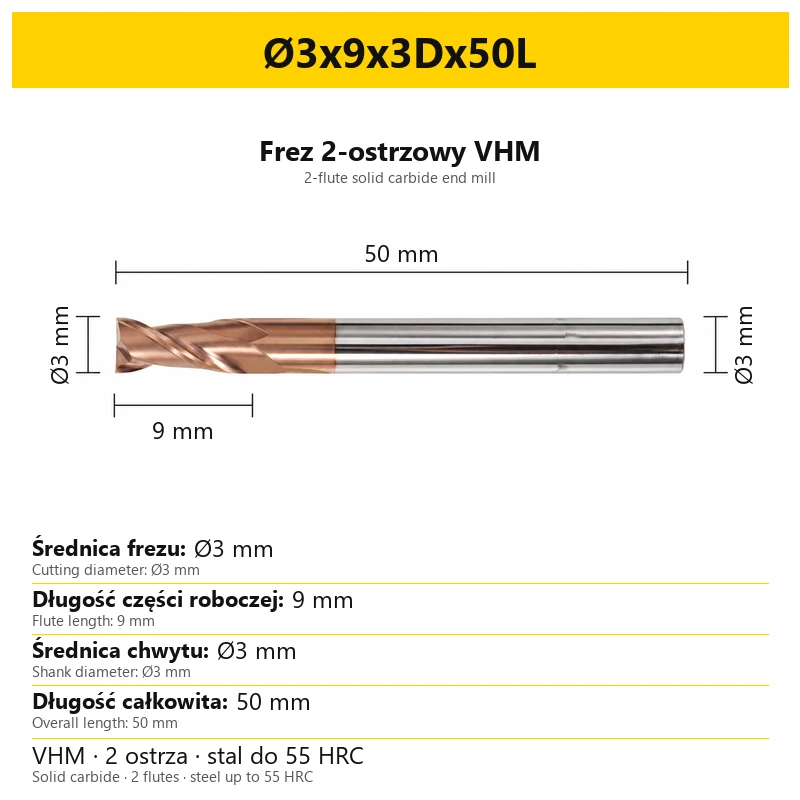
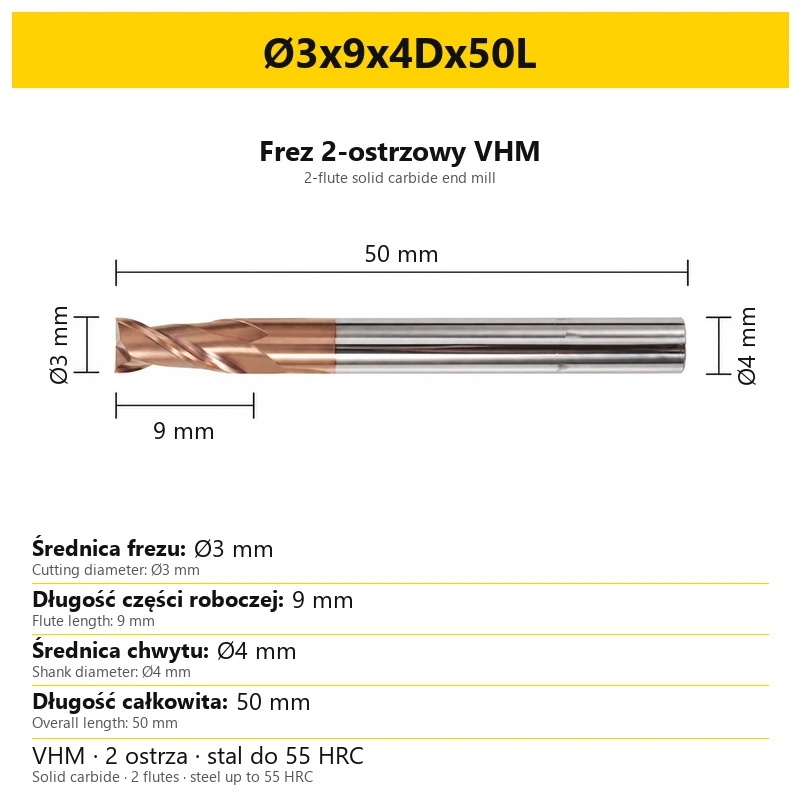
Shipping costs are not included in the price.
Shipping costs are not included in the price.

Weekly deals · −11%
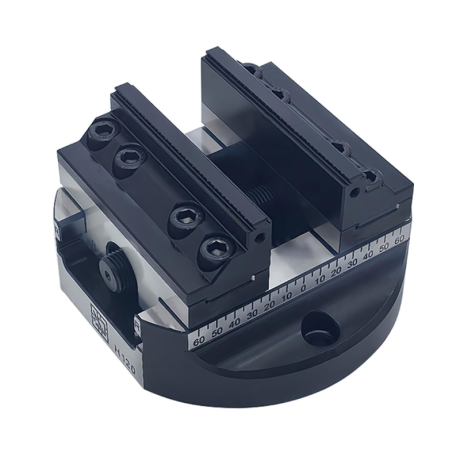
Self-centering machine vise. Hard jaws included.
€573.39 excl. VAT
Regular price: €796.27
Lowest price in the 30 days before the reduction: €796.27
Time left
Offer ends 06.11.2026 23:59. Offer applies to the vise + hard jaws bundle only.
Lowest price in the 30 days before the reduction: €796.27
€573.39 excl. VAT
Choose variant
Weekly deals · −5%
MFPN66-50-22-4T
€47.44 excl. VAT
Regular price: €61.43
Lowest price in the 30 days before the reduction: €61.43
Time left
Offer ends 06.11.2026 23:59.

Weekly deals · −5%
MFPN66-50-22-4T
€57.11 excl. VAT
Regular price: €73.94
Lowest price in the 30 days before the reduction: €73.94
Time left
Offer ends 06.11.2026 23:59.

The administrator of personal data is Kortools. We process it to respond to your inquiry. More information regarding the processing of personal data can be found in privacy policy.
Select a product variant:
Individual variants may differ in price
Product code: 432F-1772E
2-flute solid carbide end mill · TiSiN · 55 HRC series
For slots, pockets, flat surfaces and contours on CNC milling machines
A solid carbide shank end mill with a flat end. Two flutes and a TiSiN coating provide a tool for milling steel, stainless steel and cast iron. It is intended for machining centres and CNC milling machines; selection for hardened material must take account of the limitations below.
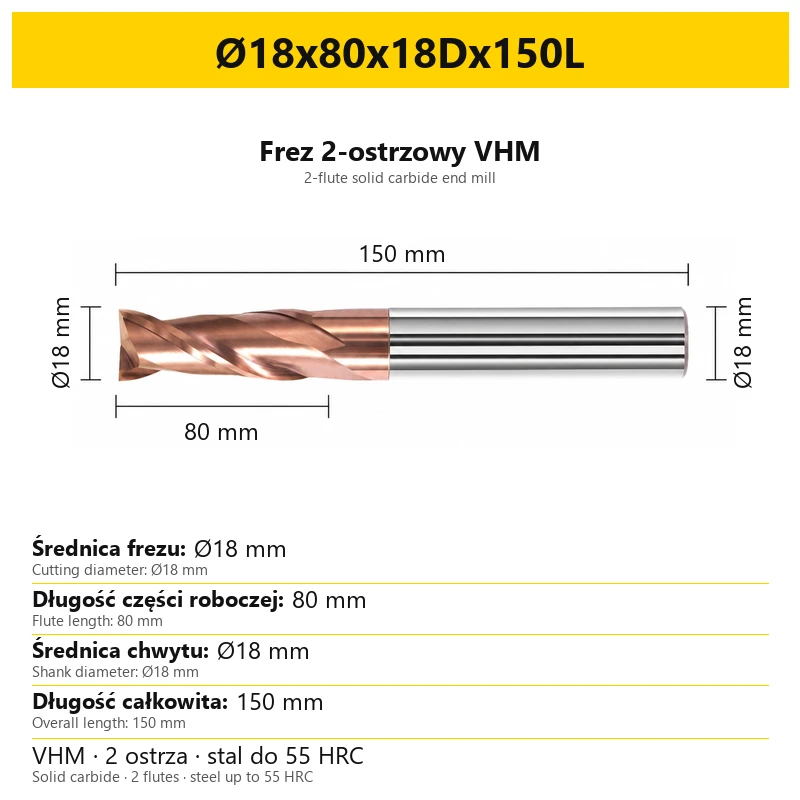
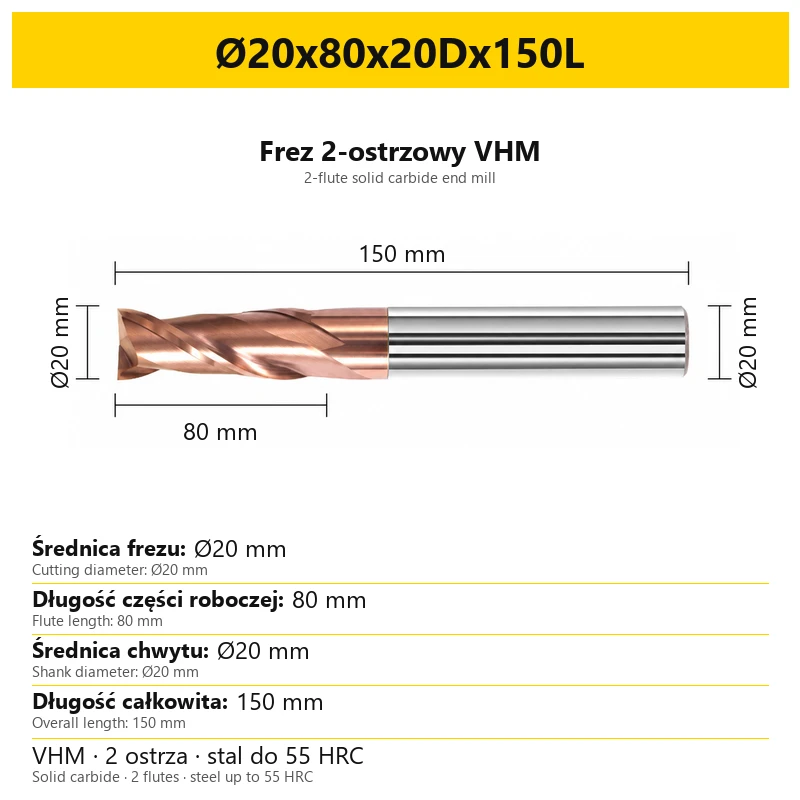
Choose the size by cutting diameter, flute length, shank diameter and overall length. These four dimensions identify the particular tool. The same cutting diameter does not necessarily mean the same shank size or flute length.
| Operation | Application |
|---|---|
| Slot milling | Machining slots, including keyways and U-shaped slots. Match the cutting diameter to the slot width. |
| Pocket milling | Machining flat-bottomed pockets. Compare the flute length with the pocket geometry and access to its walls. |
| Face milling | Machining flat surfaces with a flat-end tool geometry. |
| Side milling and contouring | Machining walls, steps and profiles. Prepare the toolpath for the cutting diameter and flute length of the selected size. |
The end mill has two flutes. Maintain chip evacuation when machining slots and pockets. Select the entry strategy and cutting conditions for the workholding, workpiece material and actual tool overhang.
| Parameter | Value |
|---|---|
| Tool type | Solid carbide shank end mill with a flat end |
| Tool material | Solid carbide (VHM), fine-grain structure of 0.6 μm |
| Number of flutes | 2 |
| Coating | TiSiN |
| Series designation | 55 HRC; material selection limits are given in section 3 |
| Helix angle | 35° |
| Shank type | Cylindrical |
| Cutting diameter | Ø1–20 mm, depending on the selected size |
| Flute length | 3–80 mm, depending on the selected size |
| Shank diameter | Ø3–20 mm, depending on the selected size |
| Overall length | 50, 60, 75, 100 or 150 mm, depending on the selected size |
These ranges describe the tool family. Not every diameter is offered with every length and shank size. Check the specific combination in the size selector and on the corresponding dimension card.
| Material | Application and limitations |
|---|---|
| Structural, carbon and alloy steels | For steel and tool steel, taking account of their heat treatment condition. Select the cutting conditions for the specific material grade. |
| Stainless steel | A recommended application group. Consider the grade, milling operation and chip evacuation. |
| Cast iron | A recommended application group. Match the cutting conditions to the cast iron grade and workpiece geometry. |
| Hardened materials | Material recommendations cover hardness below 45 HRC. At 45 HRC and above, this tool is not a recommended choice without separate confirmation of suitability. |
| Copper alloys | A supported application. Match the cutting conditions to the particular alloy. |
| Heat-resistant alloys, titanium alloys, aluminium, graphite and CFRP | These are not recommended materials for this geometry. Choose a tool intended for the specific material group. |
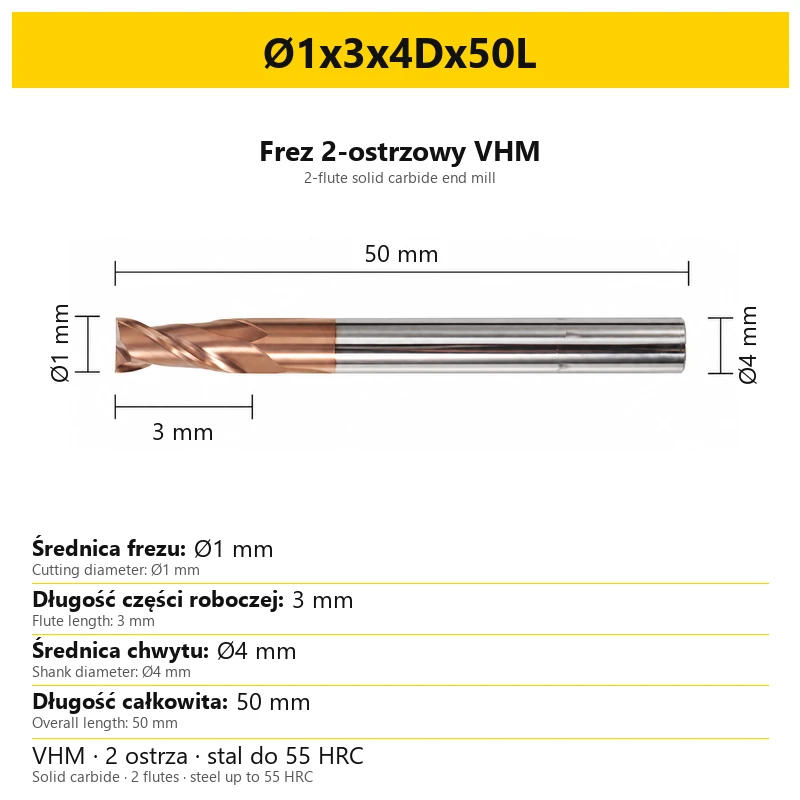
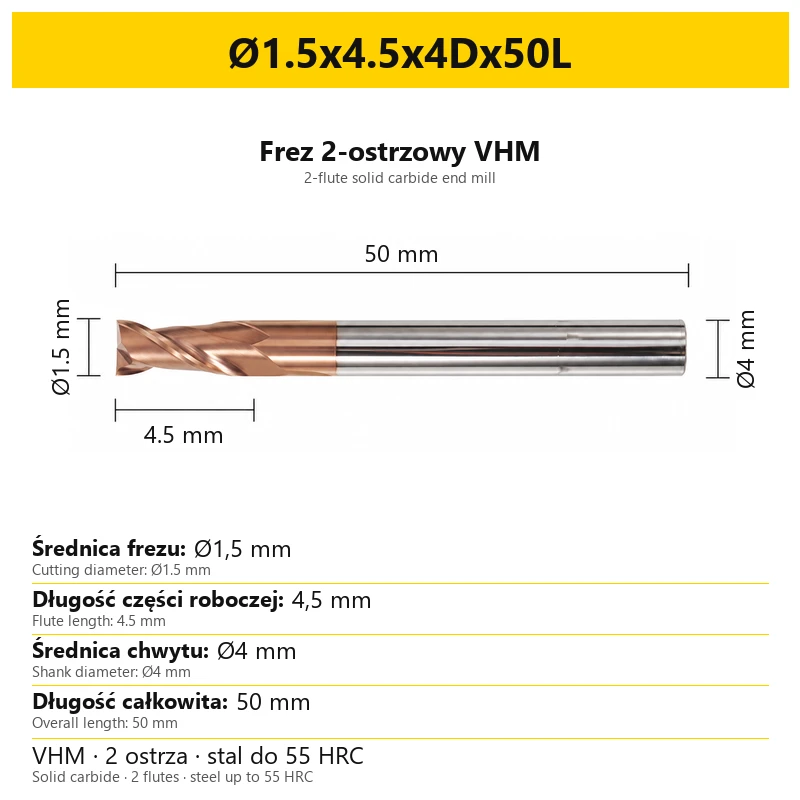
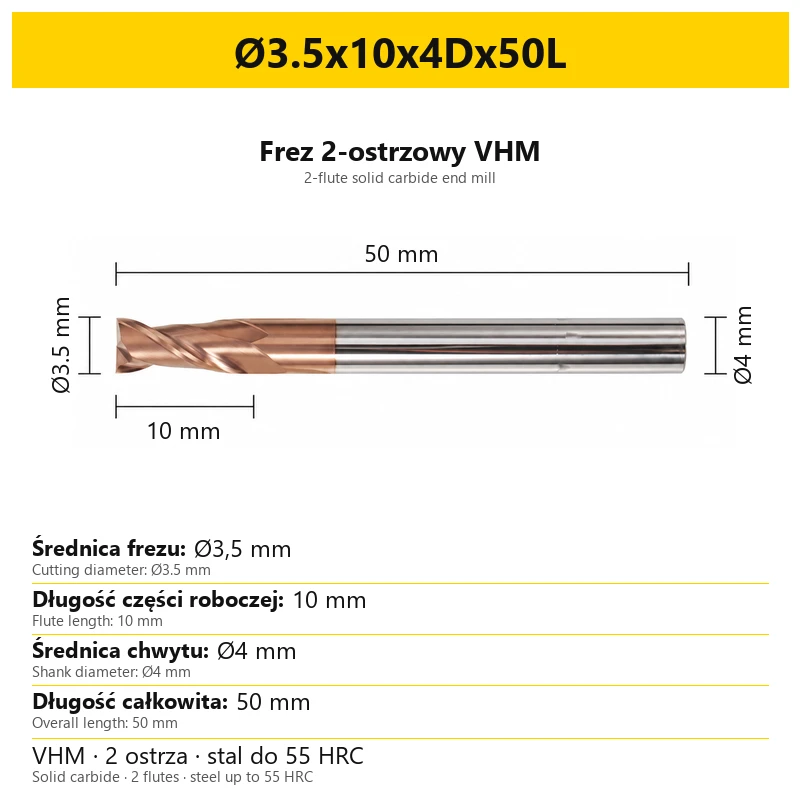
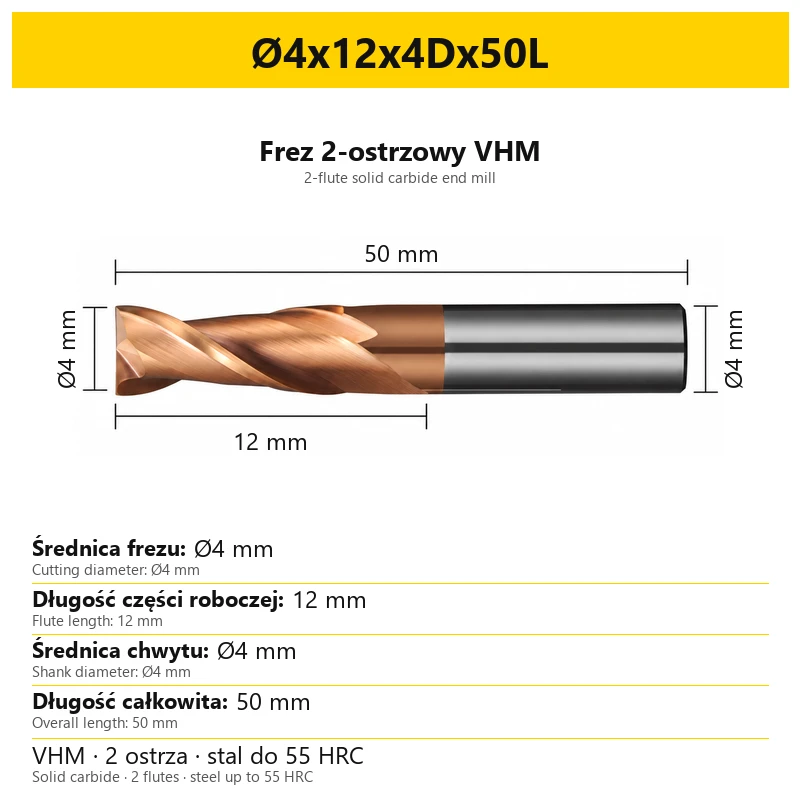
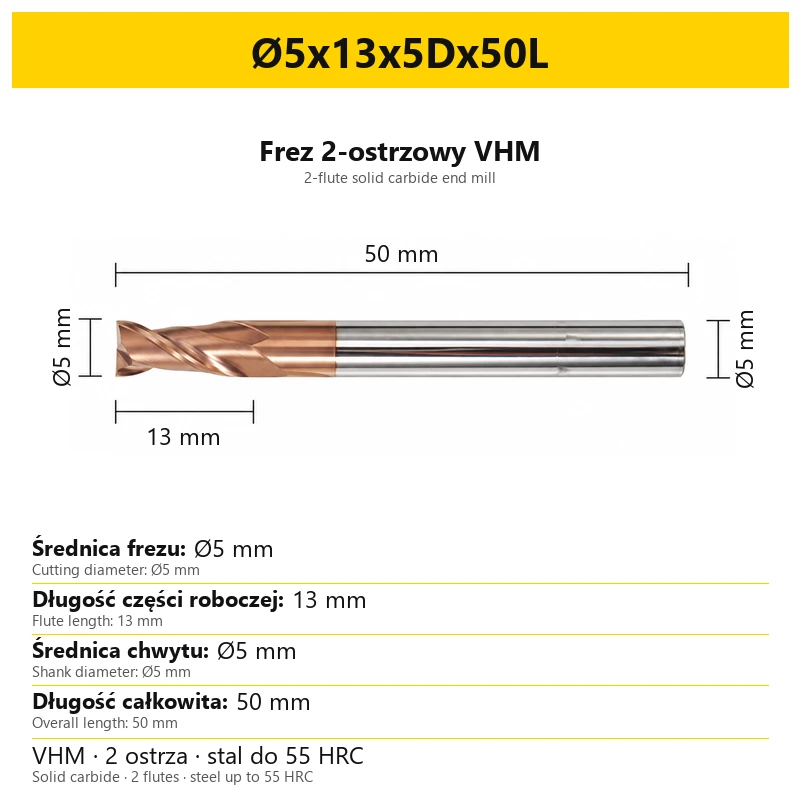
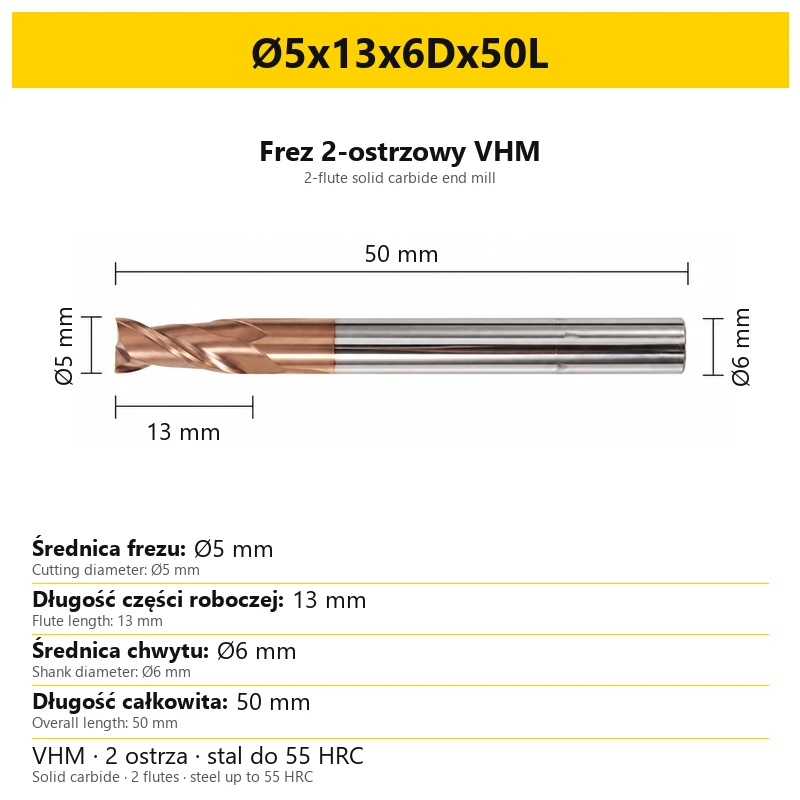
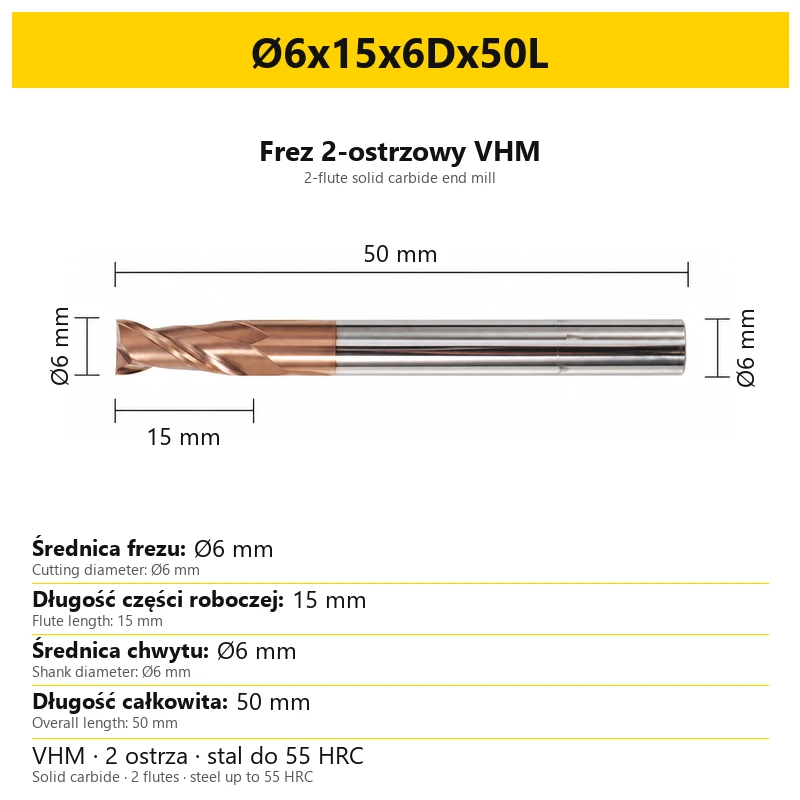
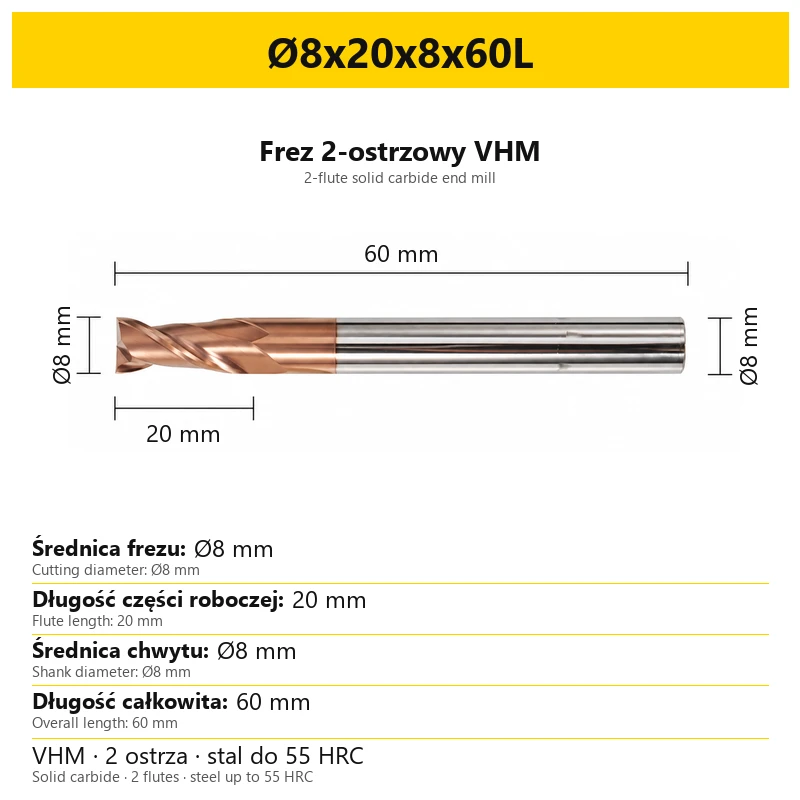
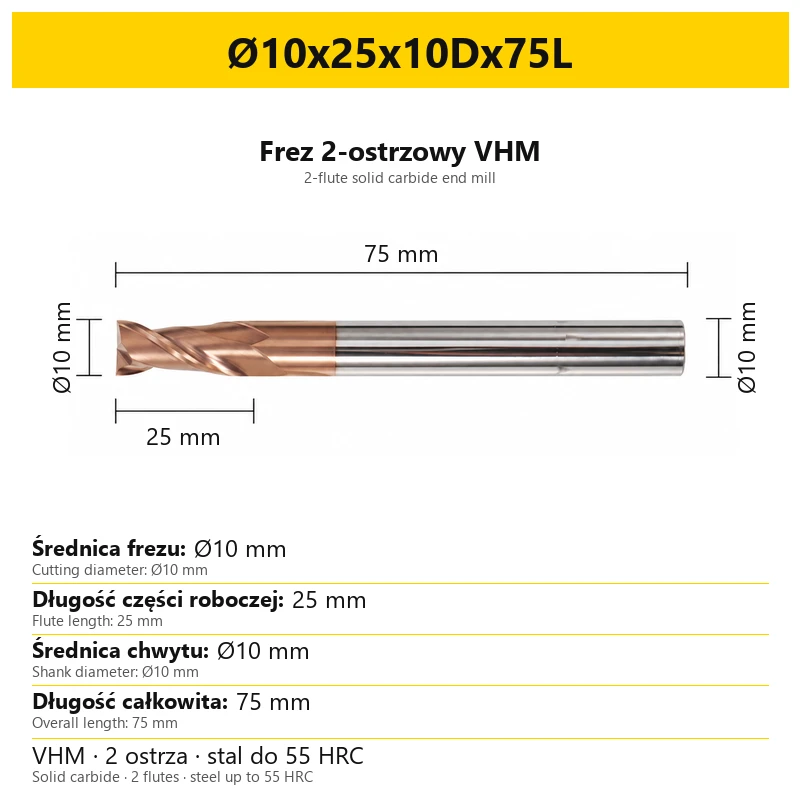
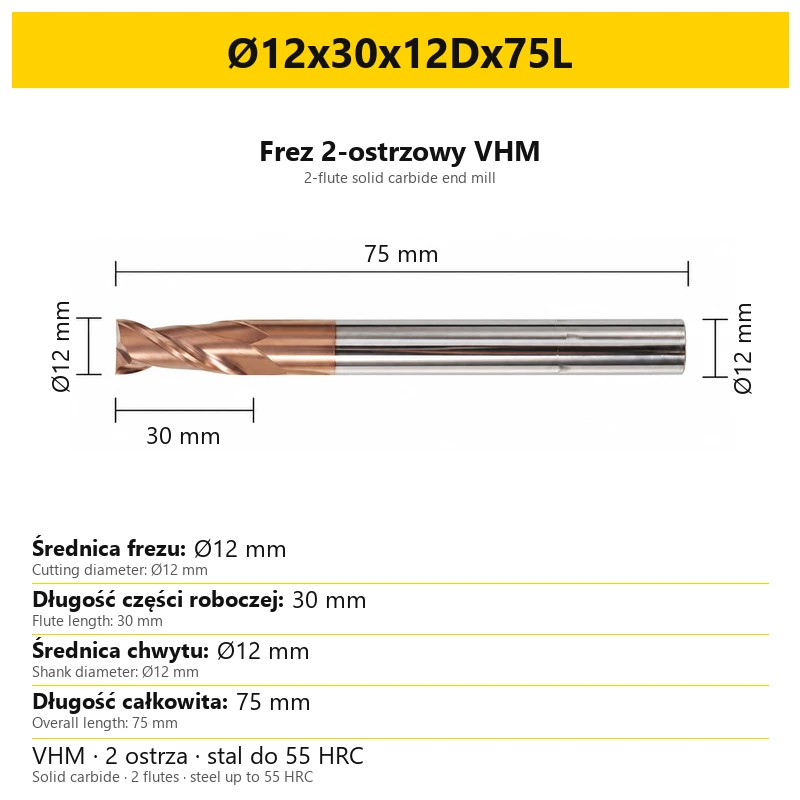
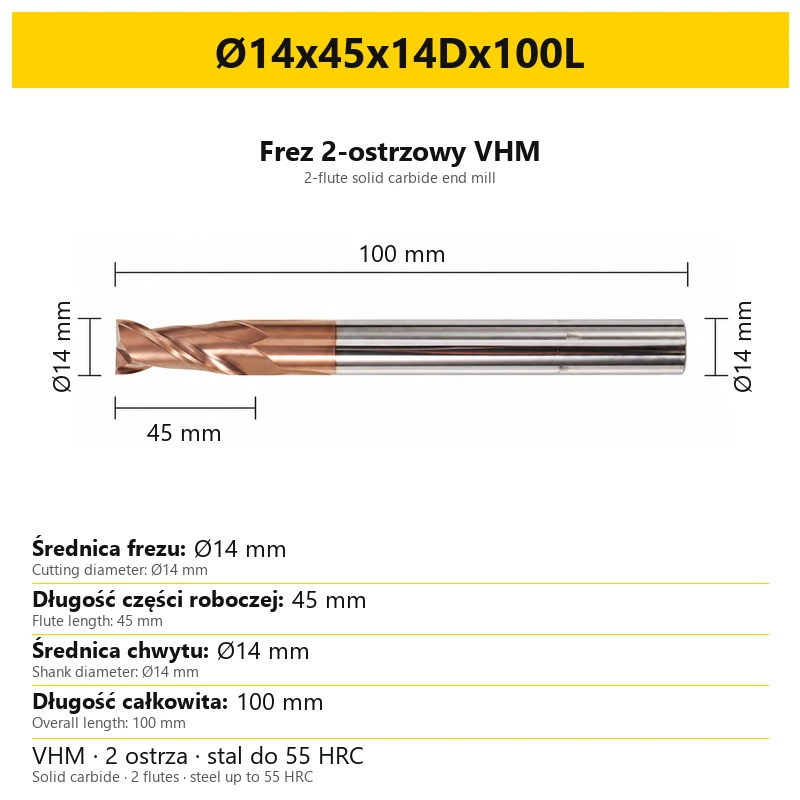
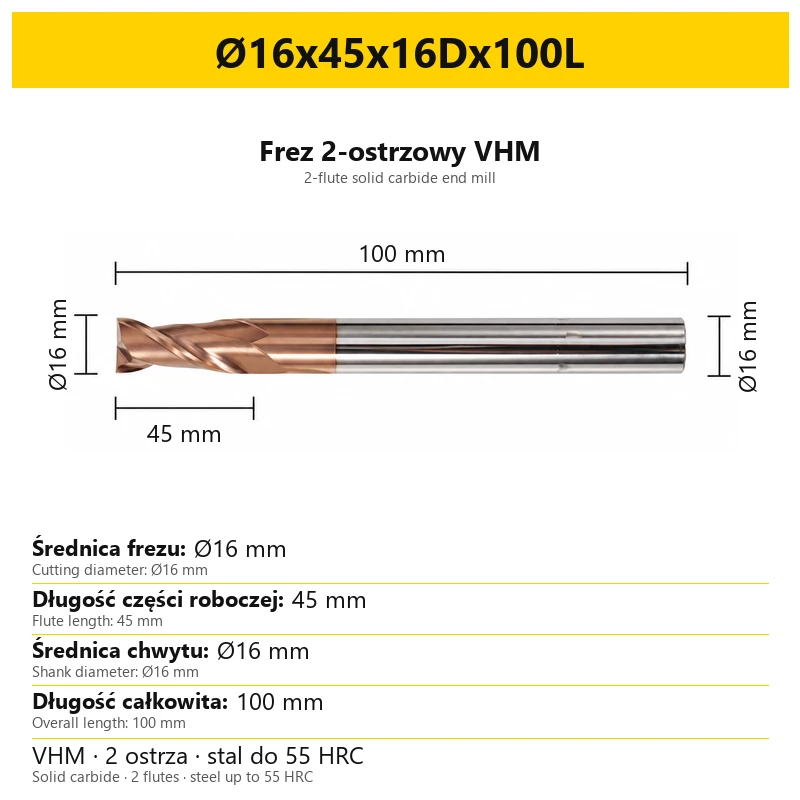
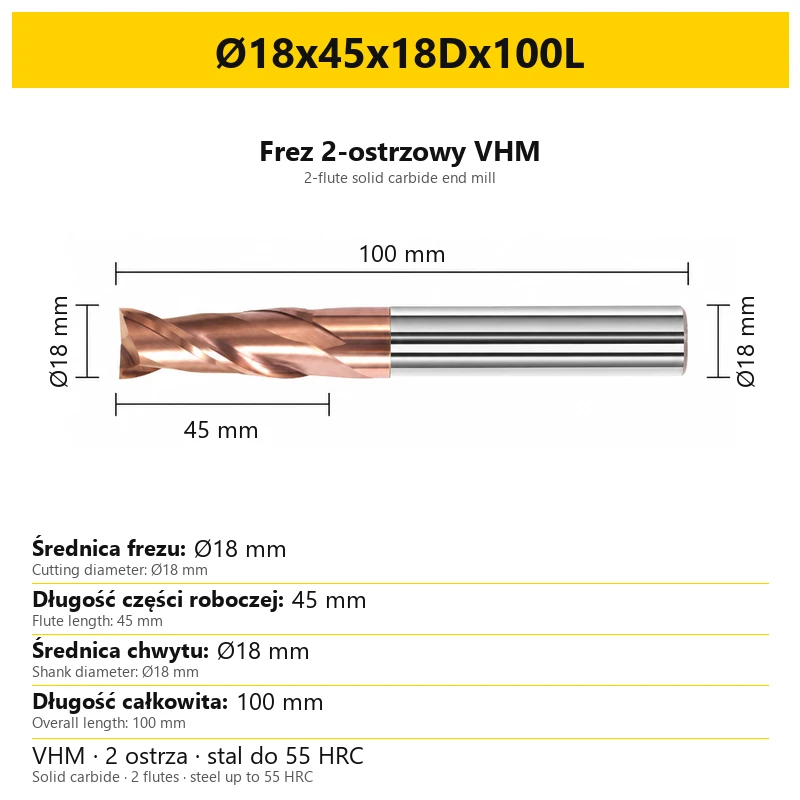
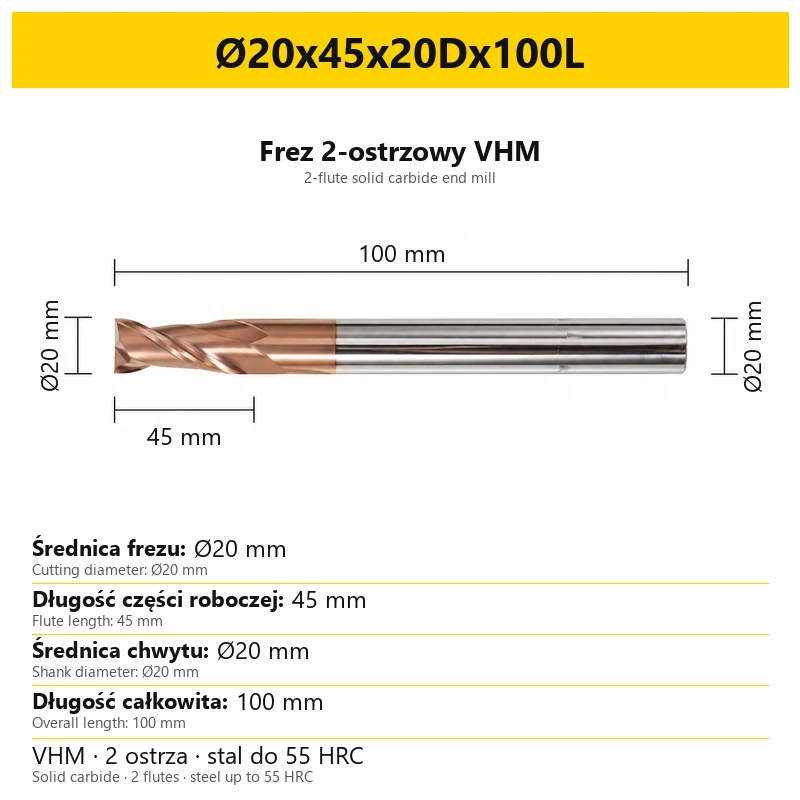
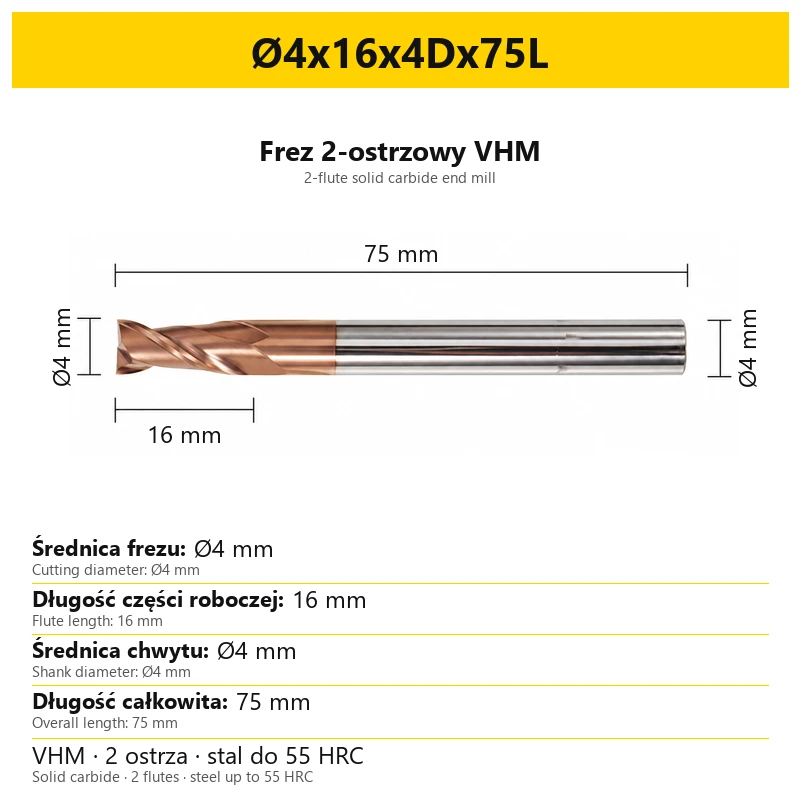
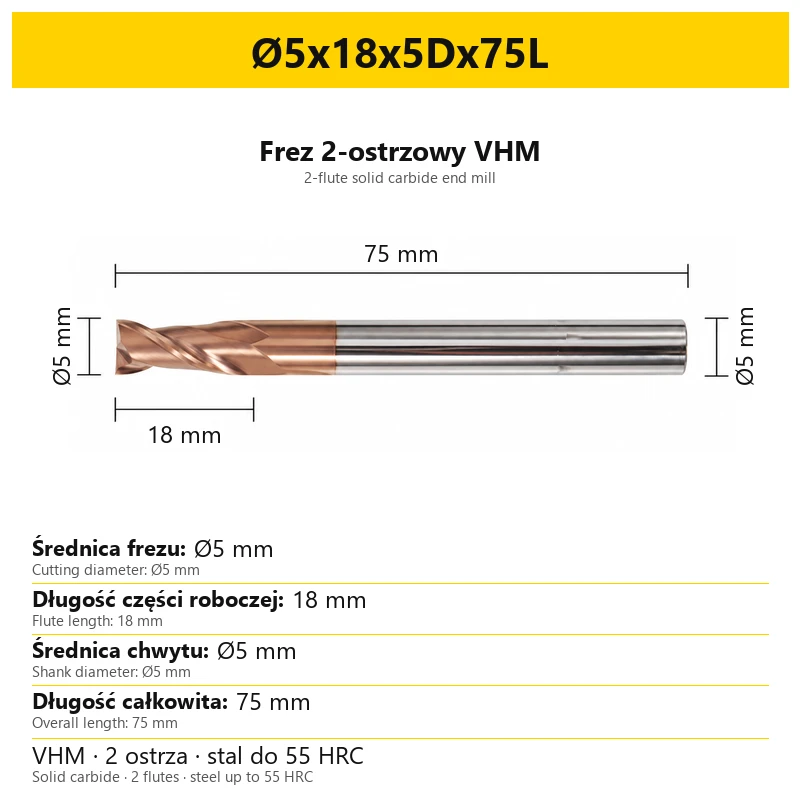
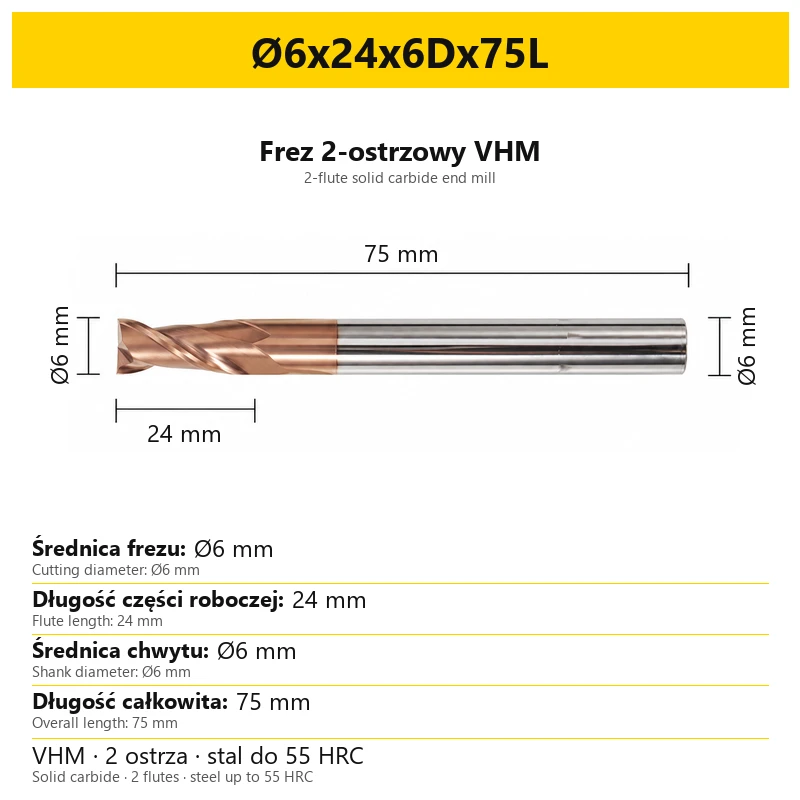
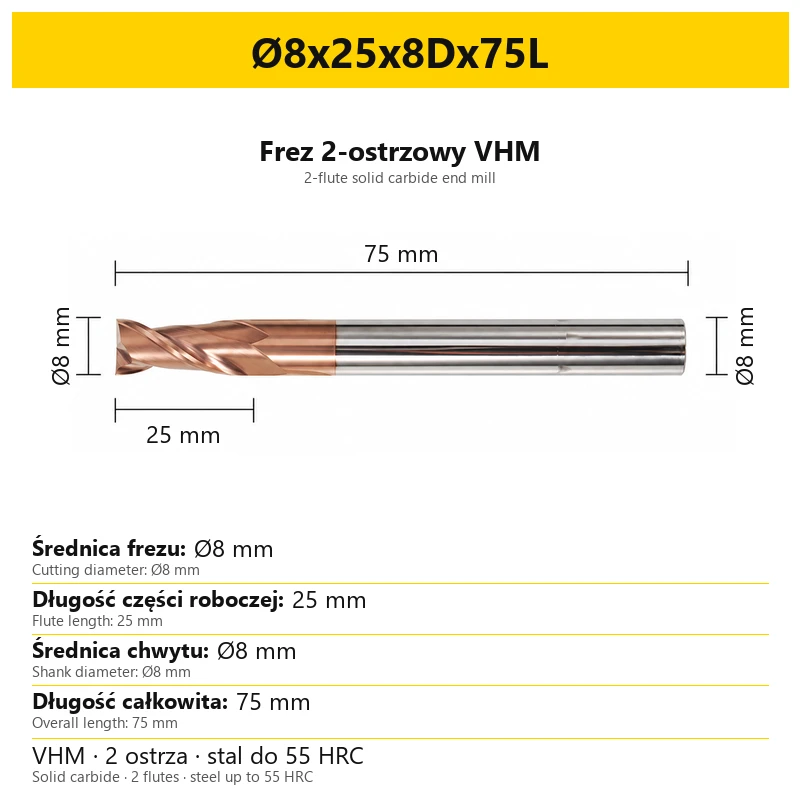
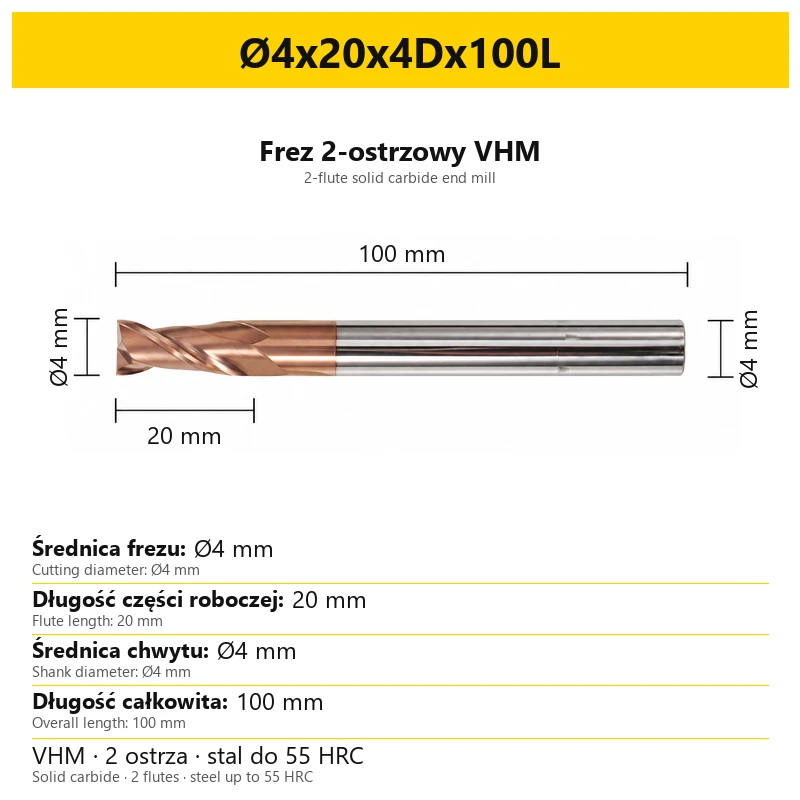
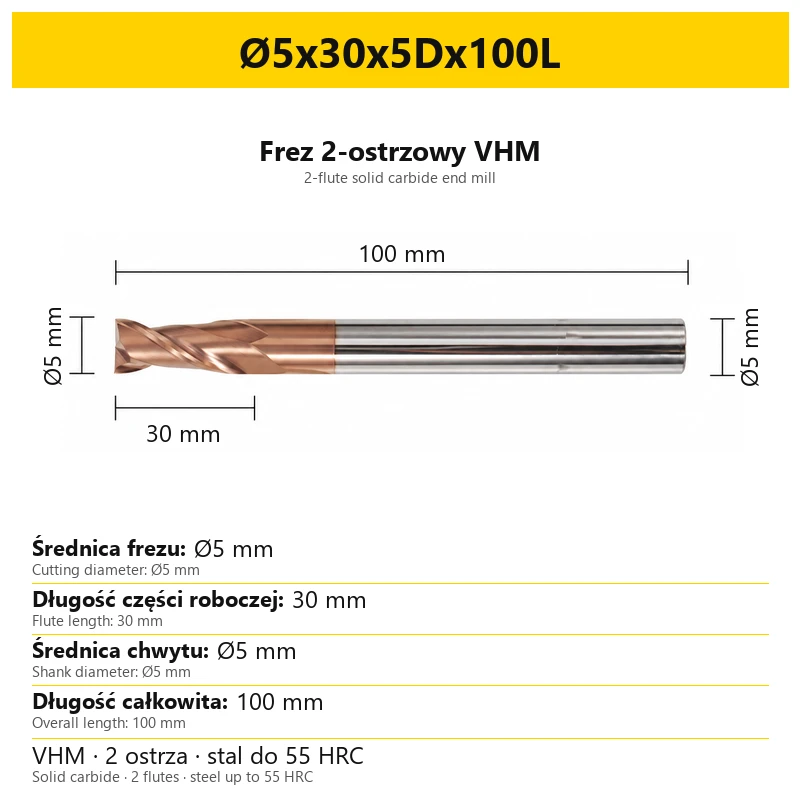
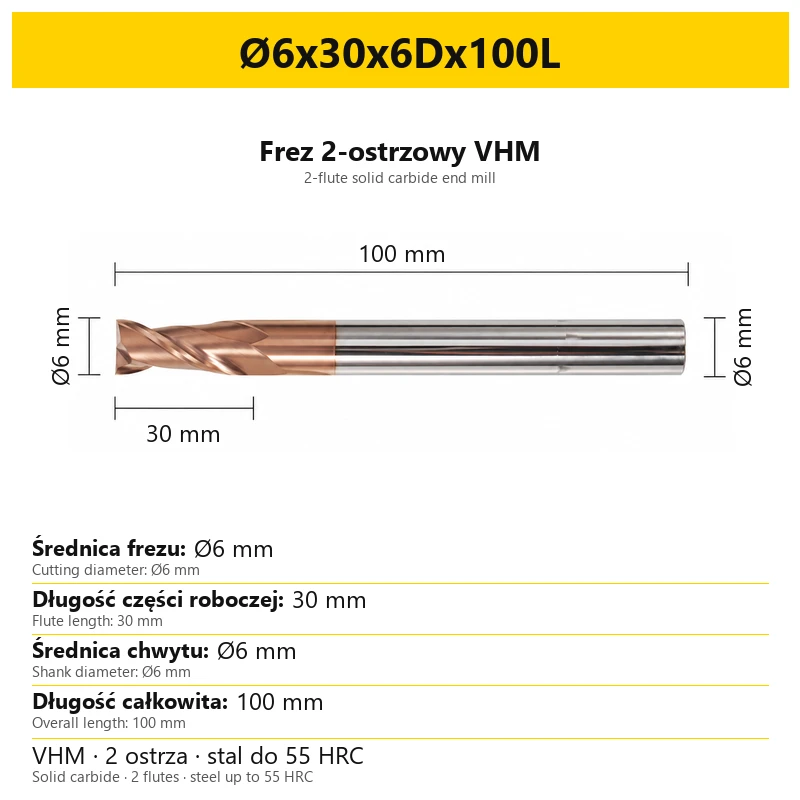
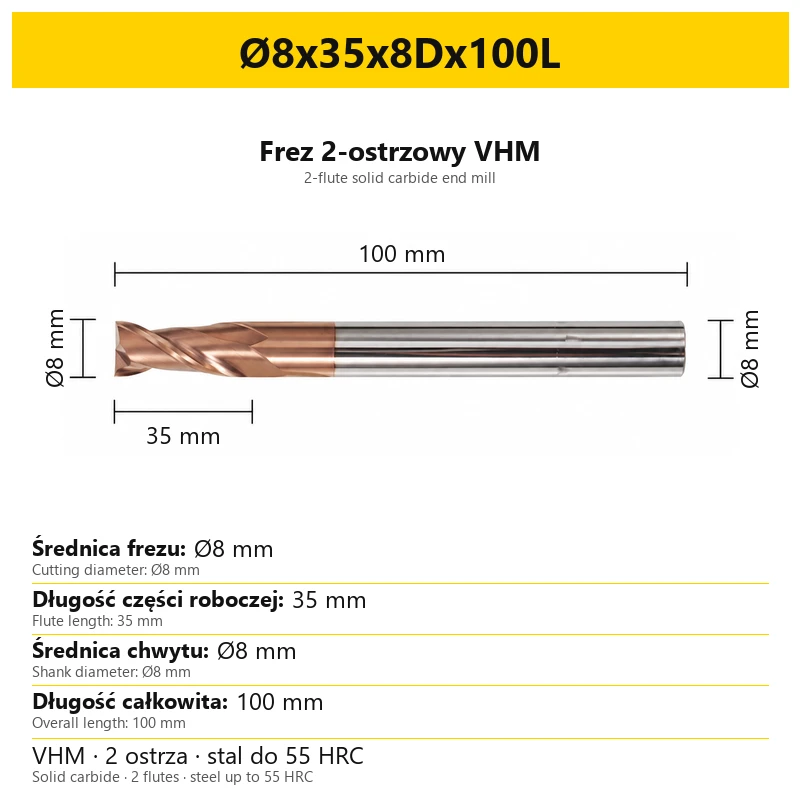
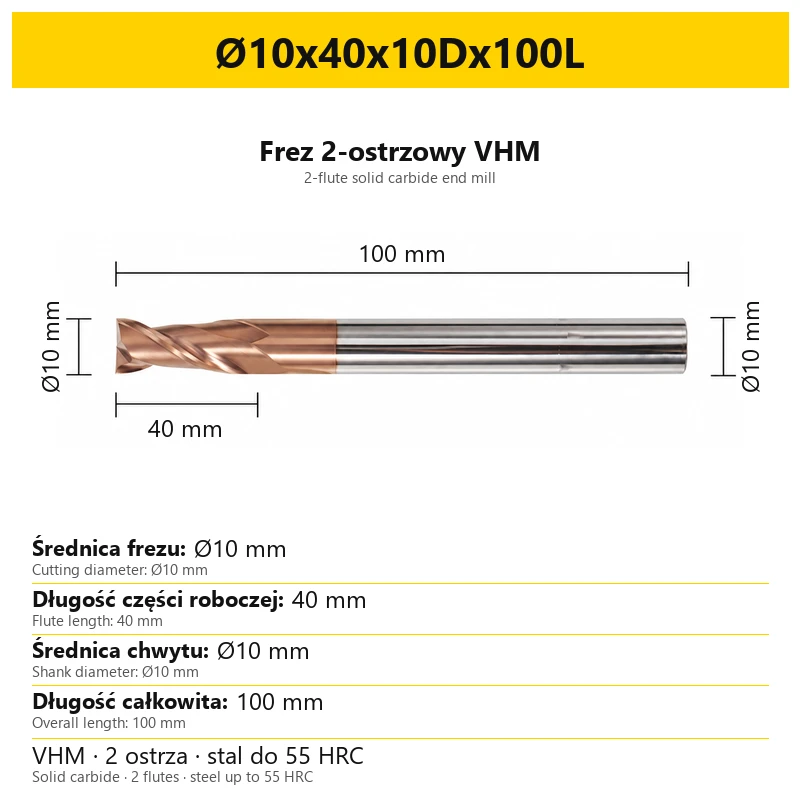
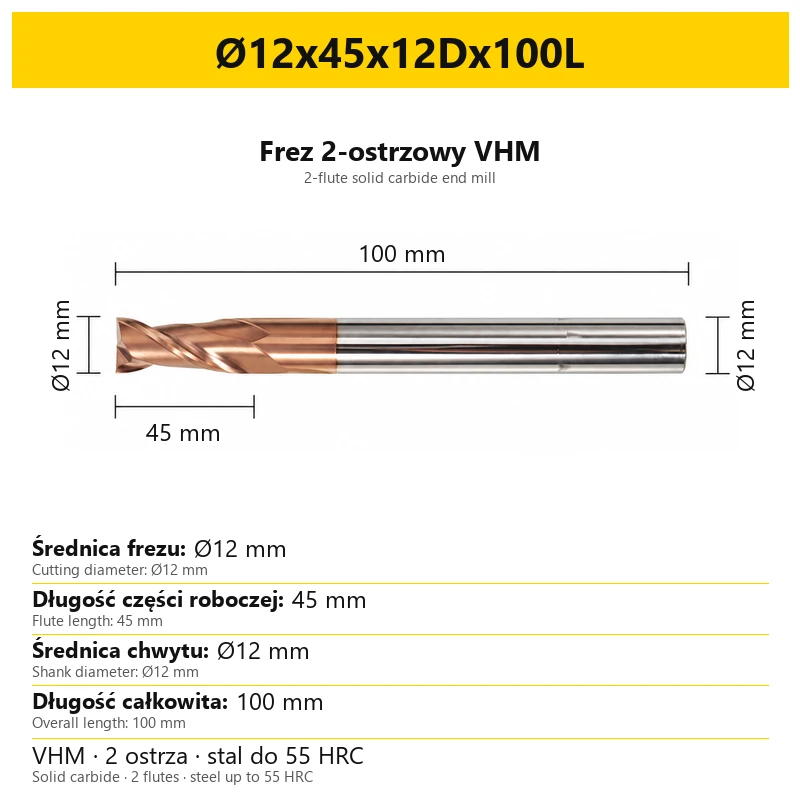
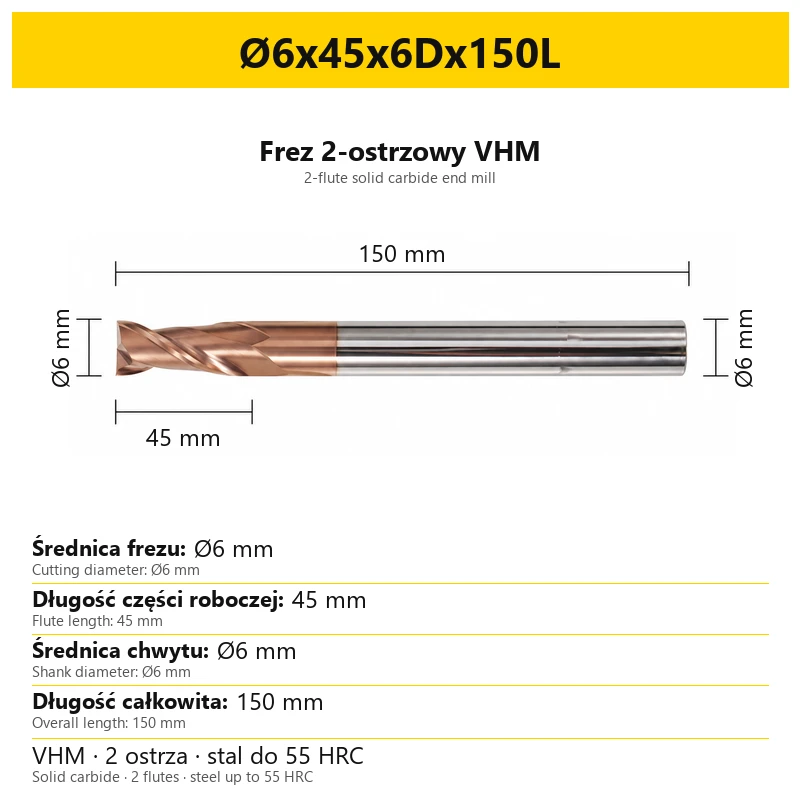
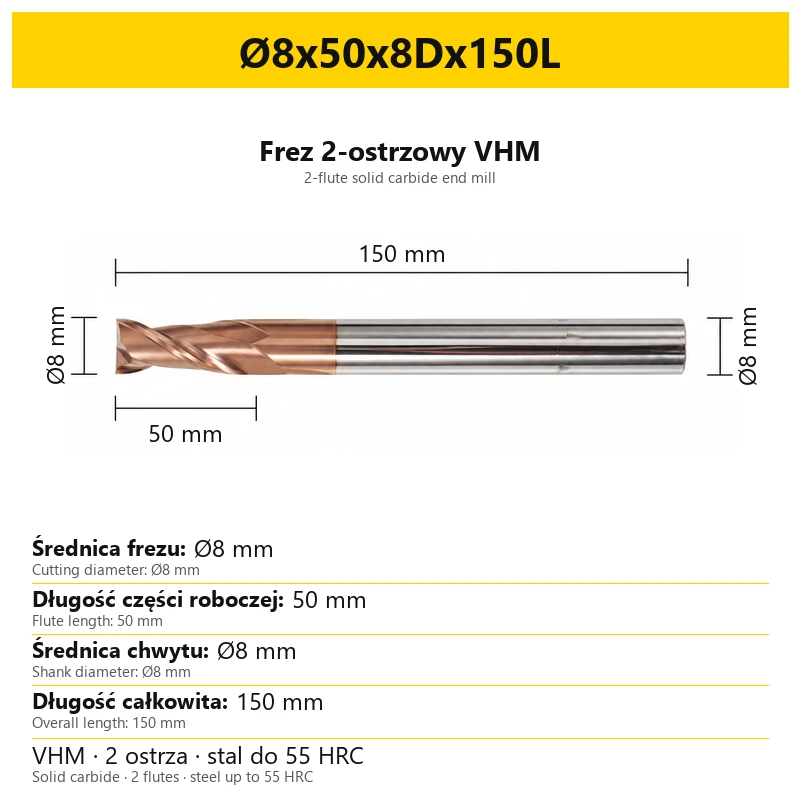
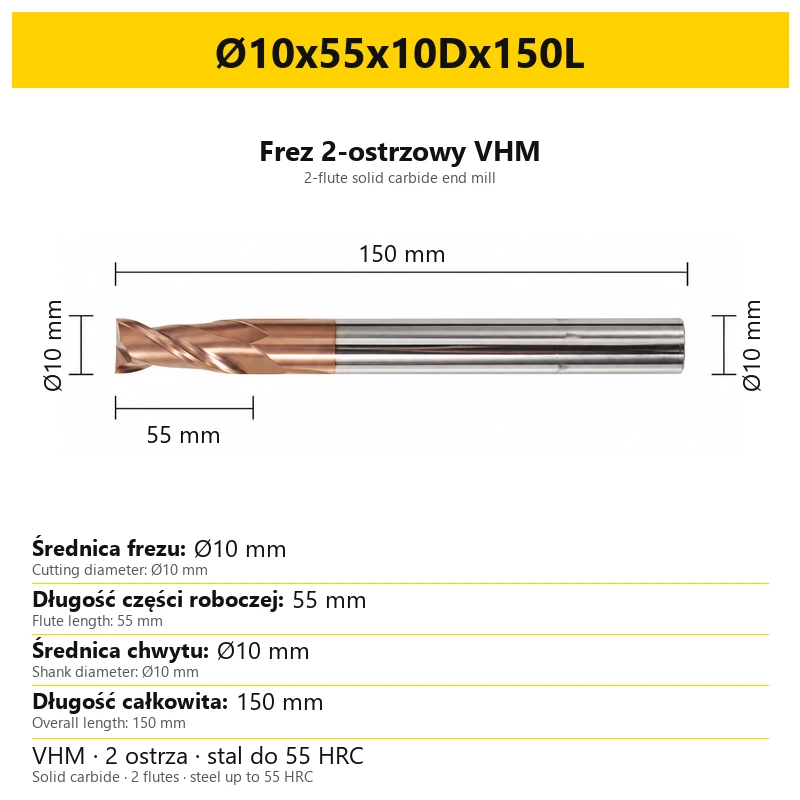
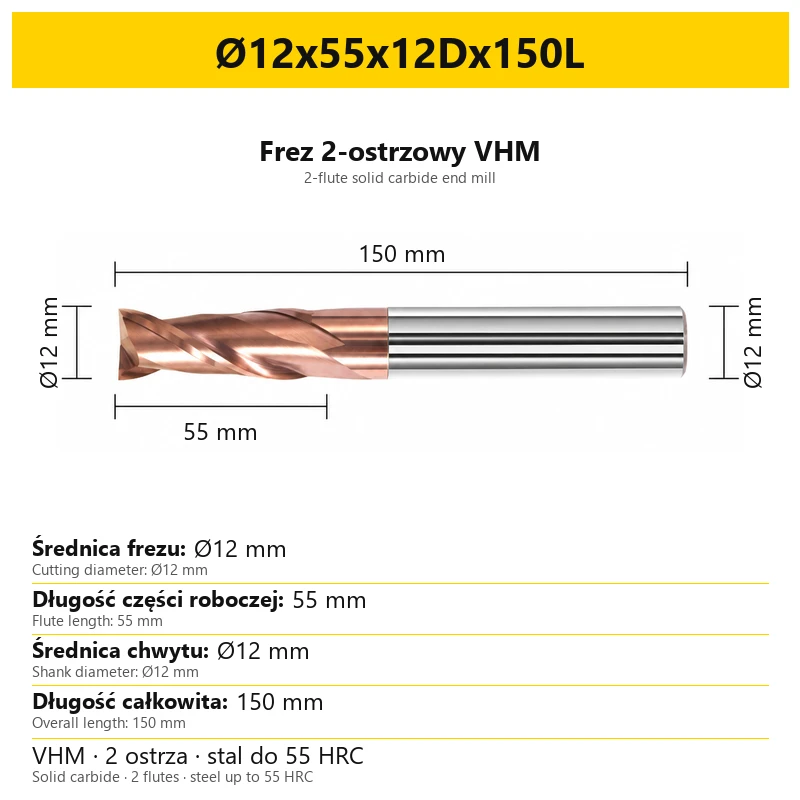
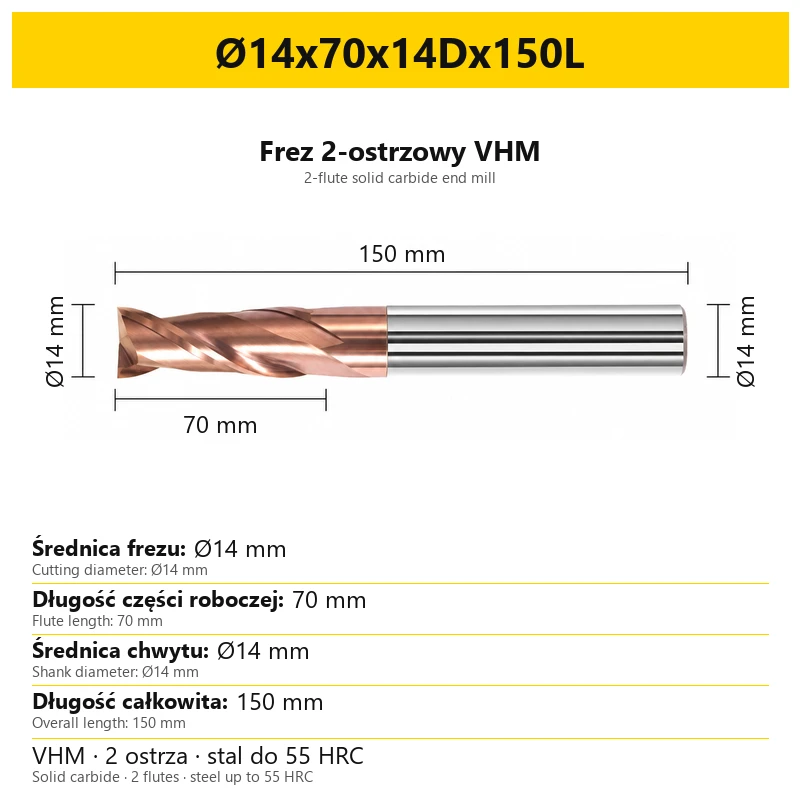
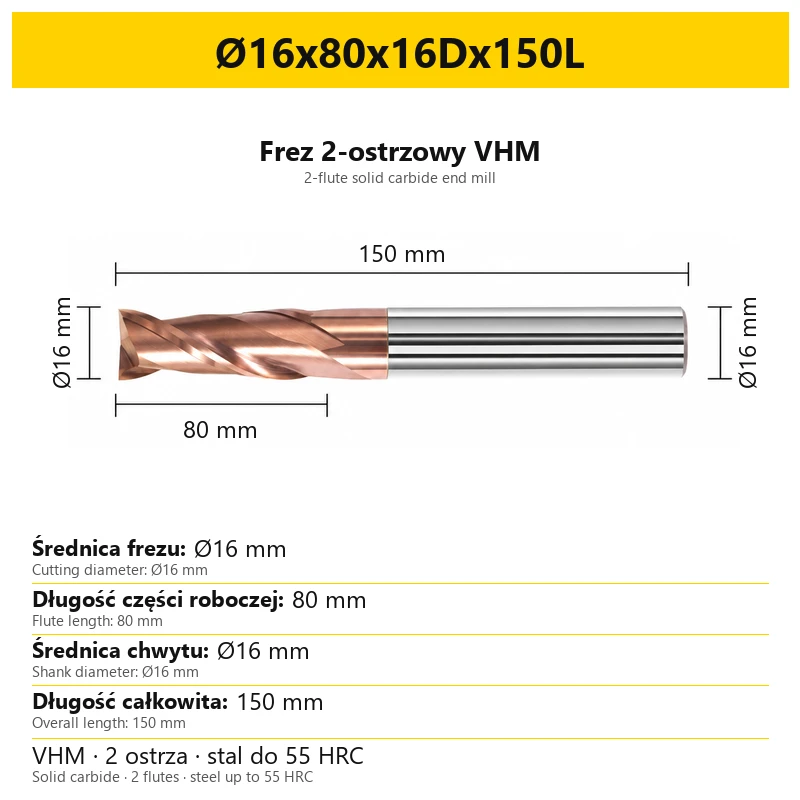
Example: Ø6x15x6Dx50L. This specifies a cutting diameter of 6 mm, flute length of 15 mm, shank diameter of 6 mm and overall length of 50 mm. All dimensions are in millimetres.
| Designation part | Meaning | Example value |
|---|---|---|
| Ø6 | Cutting diameter | 6 mm |
| 15 | Flute length, or cutting length | 15 mm |
| 6D | Cylindrical shank diameter | 6 mm |
| 50L | Overall tool length | 50 mm |
The dimension order stays the same when the cutting and shank diameters differ. The letter D after a number identifies the shank, while L identifies overall length. A decimal point in the selector and a decimal comma on a Polish card represent the same value: 1.5 mm equals 1,5 mm.
Each dimension card gives the measurements of the corresponding size. The photograph is illustrative: select dimensions from the labels, not from the proportions of the photograph. This is particularly relevant to tools with the same diameter and different lengths.
Check how the tool is seated in the holder before machining. It is intended for suitably equipped machining centres and CNC milling machines. Low-speed bench drills and handheld drills are not suitable machines for this tool.
For steel machining, air blast or mist cooling are recommended. Working without flood coolant requires effective chip evacuation and conditions appropriate to the material and operation.
Select spindle speed, feed and depth of cut for the material grade and hardness, cutting diameter, flute length, overhang and milling operation. Full-slot milling, side milling and contour finishing require their own selection of cutting conditions.
Does the end mill have two or four flutes?
It has two flutes. This family consists of 2-flute flat-end mills.
Is the cutting diameter always equal to the shank diameter?
No. Check the first dimension and the shank value ending in D separately. Choose the holder for the shank diameter.
Does a length of 150 mm mean 150 mm long flutes?
No. The value followed by L is overall length. Flute length is the second dimension in the size designation and is also shown on its dimension card.
Can the tool be used in a handheld drill?
No. It is intended for milling on a suitable machine; a handheld drill or low-speed bench drill does not provide the correct conditions for this operation.
Can hardened steel suitability be determined from the 55 HRC name alone?
No. Check the selection limits in section 3. For hardness of 45–55 HRC, suitability for the material grade and planned operation requires separate confirmation.


Cookies and related technologies allow the website to function properly and help us adjust the offer to your needs. You can choose to accept our use of all these files and go to the store, or adapt the use of files to your preferences by selecting "Customize Consents".
Here you can define your preferences regarding the use of cookies.
These files are necessary for our website to function so they can't be switched off.
These files allow you to use other functions of the website (other than those necessary for its functioning). Enabling these files will give you access to the full functionality of the website.
These files allow us to analyze our online store, which may contribute to its better functioning and adaptation to the needs of our Users.
With these files, we can conduct marketing activities.