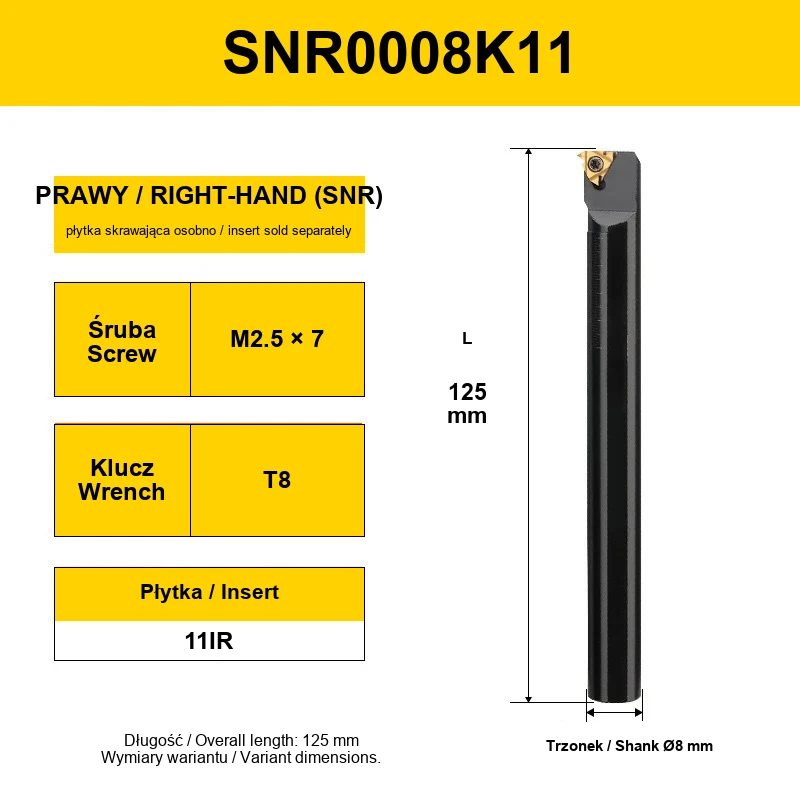
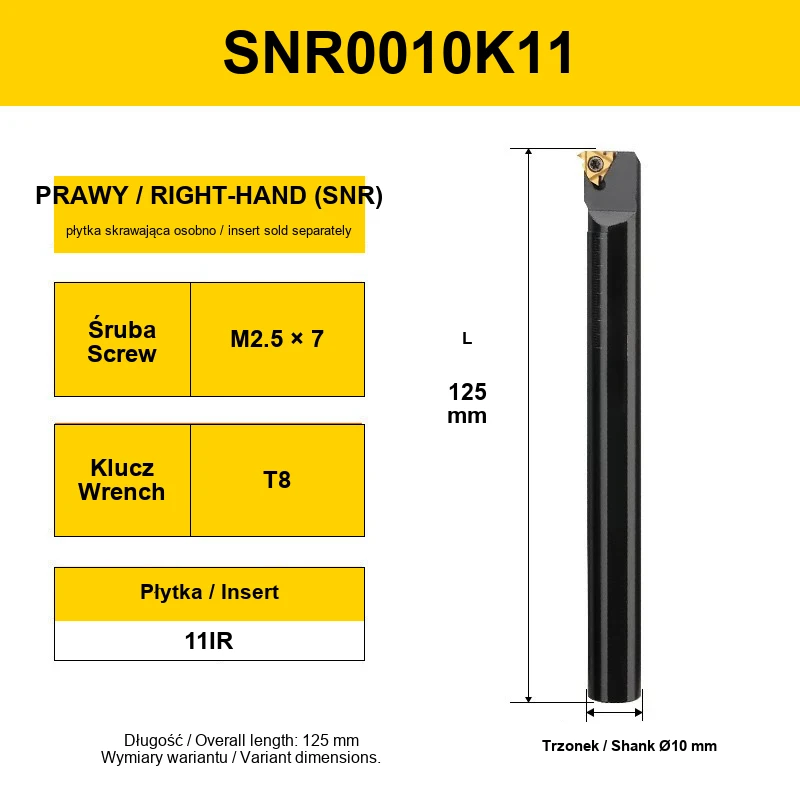
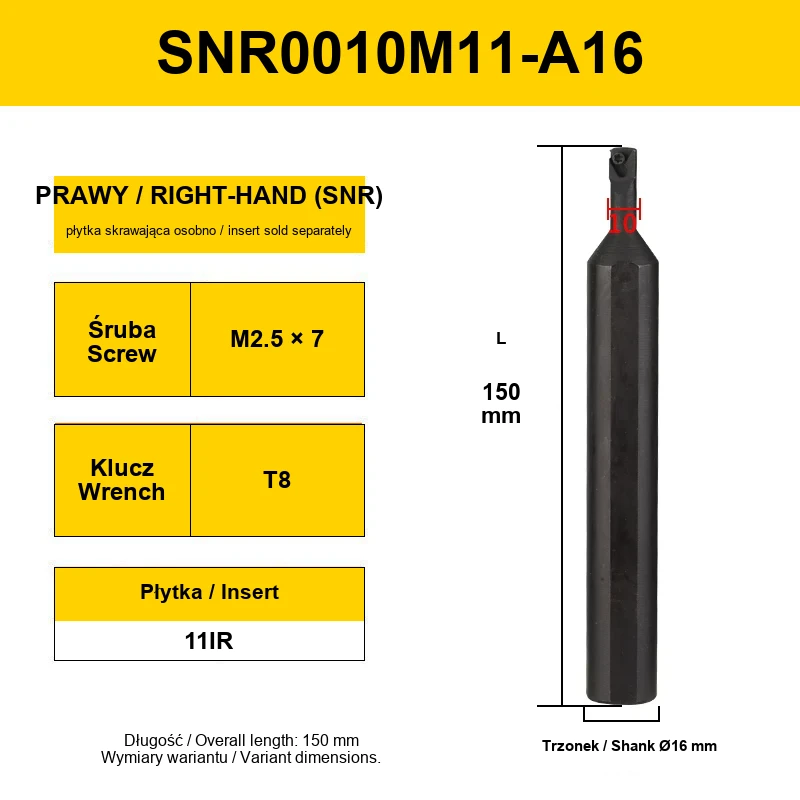
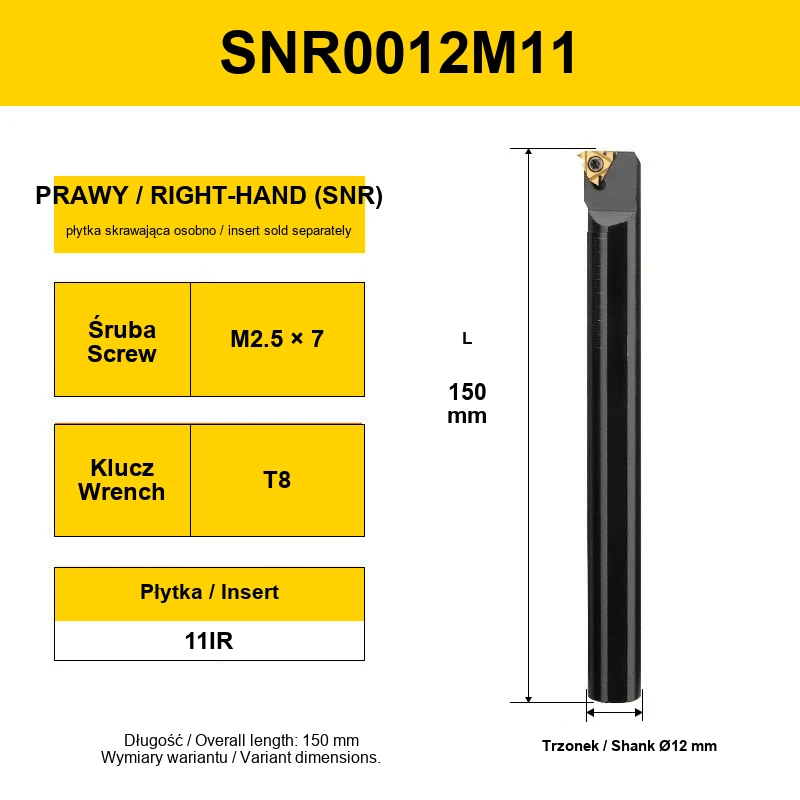
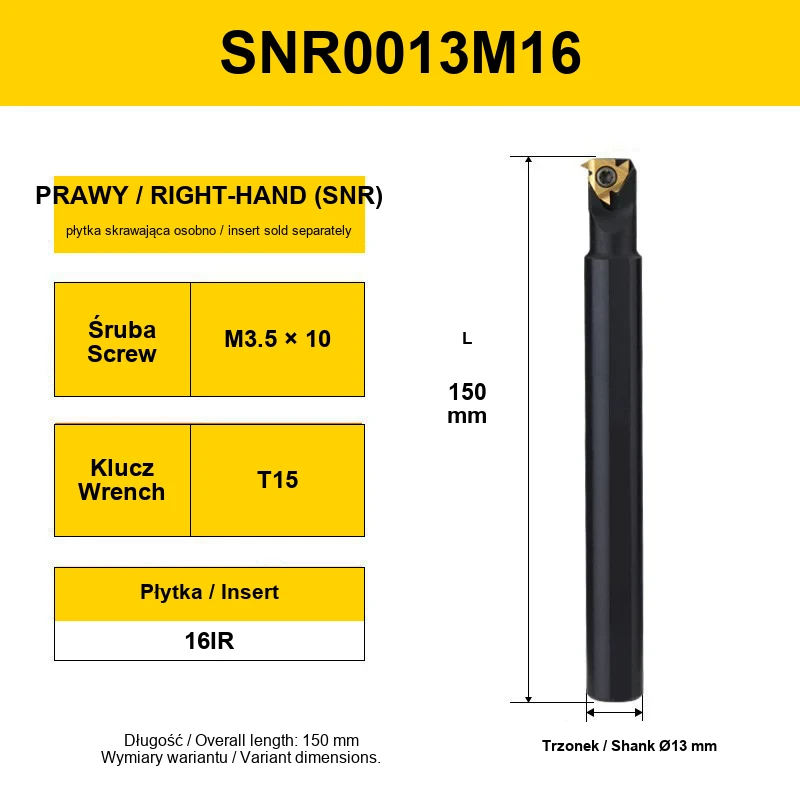
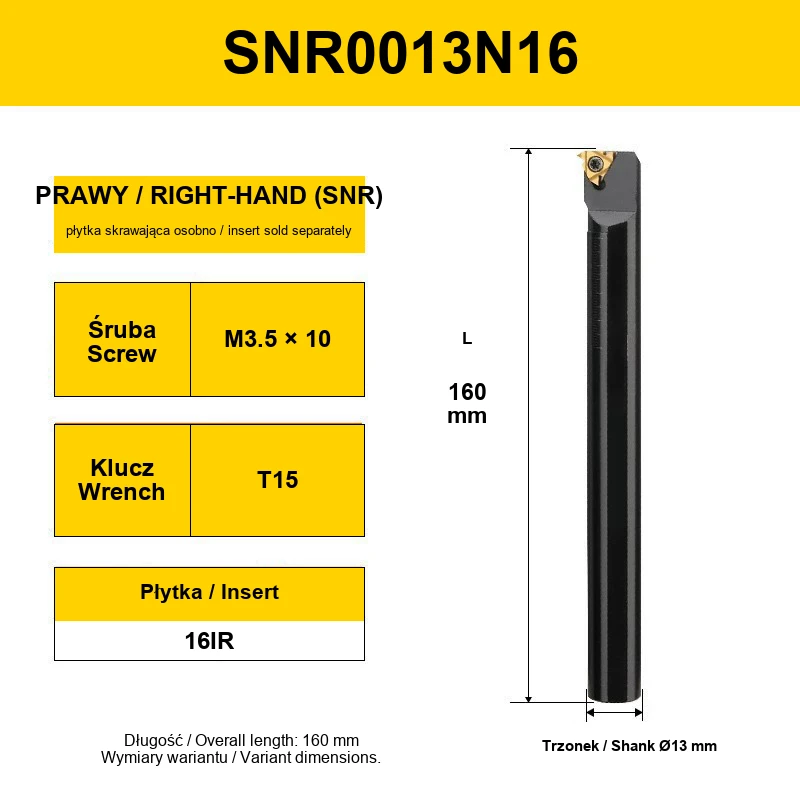
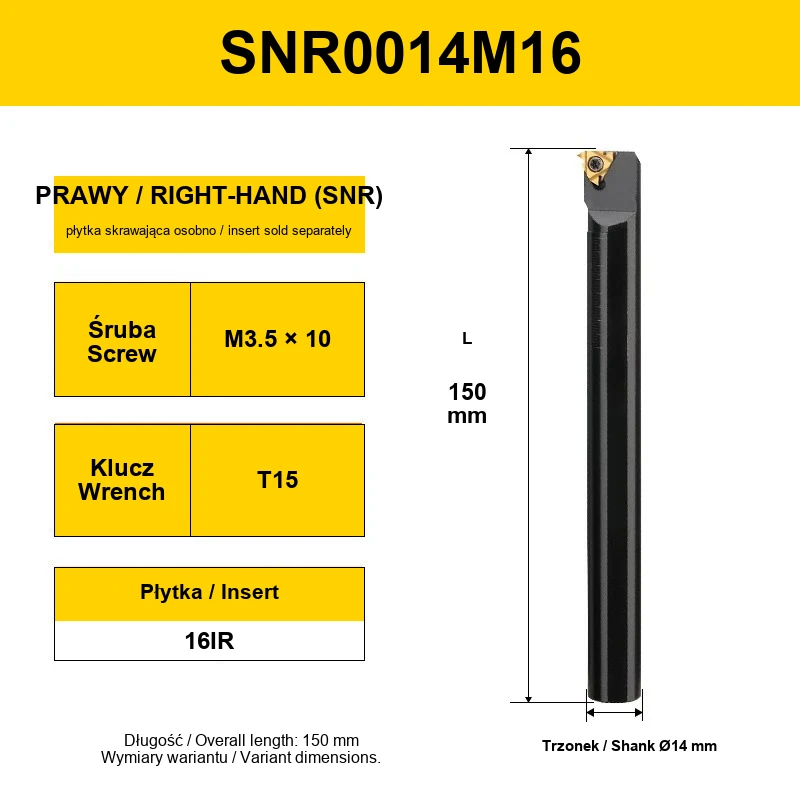
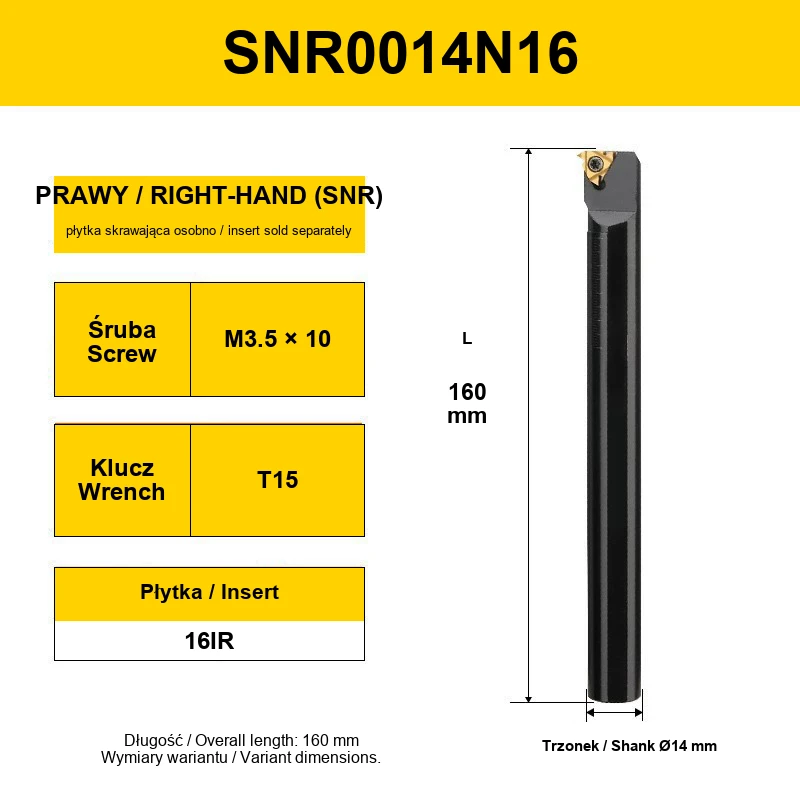
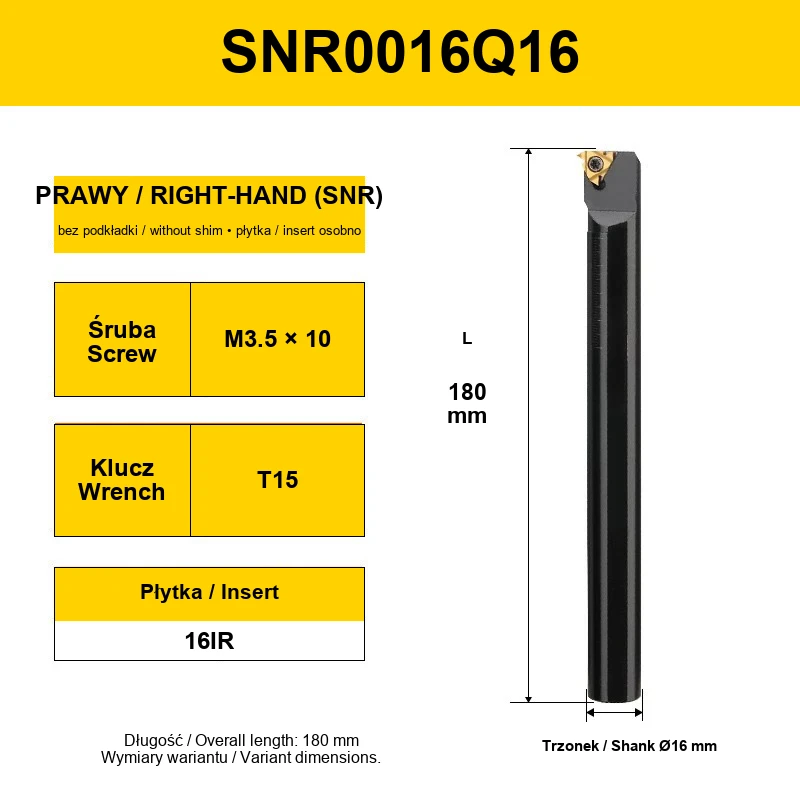
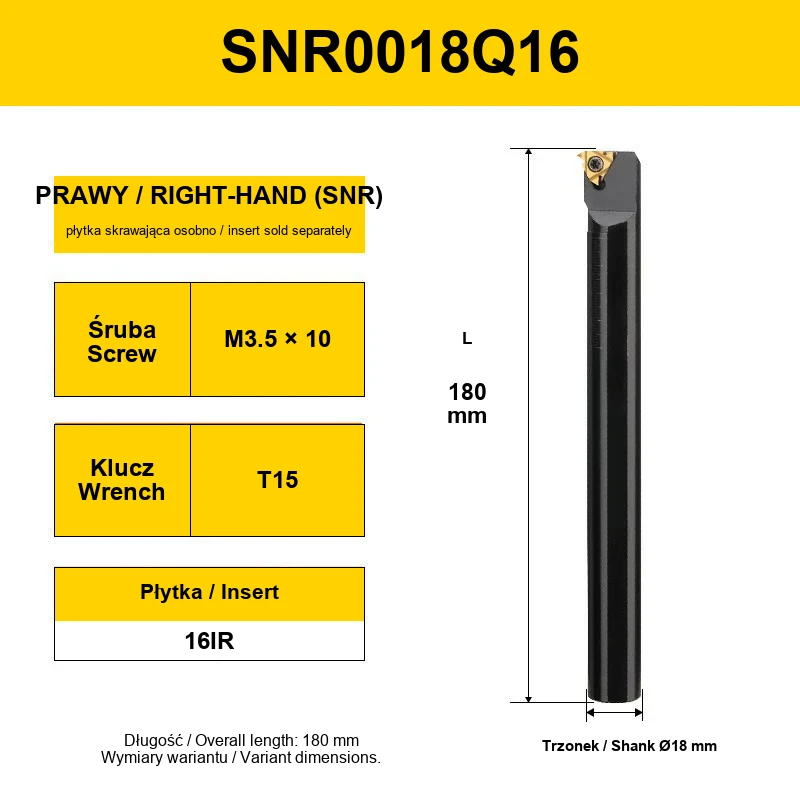
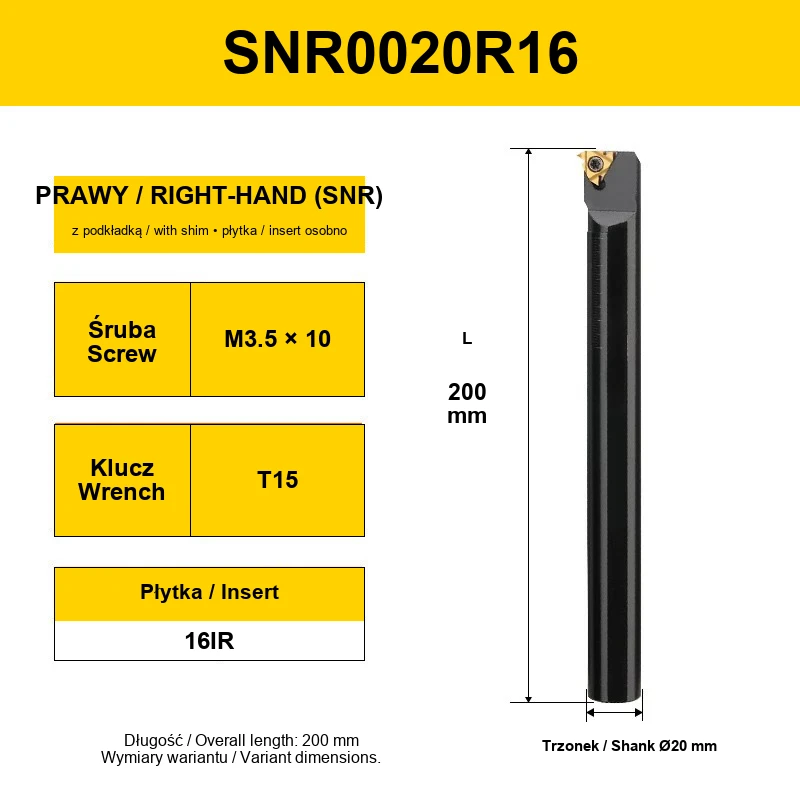
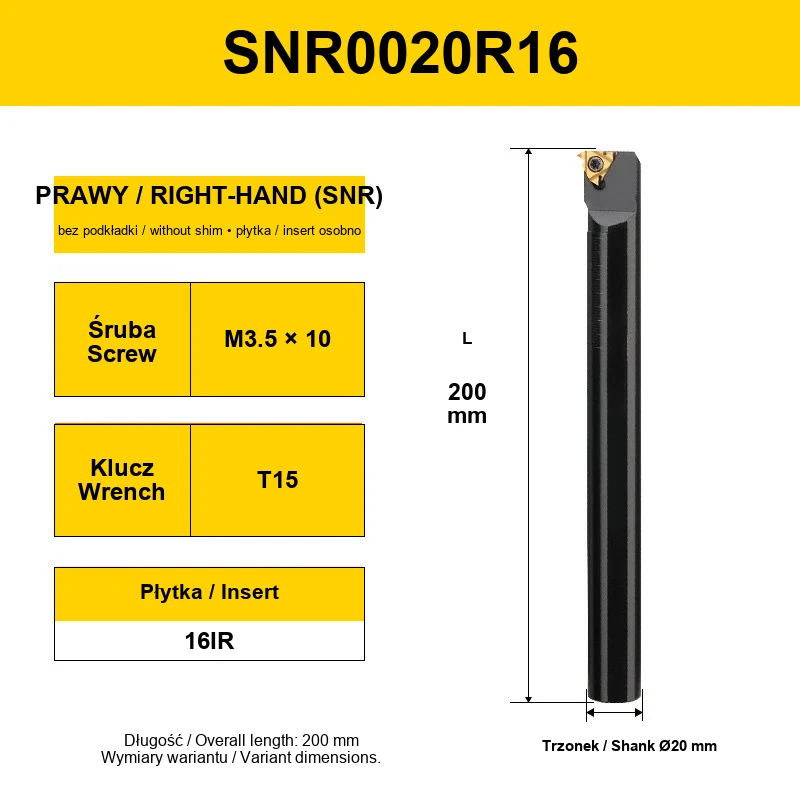
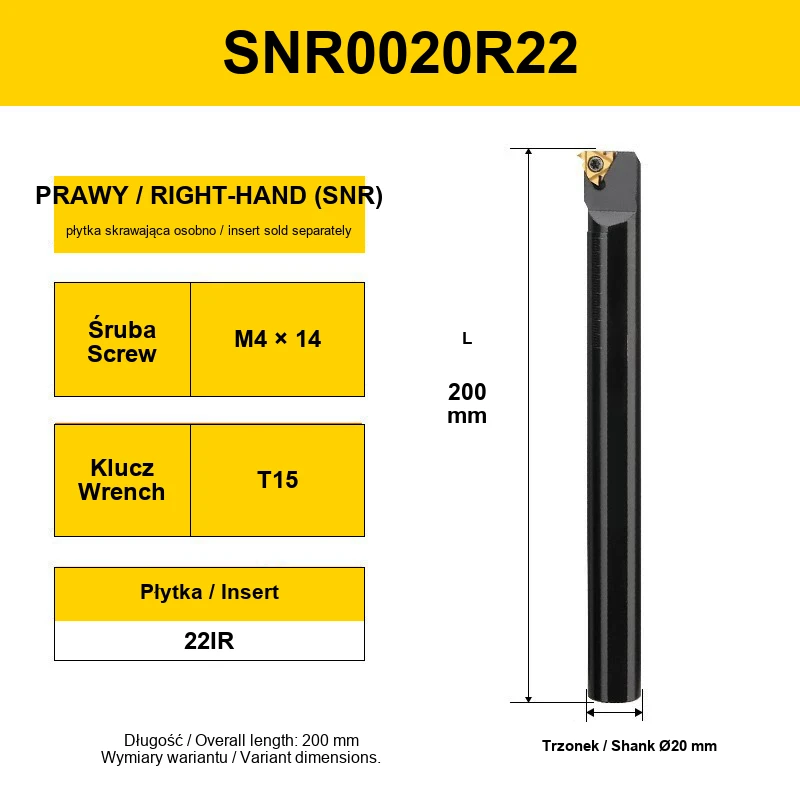
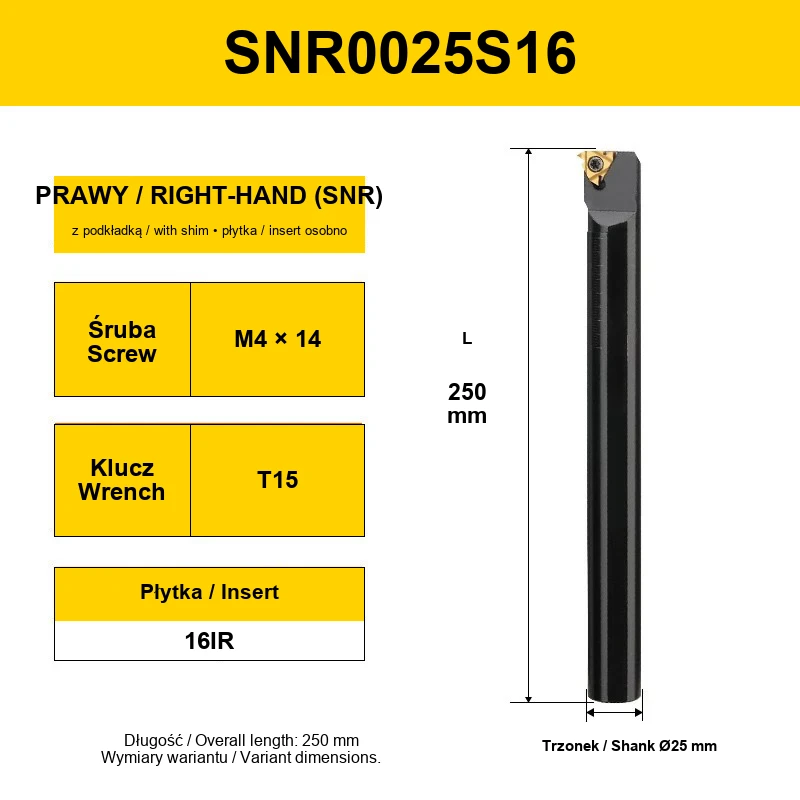
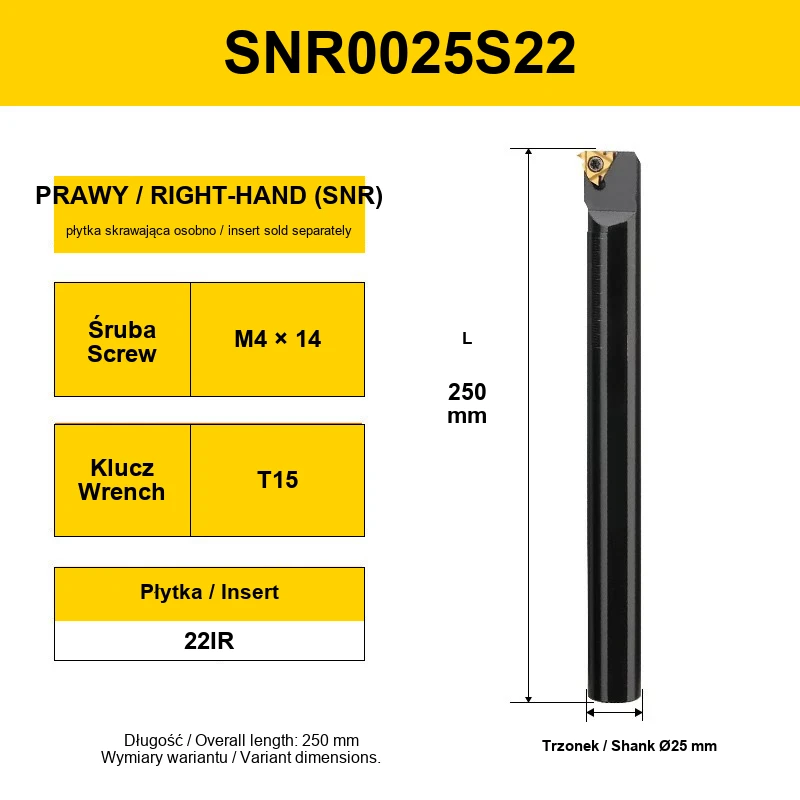
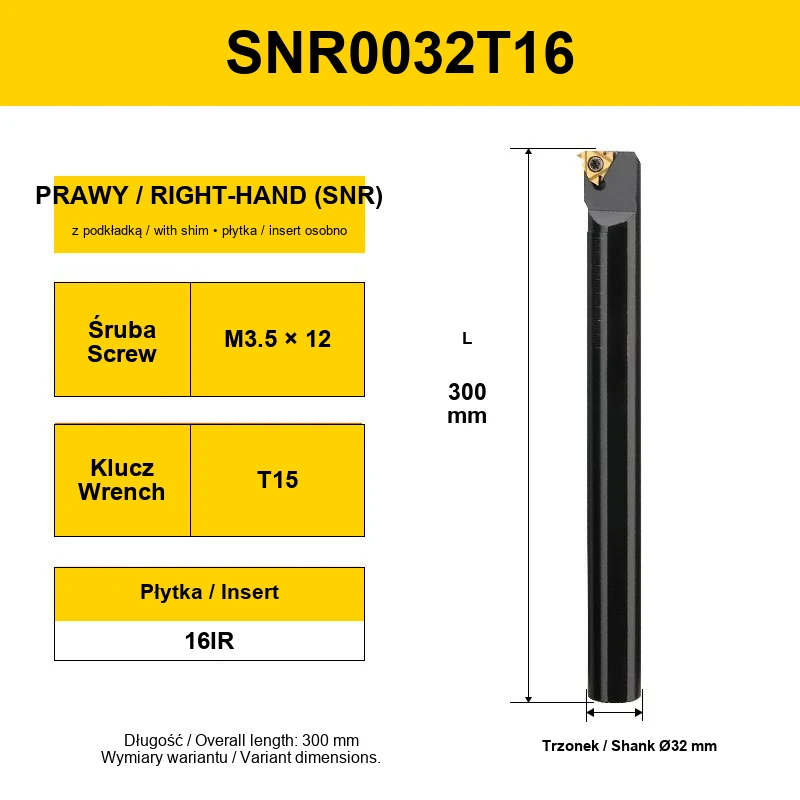
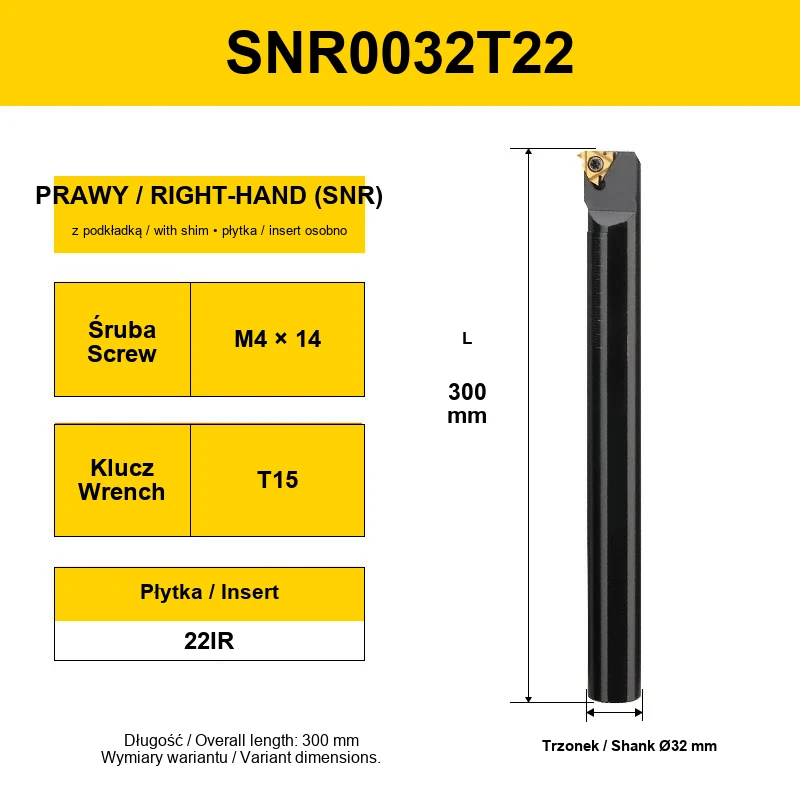
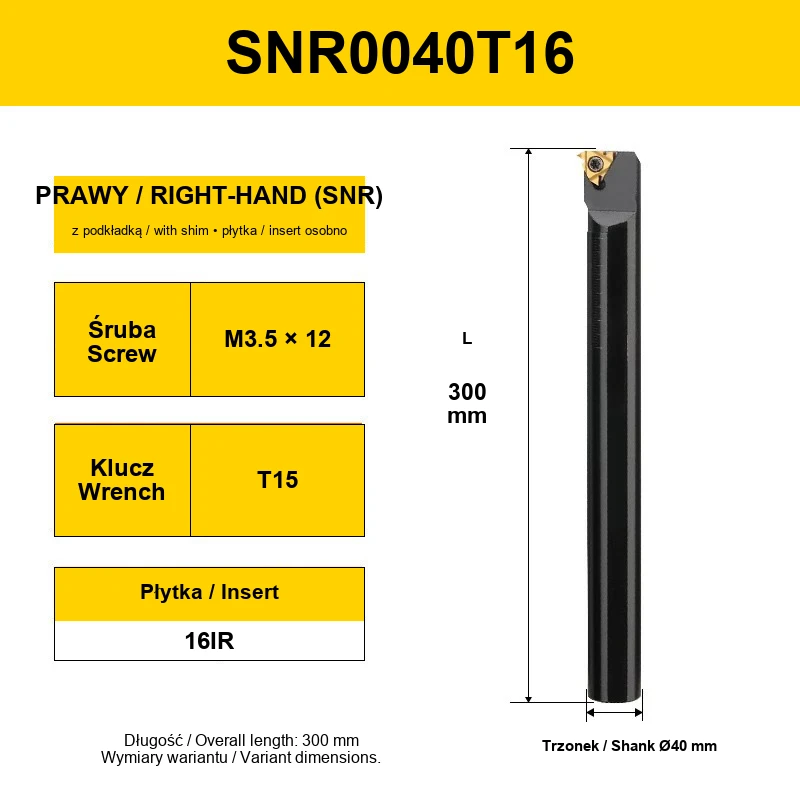
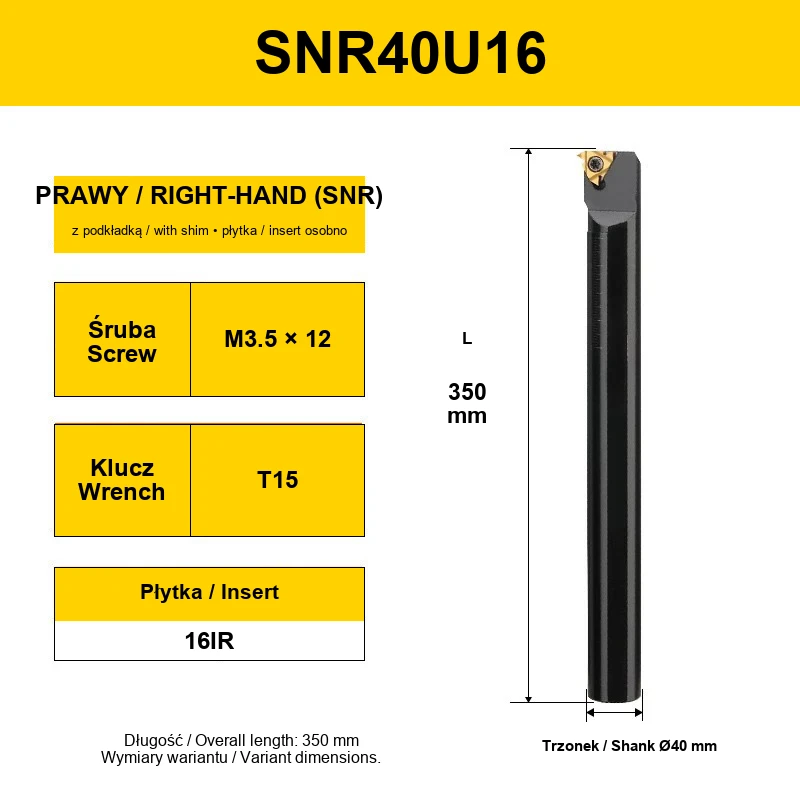
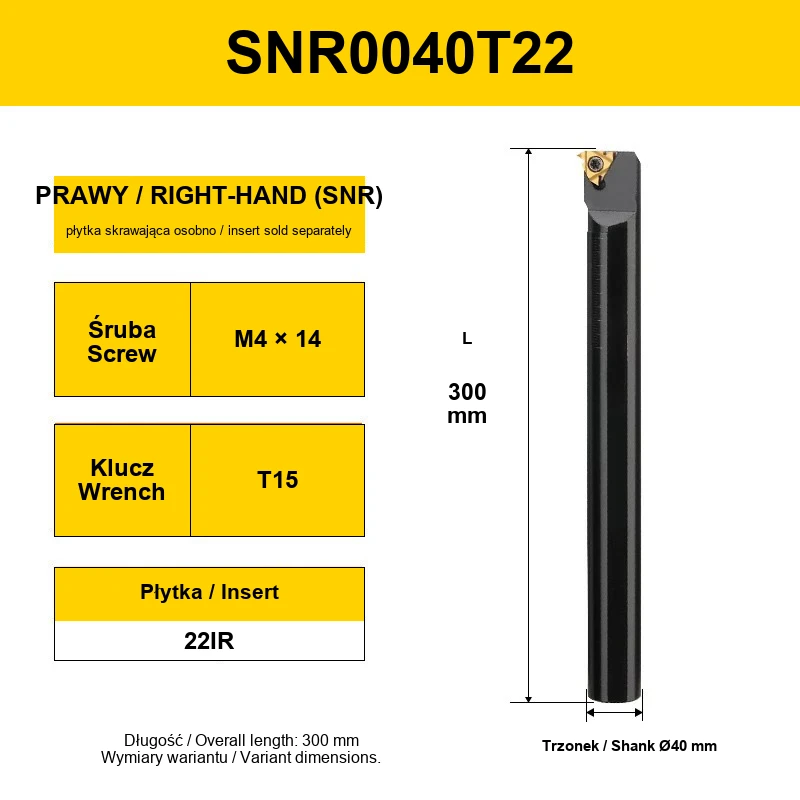
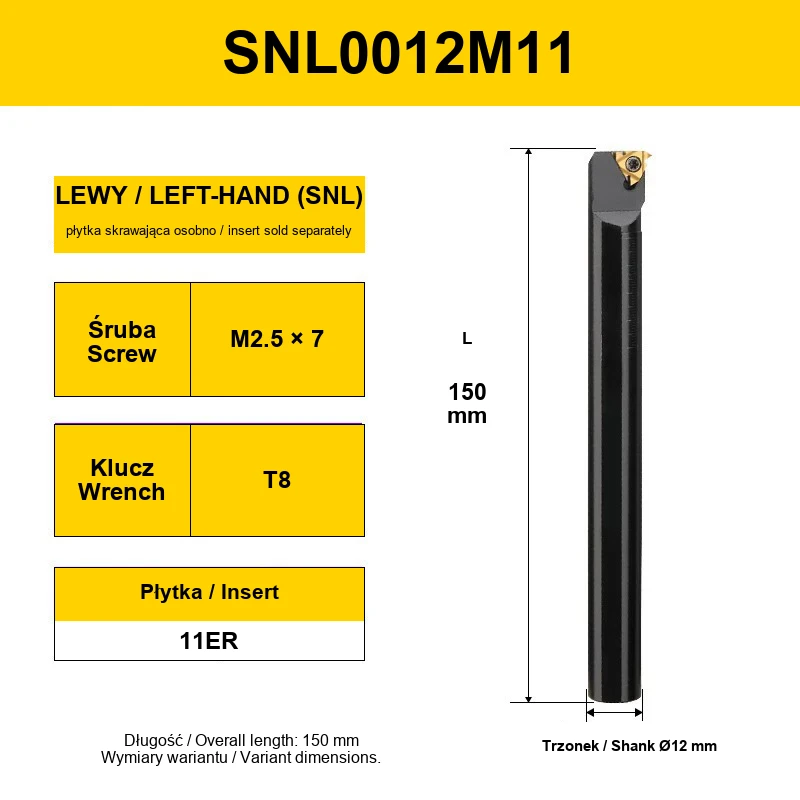
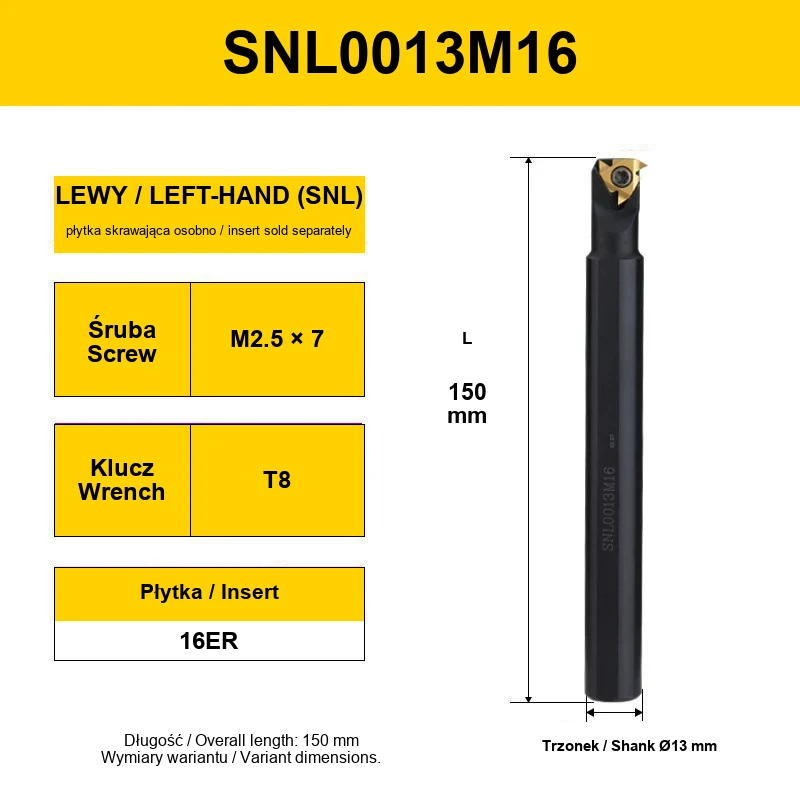
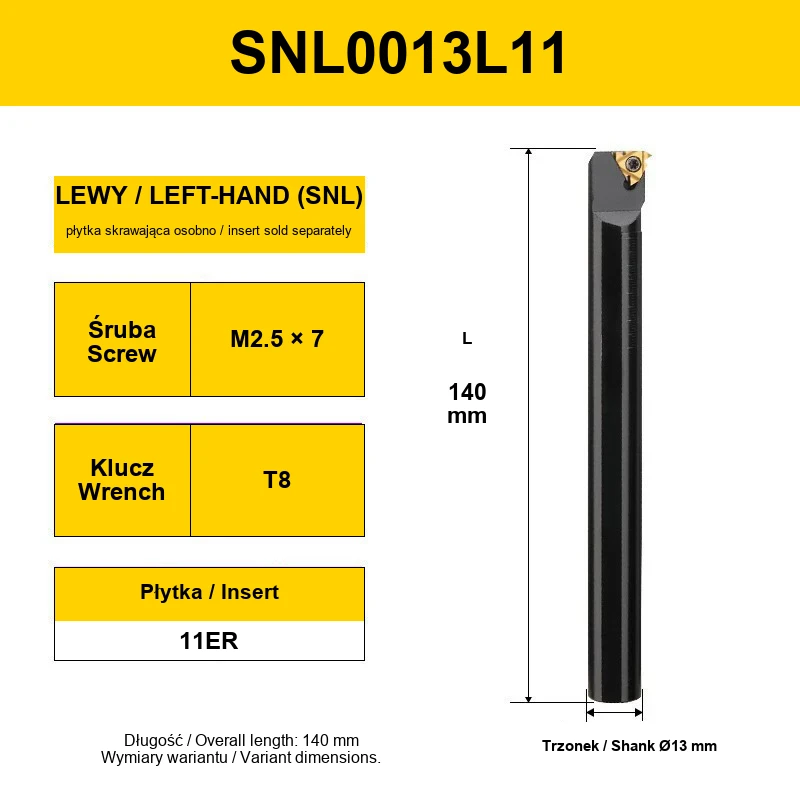
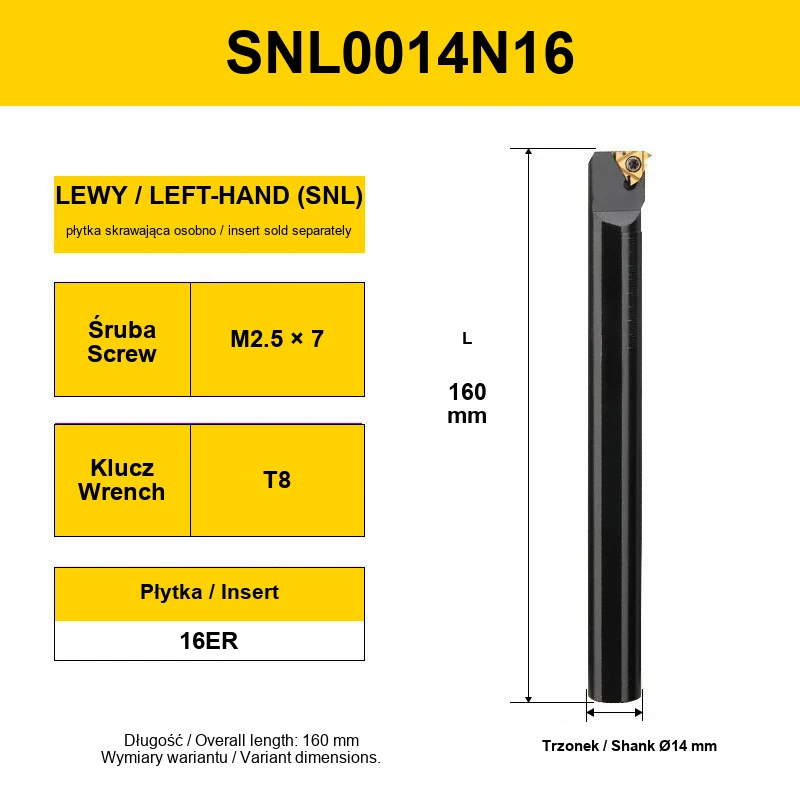
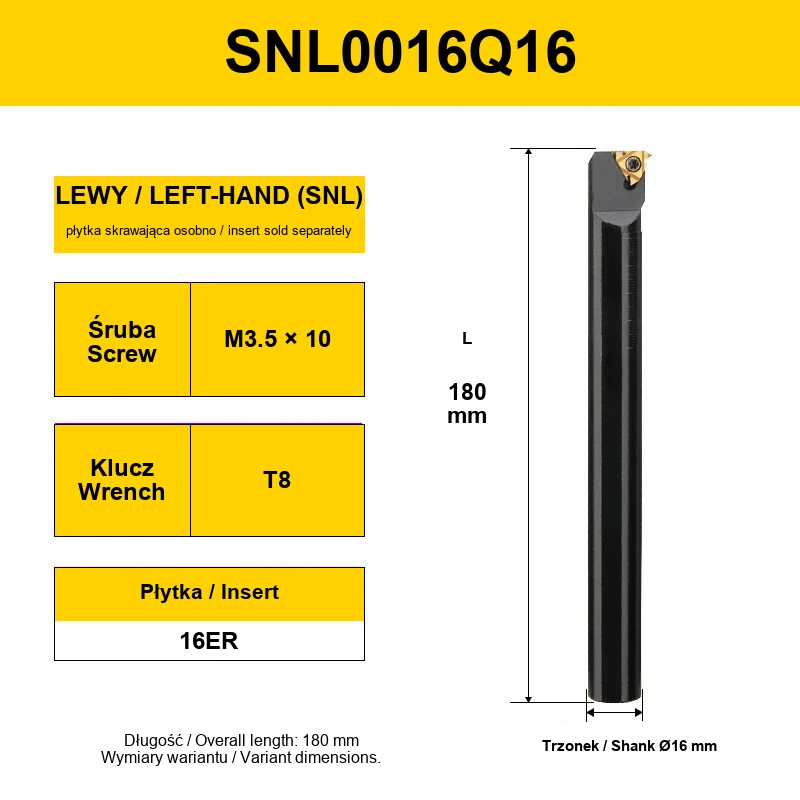
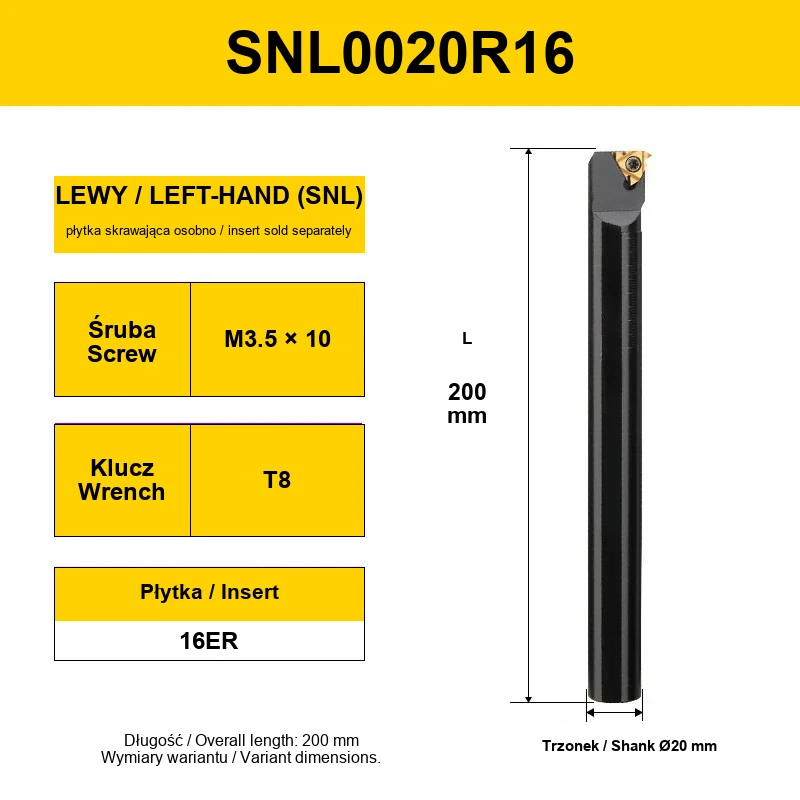
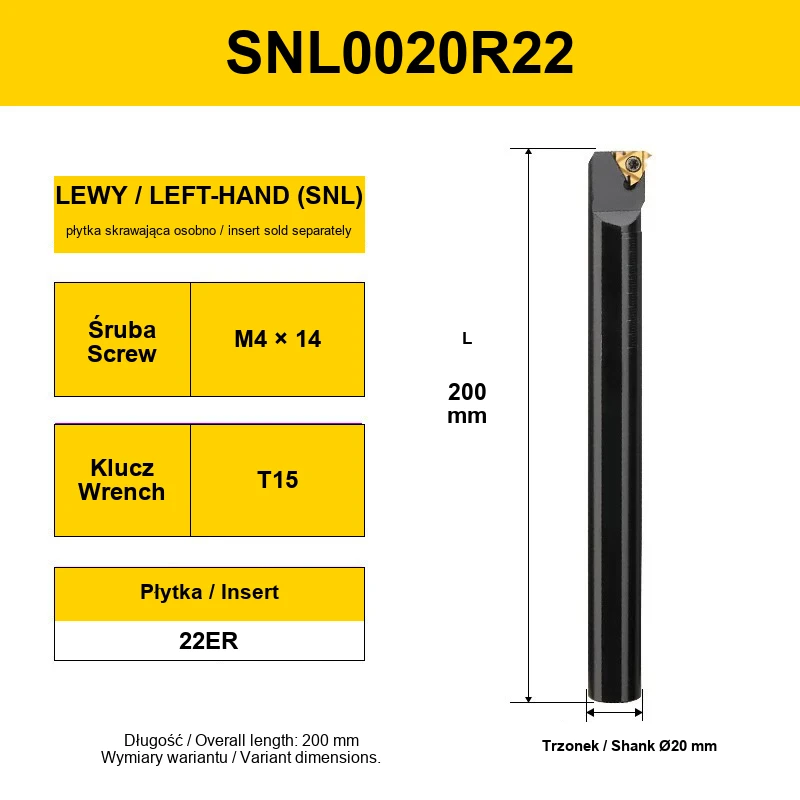
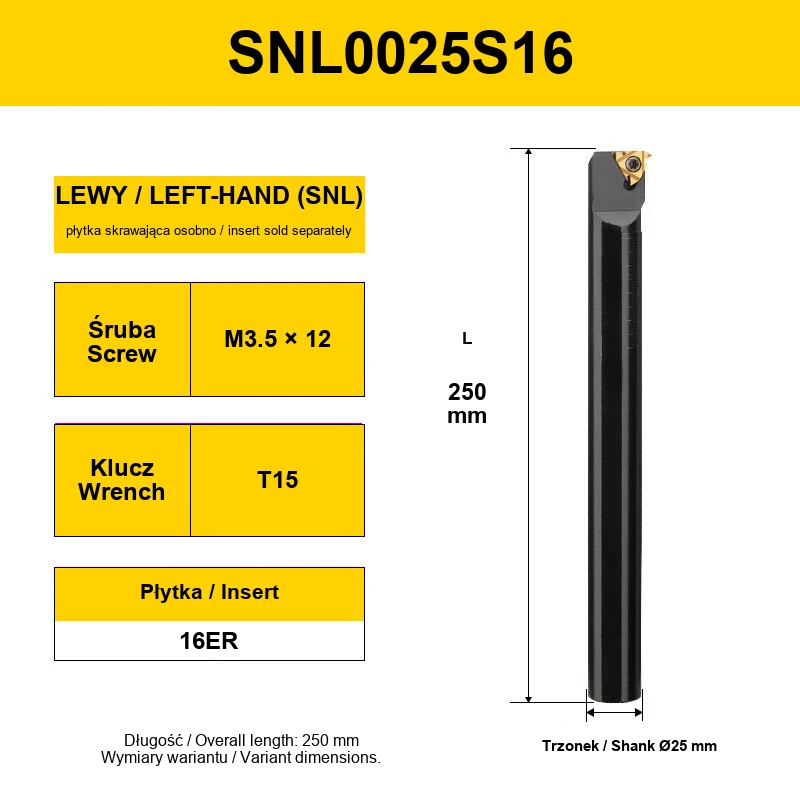
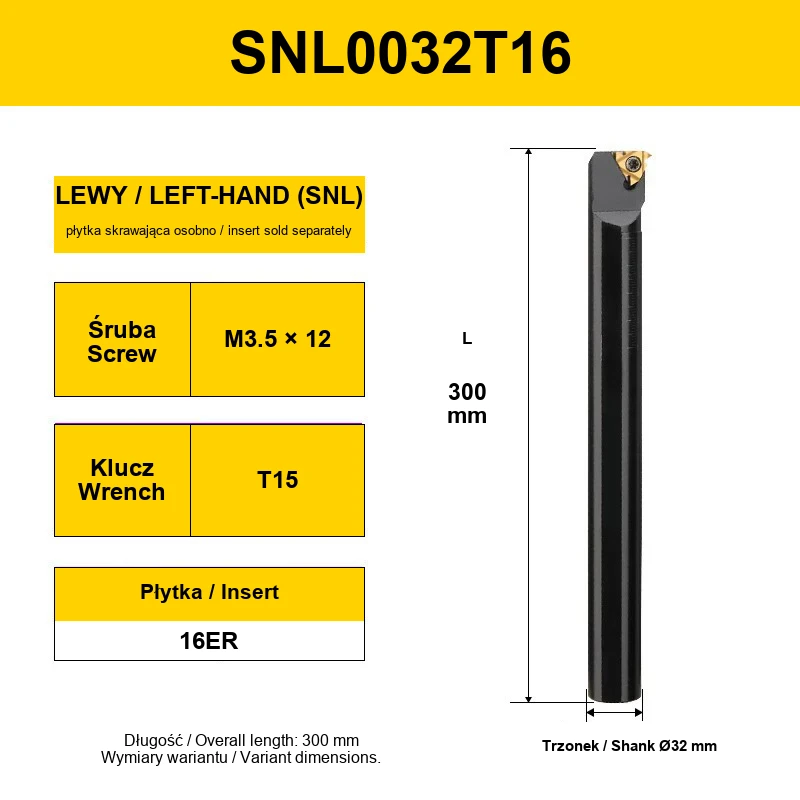


SNR/SNL 40Cr Internal Threading Boring Bar for IR/ER Inserts
Shipping costs are not included in the price.
Shipping costs are not included in the price.
Ask about the product

The administrator of personal data is Kortools. We process it to respond to your inquiry. More information regarding the processing of personal data can be found in privacy policy.
Select a product variant:
Individual variants may differ in price
Product code: MF168-661507871156
Product description
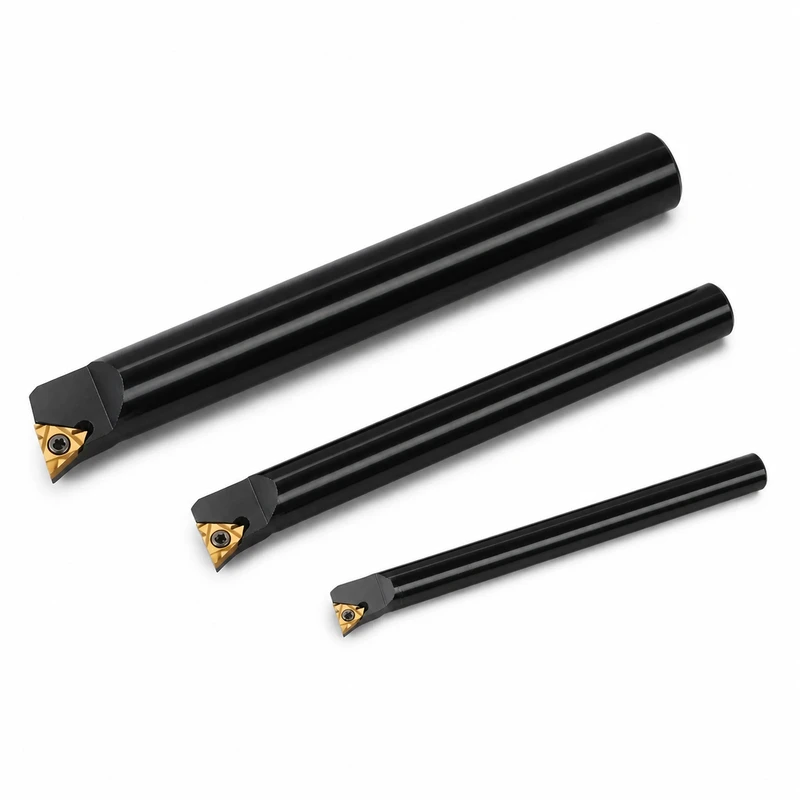
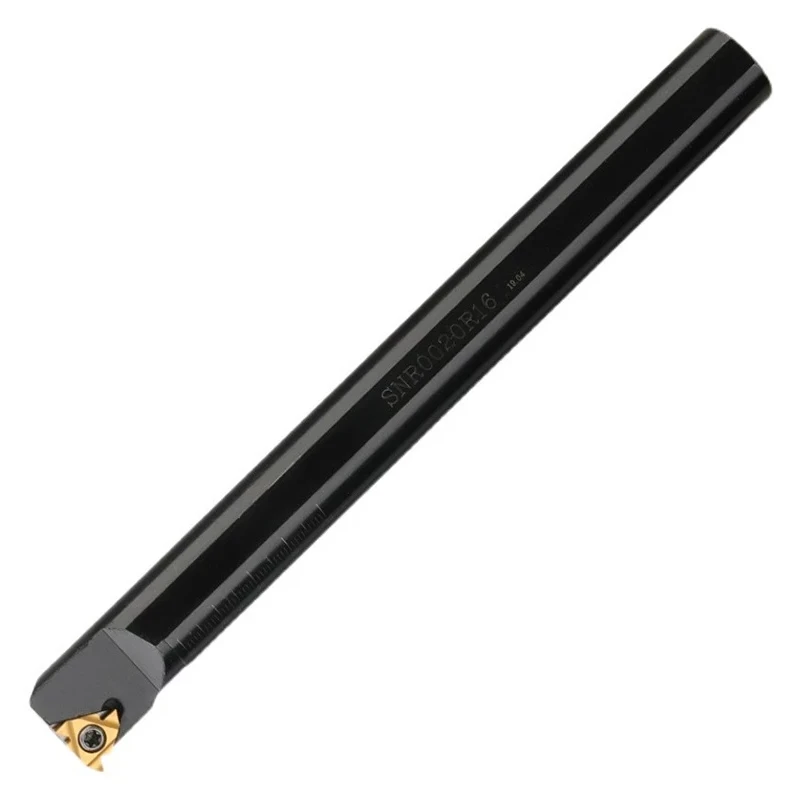
SNR / SNL internal threading boring bars
42 verified variants • Ø7–Ø50 mm shanks • 06/08/11/16/22 insert systems • cutting insert sold separately
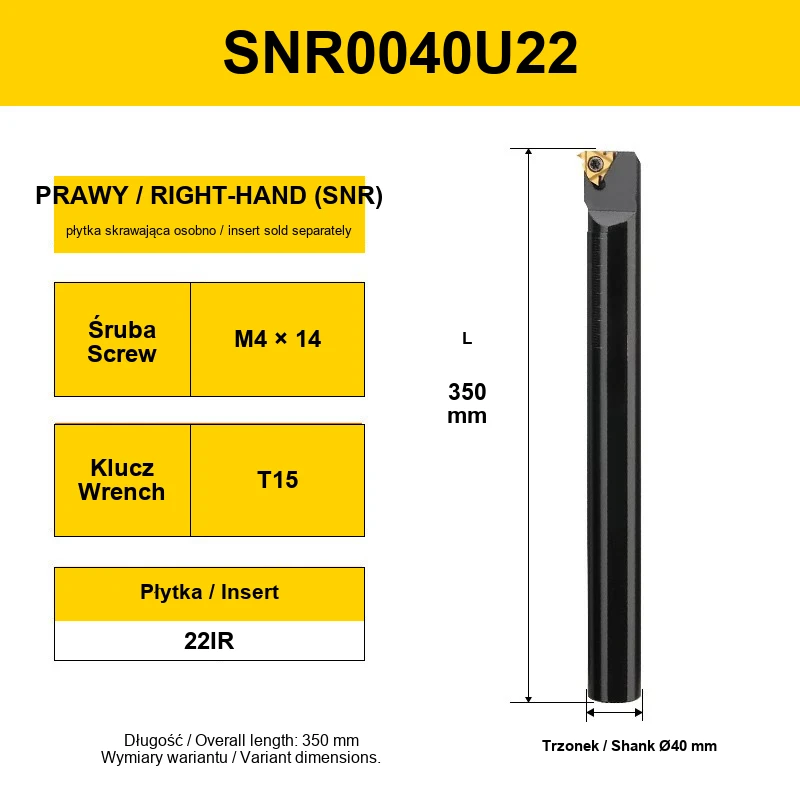
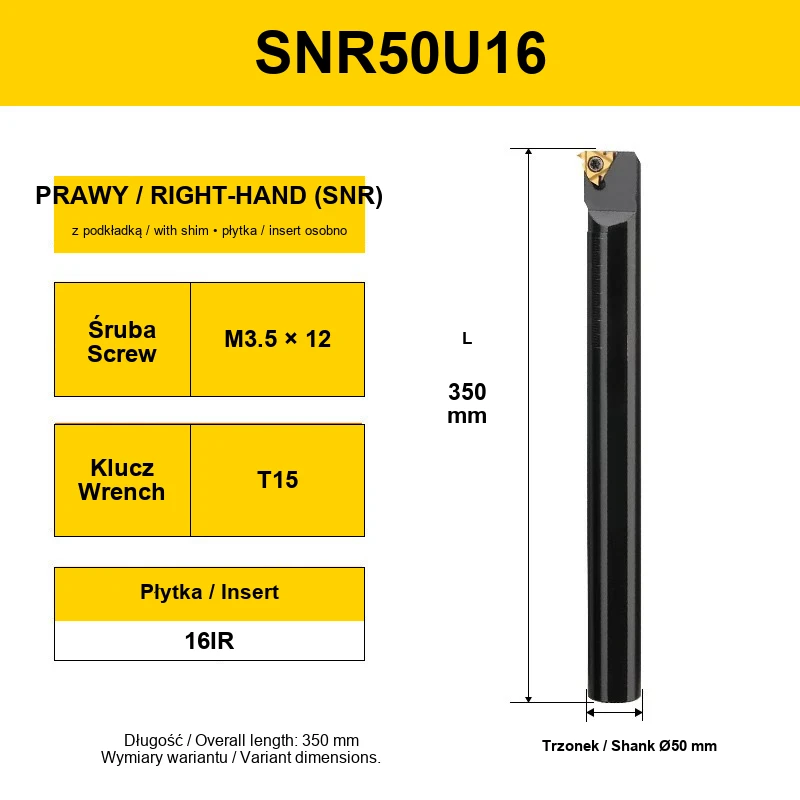
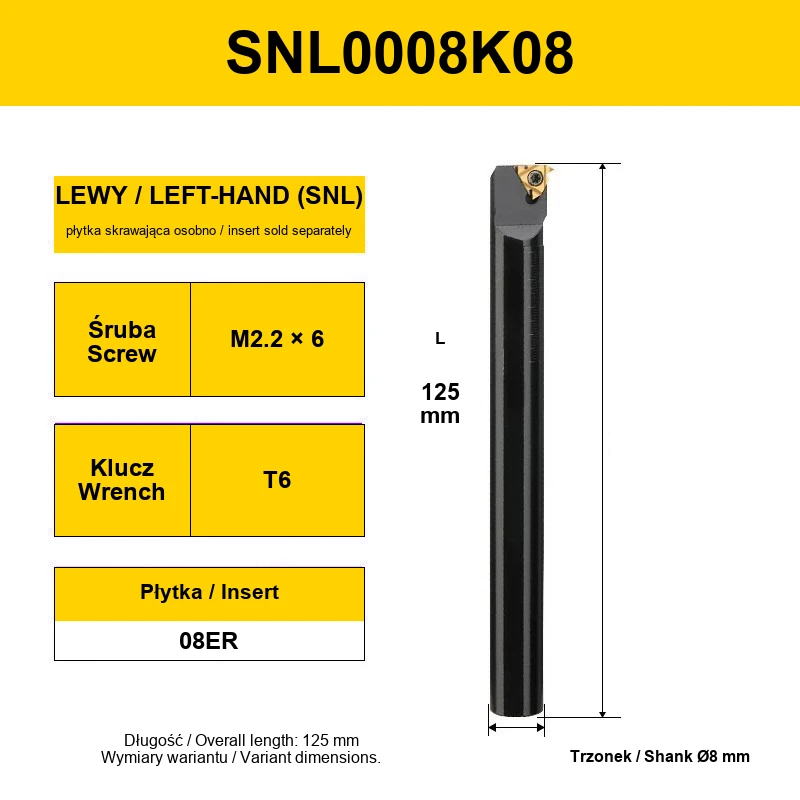
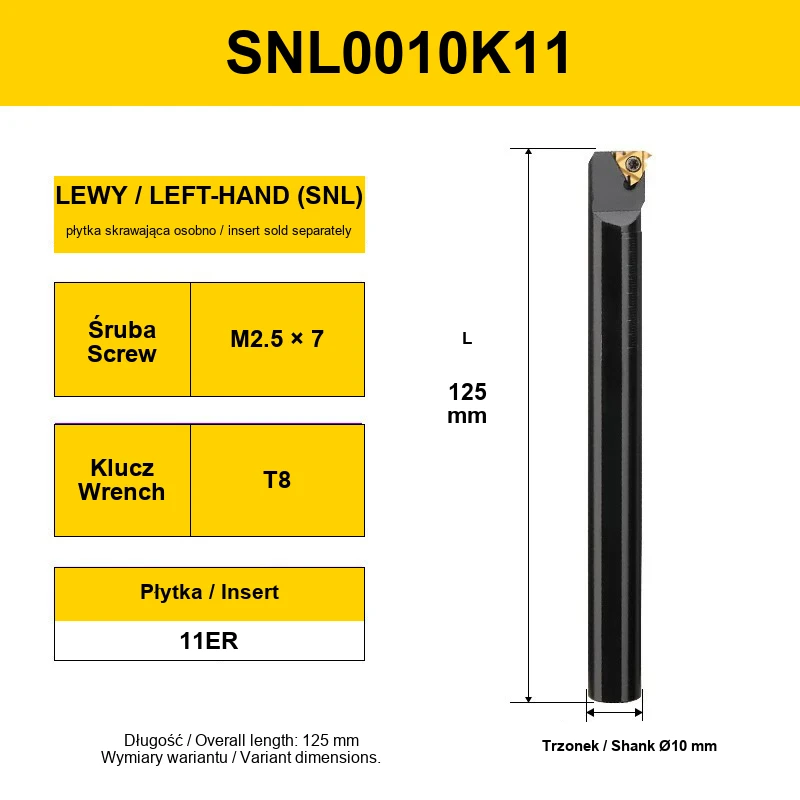
The SNR and SNL indexable boring bars in this listing are designed for turning internal threads inside a prepared bore. The range covers compact bars for small diameters and larger, more rigid holders for deeper bores and longer reach. Every variant has been checked separately for its symbol, shank diameter, overall length, insert system, screw and key.
This listing is for one tool holder only. The threading insert is not included and must match both the hand and the pocket size. The yellow-and-white variant card is the controlling specification for the selected option; if a general statement and a variant card differ, use the card for that exact option.
1. Application
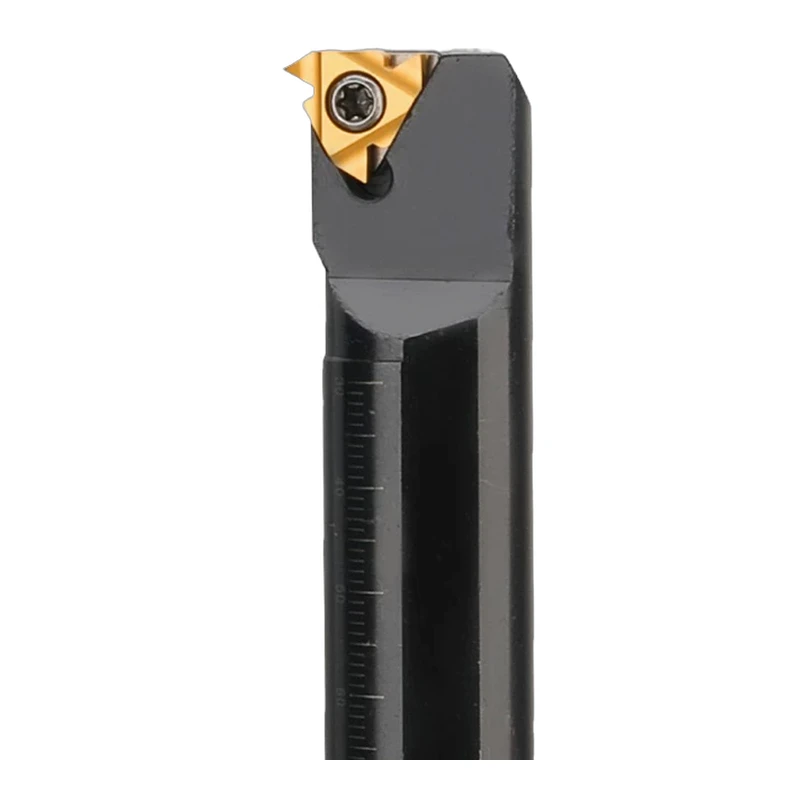
The holder carries a threading insert inside the bore so that the thread can be generated on a lathe. It can be used on CNC or conventional lathes provided the machine tool block accepts the stated shank diameter and the workpiece geometry gives the bar safe access to the cutting zone.
- internal threads in bushes, nuts, rings, housings and prepared technological bores
- single-part, small-batch and production machining on lathes with external coolant supply
- full-profile or partial-profile inserts selected for the required thread form, pitch and workpiece material
- compact variants for small bores and larger shanks for increased clamping rigidity
- right-hand SNR and left-hand SNL versions to suit the program, tool orientation and safe retraction path
The holder alone does not define the thread standard. Metric, inch, pipe, trapezoidal or other profiles are determined primarily by the selected threading insert. Before machining, also confirm the minimum bore required by the insert and holder nose, thread depth, relief groove and clearance for retracting the cutting edge.
Rigidity matters in internal turning
Use the largest shank that fits both the bore and the machine holder, and keep overhang only as long as necessary to reach the end of the thread. Excessive overhang can promote vibration, reduce surface quality and make the finished thread form less consistent.
2. SNR / SNL hand selection
The hand letter is part of the tool symbol. SNR identifies the right-hand family prepared for this listing, while SNL identifies the left-hand family. Do not choose the holder solely from whether the required thread itself is right- or left-hand. Consider tool orientation, approach side, feed direction, spindle rotation and the safe exit path.
| Family | Holder hand | Insert system in this listing | Primary check |
|---|---|---|---|
| SNR | right-hand | IR | edge position versus tool orientation and programmed feed |
| SNL | left-hand | ER | whether the mirrored geometry gives the required cutting and retract direction |
The IR and ER designations above follow the verified specifications for this range. They must not be swapped automatically even when the numerical size is the same. The insert must fit the pocket, screw hole, support surface and cutting-edge orientation.
If the previous holder has a legible symbol, compare it character by character with the selected option. If no symbol is available, record at least the clamped shank diameter, required reach, hand, insert size and the orientation of the cutting edge in the machine.
3. Specification
| Parameter | Value |
|---|---|
| Tool type | Indexable boring bar / holder for internal thread turning |
| Application | CNC and conventional lathes; cutting threads inside a bore |
| Families | SNR – right-hand; SNL – left-hand |
| Insert clamping | Central screw; the S symbol identifies screw clamping |
| Holder material | 40Cr steel |
| Nominal family range | Ø5–Ø50 mm |
| Actual shank diameter in available variants | Ø7–Ø50 mm |
| Overall length | 110–350 mm, depending on variant |
| Insert systems for SNR | 06IR, 08IR, 11IR, 16IR or 22IR |
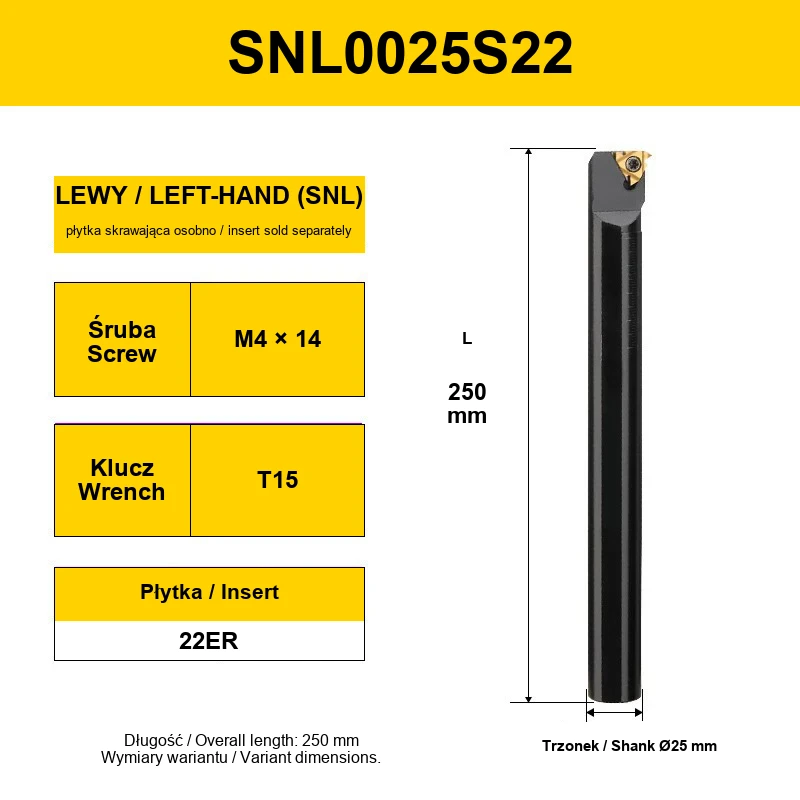
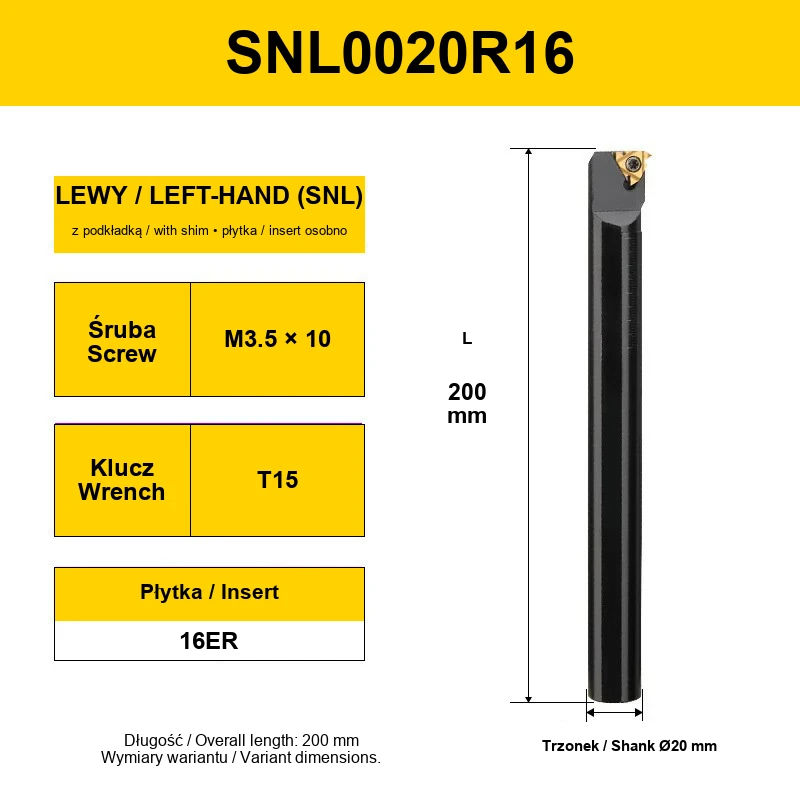
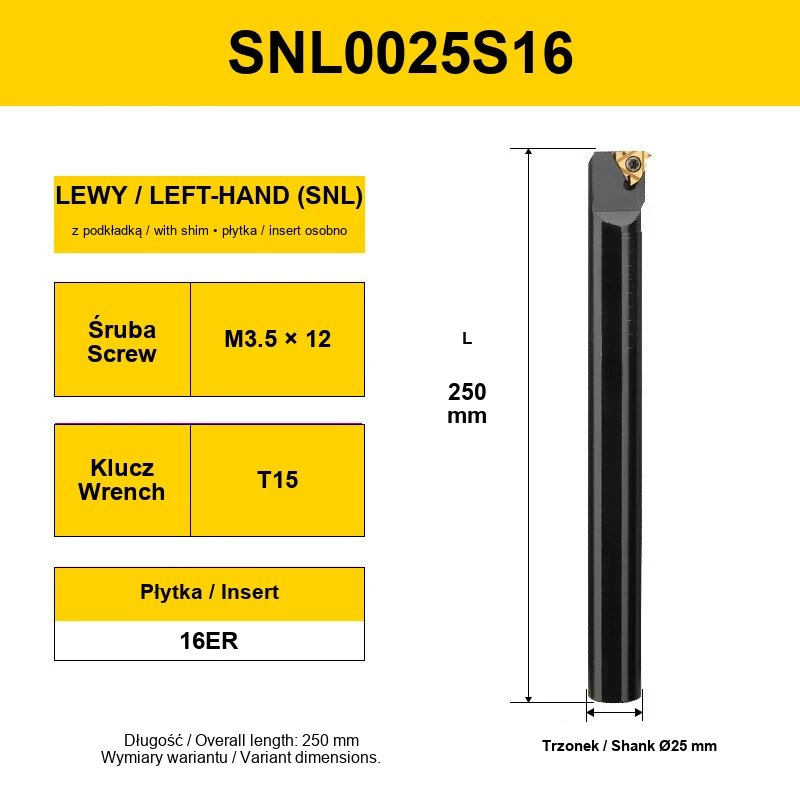
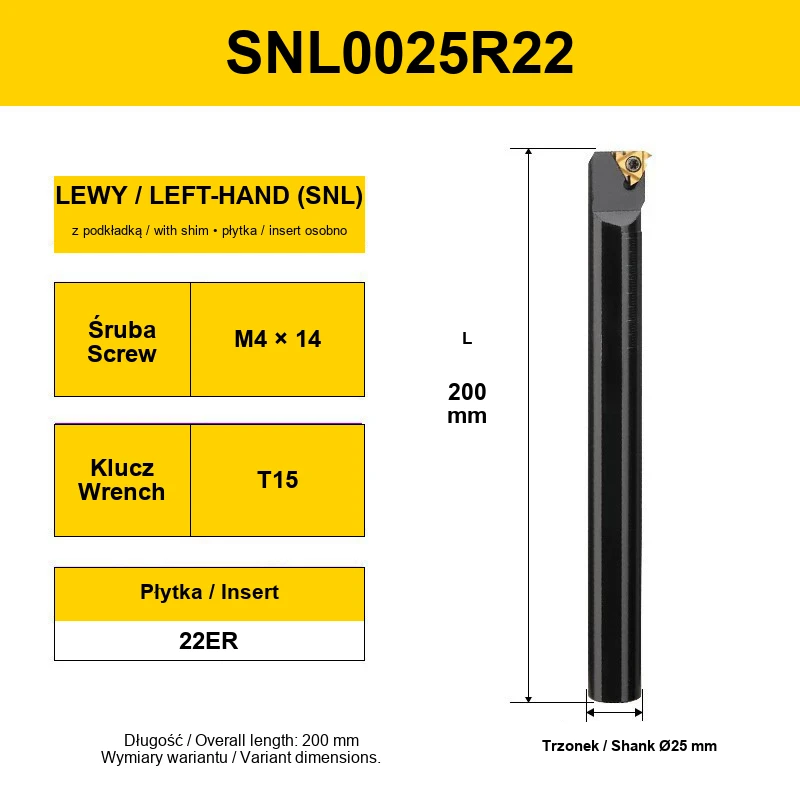
| Insert systems for SNL | 08ER, 11ER, 16ER or 22ER |
| Clamping screws | M2.2 × 6, M2.5 × 6, M2.5 × 7, M3.5 × 10, M3.5 × 12 or M4 × 14 |
| Keys | Torx T6, T8 or T15 – the exact size is printed on the variant card |
| Shim | Variant-specific: supplied with a shim, without a shim, or not confirmed |
| Cutting insert included | No – select and purchase the insert separately |
| Prepared variants | 42: 27 right-hand and 15 left-hand |
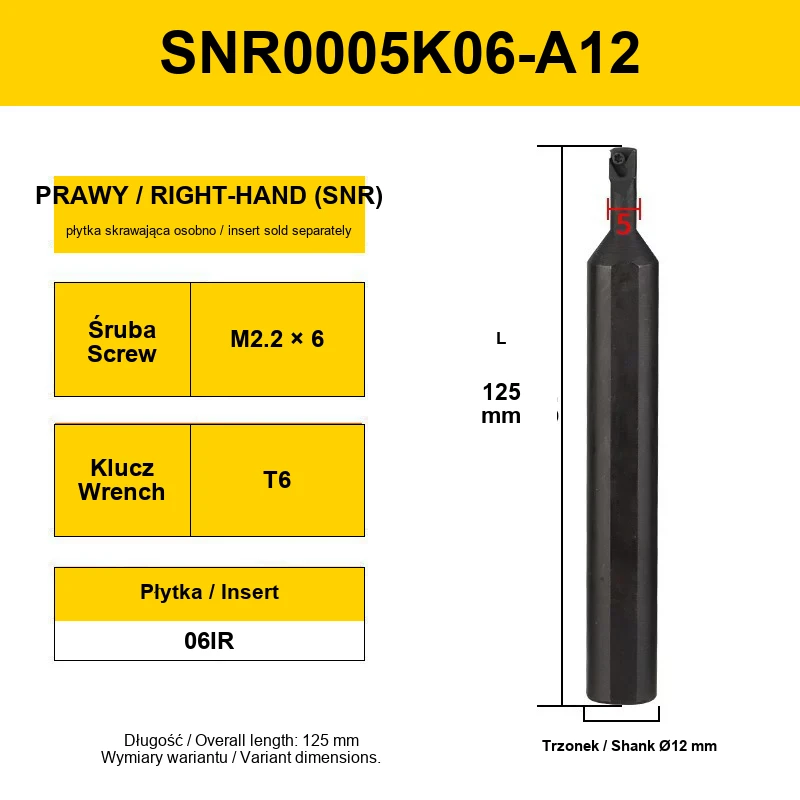
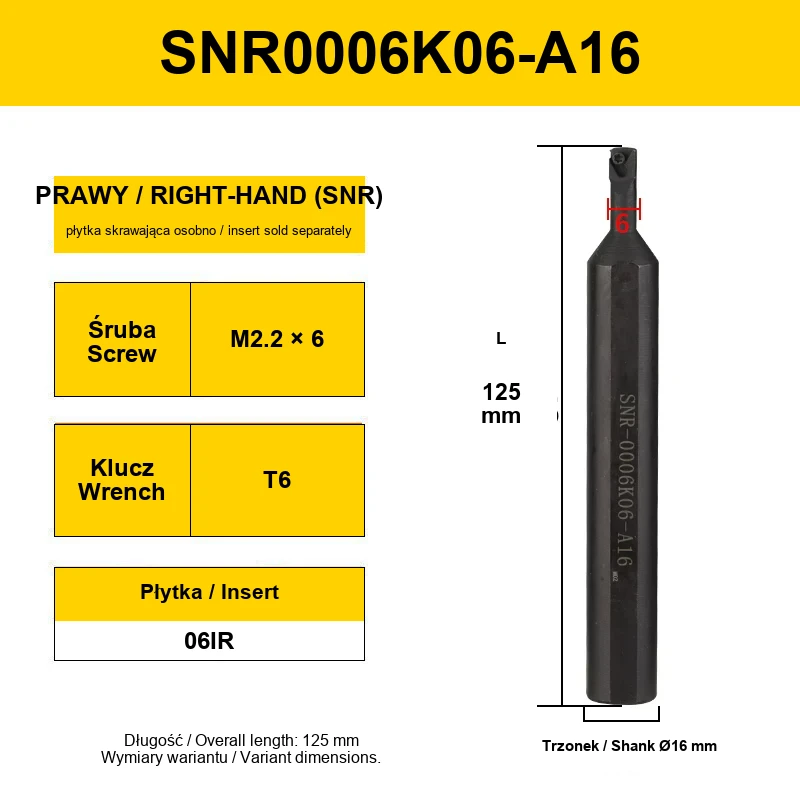
The two smallest variants use an adapter-style design: the nominal working section is 5 or 6 mm while the clamped shank is Ø12 or Ø16 mm. For these options, never infer the machine-clamping diameter from the first numerical block alone; read the variant card.
Length letters J, K, L, M, N, Q, R, S, T and U identify length groups, but purchasing decisions should use the stated metric overall length. The prepared set spans 110 to 350 mm. The same shank diameter may be offered in more than one length or for more than one insert size.
4. Insert systems and available range
The table below groups the prepared options by holder hand and insert system. It is a selection map, not a replacement for the exact variant card. Shank and overall-length ranges refer only to the options verified for this listing.
| Family | Hand | Insert | Shank range | Overall length | Variants |
|---|---|---|---|---|---|
| SNL | left-hand | 08ER | Ø8 mm | 125 mm | 1 |
| SNL | left-hand | 11ER | Ø10–Ø13 mm | 125–150 mm | 3 |
| SNL | left-hand | 16ER | Ø13–Ø32 mm | 150–300 mm | 8 |
| SNL | left-hand | 22ER | Ø20–Ø25 mm | 200–250 mm | 3 |
| SNR | right-hand | 06IR | Ø12–Ø16 mm | 125 mm | 2 |
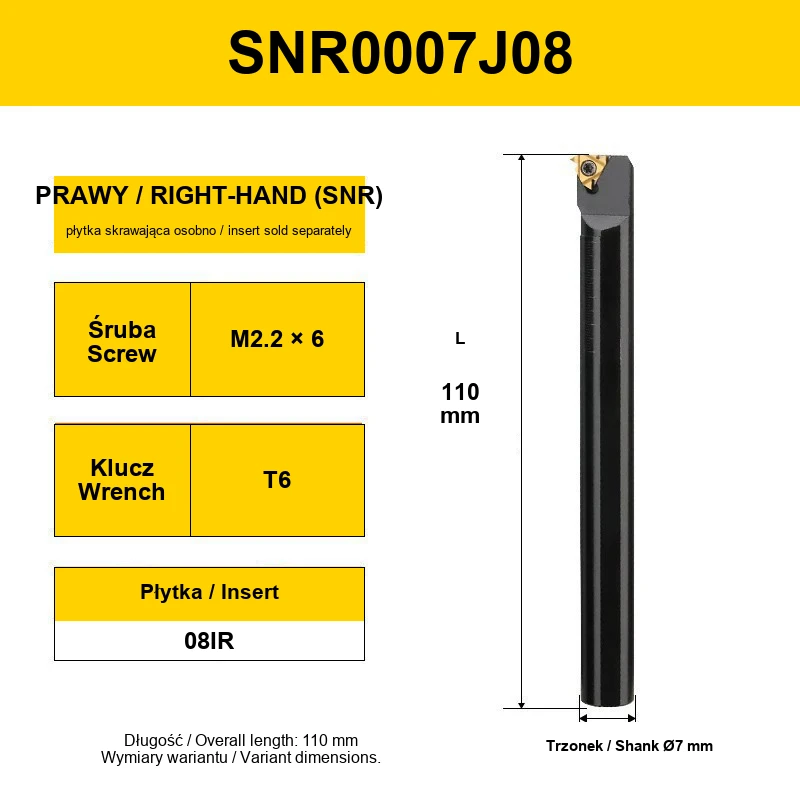
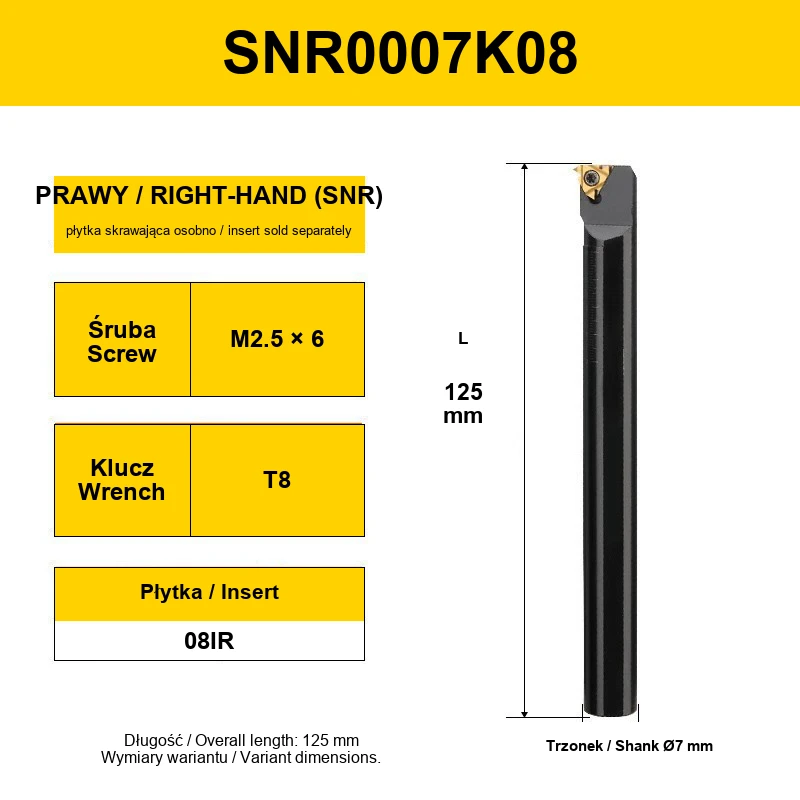
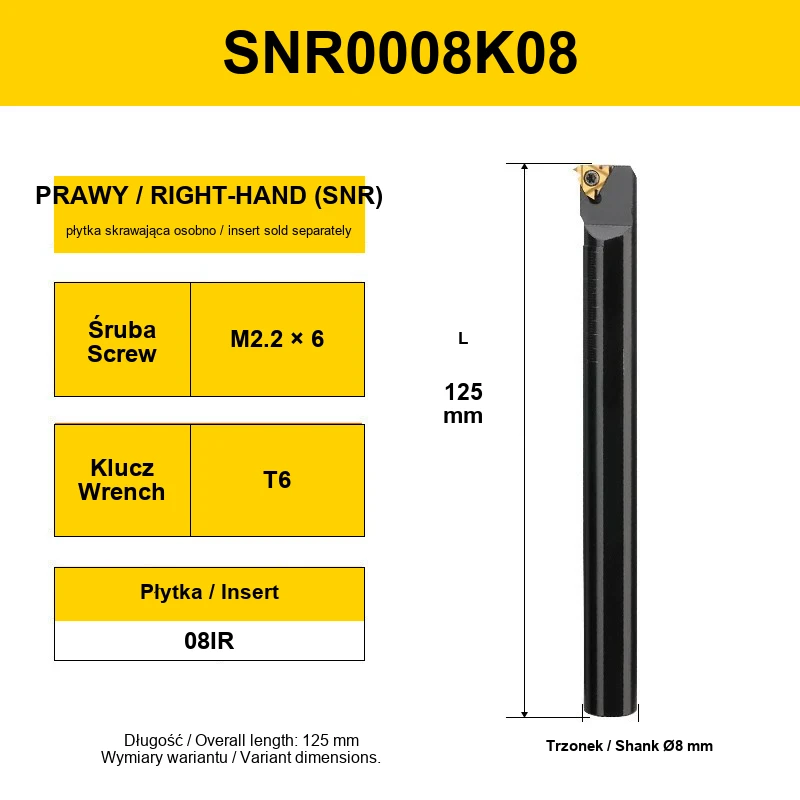
| SNR | right-hand | 08IR | Ø7–Ø8 mm | 110–125 mm | 3 |
| SNR | right-hand | 11IR | Ø8–Ø16 mm | 125–150 mm | 4 |
| SNR | right-hand | 16IR | Ø13–Ø50 mm | 150–350 mm | 13 |
| SNR | right-hand | 22IR | Ø20–Ø40 mm | 200–350 mm | 5 |
Understanding the insert size
The final number 06, 08, 11, 16 or 22 identifies the insert-size family that fits the pocket. It does not by itself define the thread profile or pitch. A 16IR insert, for example, is available in different profiles and carbide grades; only the complete insert designation establishes the thread and workpiece application.
When selecting an insert, check the IR or ER orientation, size 06/08/11/16/22, profile angle, pitch range, full or partial profile, carbide grade and intended workpiece material. The clamping-screw size is not an insert designation and should never be the only compatibility test.
5. Reading the holder code
The symbol consists of six logical parts. Shown with separators for clarity, the structure is S · N · R/L · diameter · length letter · insert size. This explains the tool function without publishing a static list of every SKU inside the description.
| Code part | Meaning | What to verify |
|---|---|---|
| S | screw-clamped insert | complete screw and pocket for the selected option |
| N | internal-thread tool | clearance between the bar nose and the smallest bore |
| R or L | right- or left-hand holder | tool-block orientation, feed and retract path |
| diameter digits | nominal bar diameter | actual clamped shank on the card; adapter variants are exceptions |
| J–U | length code | metric overall length and required reach |
| 06–22 | insert-size system | IR/ER orientation, profile, pitch and carbide grade |
An added A12 or A16 suffix identifies a version with a larger clamping shank than the nominal working-section diameter. For these tools the variant card is the mandatory reference for the diameter clamped in the machine.
6. Clamping parts and package contents
Each option is one holder. The cutting insert is sold separately. The verified variant data confirms the screw and key for each option, but shim status is not uniform across the range: several options explicitly state with or without a shim, while other options do not provide enough evidence to generalise.
| Screw | Key | Insert systems encountered | Typical shank range | Rule |
|---|---|---|---|---|
| M2.2 × 6 | T6 | 06IR, 08ER, 08IR | Ø7–Ø16 mm | check the selected variant card |
| M2.5 × 6 | T8 | 08IR | Ø7 mm | check the selected variant card |
| M2.5 × 7 | T8 | 11ER, 11IR, 16ER | Ø8–Ø16 mm | check the selected variant card |
| M3.5 × 10 | T15 | 16ER, 16IR | Ø13–Ø20 mm | check the selected variant card |
| M3.5 × 10 | T8 | 16ER | Ø16–Ø20 mm | check the selected variant card |
| M3.5 × 12 | T15 | 16ER, 16IR | Ø25–Ø50 mm | check the selected variant card |
| M4 × 14 | T15 | 16IR, 22ER, 22IR | Ø20–Ø40 mm | check the selected variant card |
- the threading insert is not included; purchase one matching the system printed on the card
- do not assume a shim is supplied when the variant card does not confirm it
- replacement screws must match diameter, length and drive; an overlong screw may bottom out
- use the key stated for the exact option; T6, T8 and T15 are not interchangeable
- before tightening, clean the pocket and verify that the insert is fully seated without trapped chips
We do not publish a universal tightening torque because no verified torque table is available for this family. Follow the technical recommendations for the clamping component, do not extend the key and replace any screw with a damaged Torx drive.
7. Variant selection step by step
- Measure the finished bore and establish the minimum working diameter required by both the insert and the holder nose. Shank diameter alone does not prove the bar will clear the bore.
- Determine holder hand from tool orientation, spindle rotation, feed direction and the thread exit. If uncertain, compare with the previous holder or run a machine simulation.
- Choose the largest shank that fits the machine block and bore. Greater rigidity generally helps control vibration in internal turning.
- Select an overall length that reaches the end of the thread while avoiding unnecessary overhang.
- Select the IR system for the prepared SNR options or the ER system for the prepared SNL options, then choose size 06, 08, 11, 16 or 22.
- Read the exact screw, key and shim status on the variant card. This is essential where two options share the same basic symbol but declare different package configurations.
- Select the insert profile and carbide grade separately for the thread standard, pitch and workpiece material. The holder cannot replace that process decision.
Checks before the first cut
Clamp as much of the shank as practical, set the edge on centre height and manually check clearance through the smallest bore section. Simulate the path, verify the relief groove and make a light proving pass before full-depth threading. Cutting data must come from the selected insert, not from the holder alone.
8. FAQ
Is the threading insert included?
No. The listing is for one holder; the matching IR or ER threading insert is purchased separately.
What is the difference between SNR and SNL?
In this range SNR is the right-hand holder and SNL is the left-hand holder. Select hand from machine orientation, feed direction and the required retract path.
Does every SNR holder use a 16IR insert?
No. The range also includes 06IR, 08IR, 11IR and 22IR systems. The final size block and the variant card identify the correct family.
Why can nominal diameter differ from shank diameter?
Two compact adapter versions use an A12 or A16 shank. Their working section is smaller, while the section clamped in the machine is Ø12 or Ø16 mm.
Is a shim always supplied?
No single answer applies to every option. Some variants explicitly state with or without a shim; other options are marked as not confirmed on their card.
Can I use an insert from another brand?
A dimensionally compatible IR/ER insert may be considered, but check the screw hole, support surface, cutting-edge orientation and complete seating before machining.
Which length should I choose?
Choose enough reach to finish the thread with the shortest practical overhang. A longer bar is not automatically better and may be more prone to vibration.
How do I select thread profile and workpiece material?
Use the complete insert designation. The insert determines profile, pitch range and carbide grade for steel, stainless steel, cast iron or non-ferrous materials.
Bestsellers
-
Bestseller
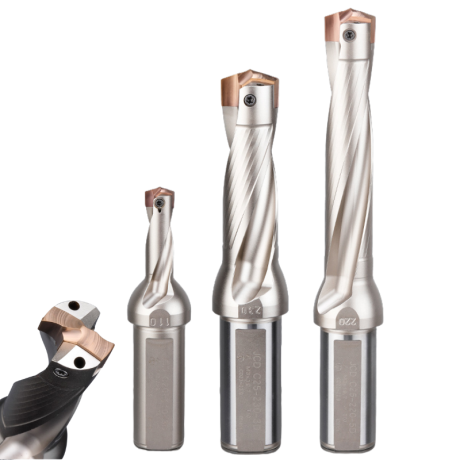
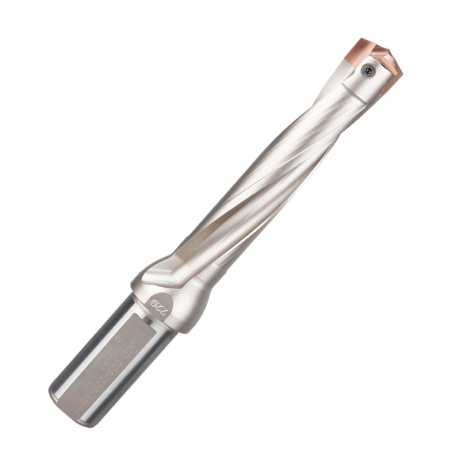
JCD modular drill with replaceable tip - internal cooling, for deep holes | GrotXD
JCD C20-100-3D Ø10~10.9 JCD C20-110-3D Ø11~11.9 JCD C20-120-3D Ø12~12.9 JCD C20-130-3D Ø13~13.9 JCD C20-140-3D Ø14~14.9 + 61 morePrice €69.86Price €56.79without VAT -
Bestseller
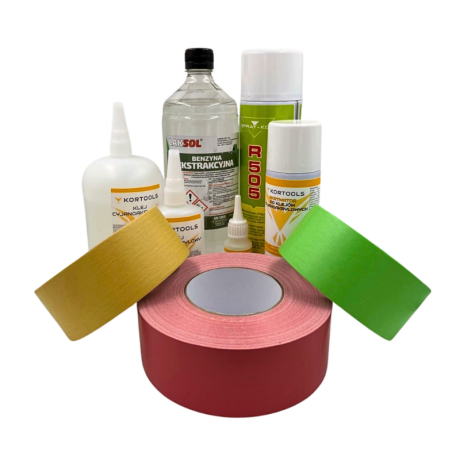
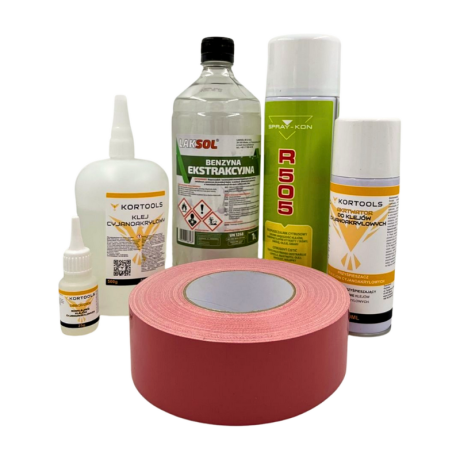
Kortools Adhesive + Tape CNC Workholding Kit
Yellow tape 5cm x 50m; adhesive 100g Yellow tape 5cm x 50m; adhesive 500g Yellow tape 10cm x 50m; adhesive 100g Yellow tape 10cm x 50m; adhesive 500g Green tape 5cm x 50m; adhesive 100g + 7 morePrice €44.66Price €36.31without VAT -
Price €17.18Price €13.97without VAT
-
Price €7.10Price €5.77without VAT
-
Price €7.56Price €6.14without VAT
-
Bestseller
 Other Accessories 0.00
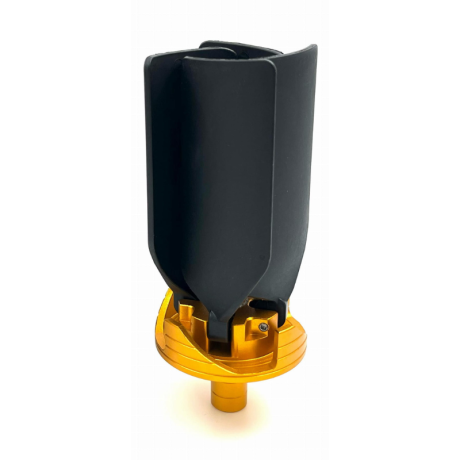
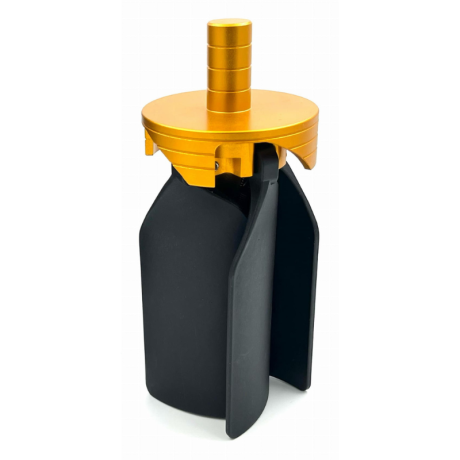
CNC Chip Fan / Chip Blower
Complete CNC chip fan Kit: blades, springs, pins and screwsPrice €53.82Price €43.76without VAT -
Bestseller
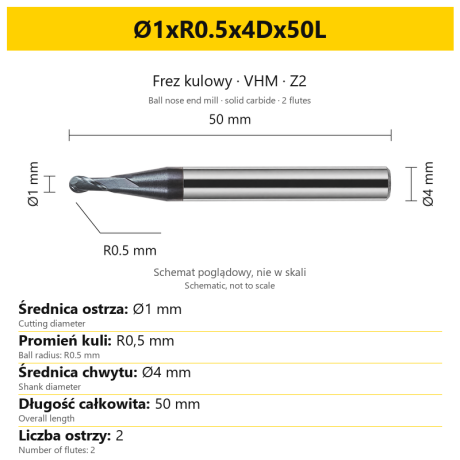 Ball Nose End Mills 0.00
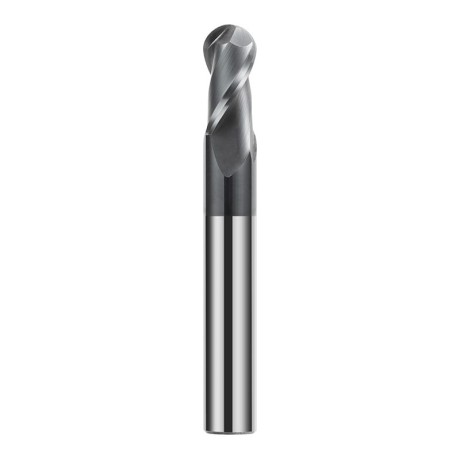
2-Flute Carbide Ball Nose End Mill - HYPERCUT
Ø1xR0.5x4Dx50L Ø1.5xR0.75x4Dx50L Ø2xR1x4Dx50L Ø2.5xR1.25x4Dx50L Ø3xR1.5x3Dx50L + 26 morePrice €10.14Price €8.25without VAT -
Bestseller
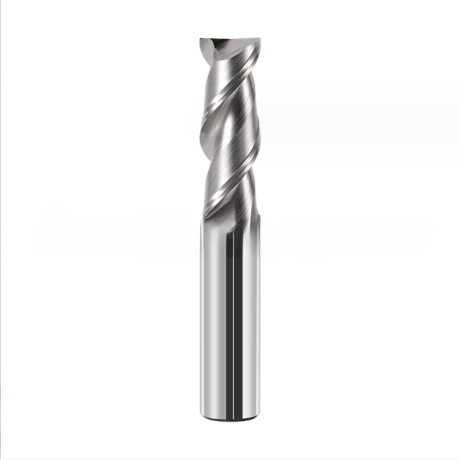
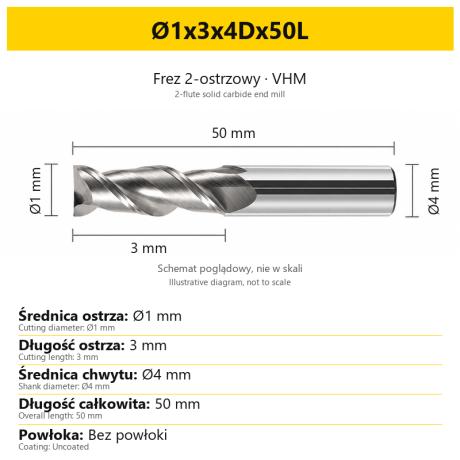 2-Flute End Mills 0.00
2-Flute Carbide End Mill for Aluminium
Ø1x3x4Dx50L Ø1.5x4x4Dx50L Ø2x6x4Dx50L Ø2.5x7.5x4Dx50L Ø3x9x3Dx50L + 31 morePrice €5.35Price €4.35without VAT -
Bestseller
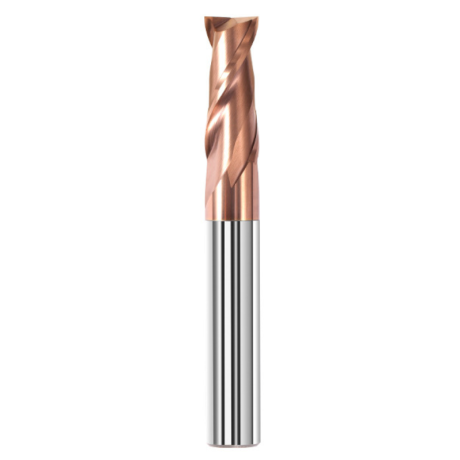
 2-Flute End Mills 0.00
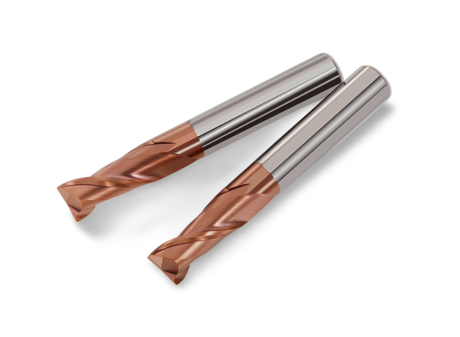
2-Flute Carbide End Mill for Steel 55 HRC - TiSiN - Solid Carbide
Ø6x24x6Dx75L Ø8x25x8Dx75L Ø4x20x4Dx100L Ø5x30x5Dx100L Ø6x30x6Dx100L + 31 morePrice €4.40Price €3.58without VAT -
Bestseller
 Ball Nose End Mills 0.00
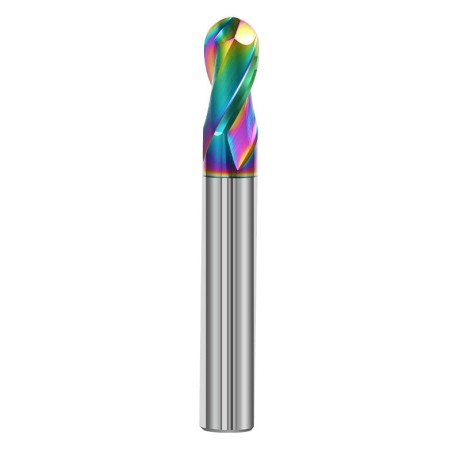
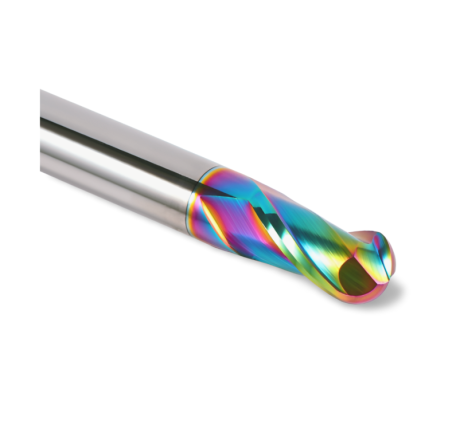
2-Flute DLC Coated Carbide Ball Nose End Mill| DuraEdge Alu
Ø1.0xR0.5x4Dx50L Ø1.5xR0.75x4Dx50L Ø2.0xR1x4Dx50L Ø2.5xR1.25x4Dx50L Ø3.0xR1.5x3Dx50L + 34 morePrice €7.89Price €6.41without VAT -
Bestseller
 2-Flute End Mills 0.00
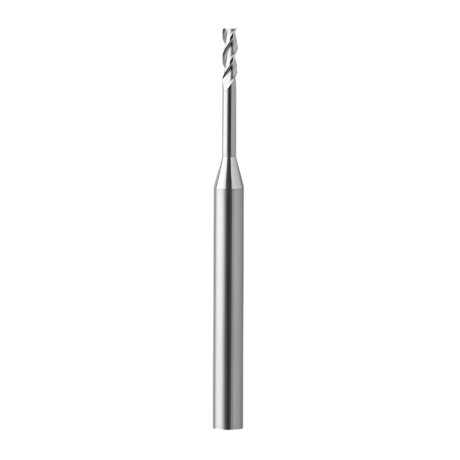
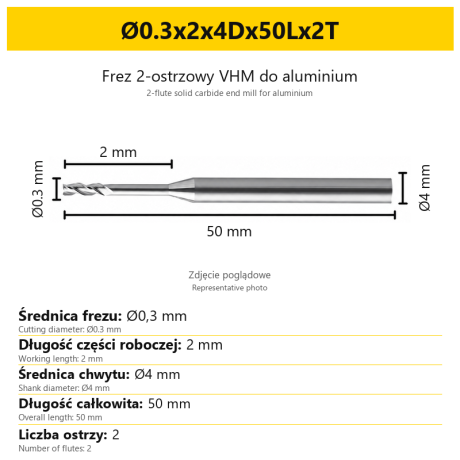
2-Flute End Mill for Aluminium | VHM | Miniature Ø0.3 - Ø0.9
Ø0.3x2x4Dx50Lx2T Ø0.3x3x4Dx50Lx2T Ø0.3x4x4Dx50Lx2T Ø0.4x2x4Dx50Lx2T Ø0.4x3x4Dx50Lx2T + 28 morePrice €7.99Price €6.50without VAT -
Bestseller
 Ball Nose End Mills 0.00
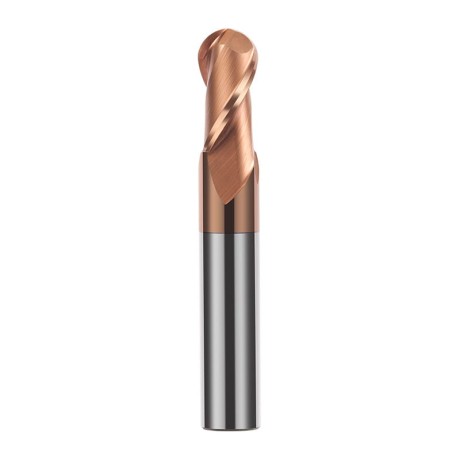
2-Flute TiSiN Coated Carbide Ball Nose End Mill
Ø1xR0.5x4Dx50L Ø1.5xR0.75x4Dx50L Ø2xR1x4Dx50L Ø2.5xR1.25x4Dx50L Ø3xR1.5x3Dx50L + 38 morePrice €7.28Price €5.92without VAT -
Bestseller
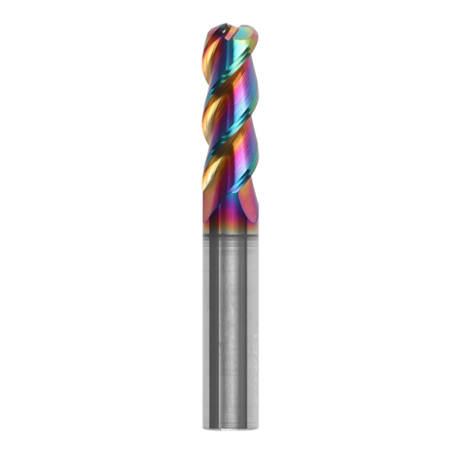
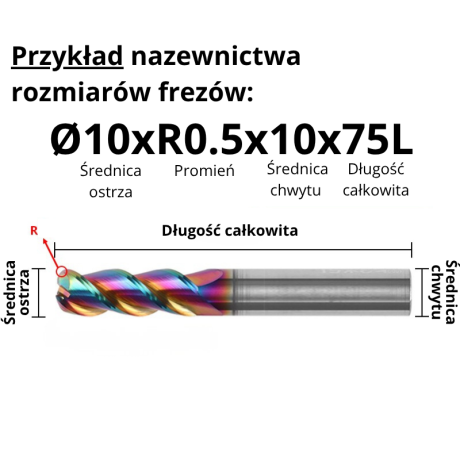
3-Flute Carbide Corner Radius End Mill for Aluminium| AL DLC
Ø1xR0.1x4Dx50L Ø1xR0.2x4Dx50L Ø1xR0.3x4Dx50L Ø1.5xR0.1x4Dx50L Ø1.5xR0.2x4Dx50L + 137 morePrice €4.96Price €4.04without VAT -
Bestseller
 3-Flute End Mills 0.00
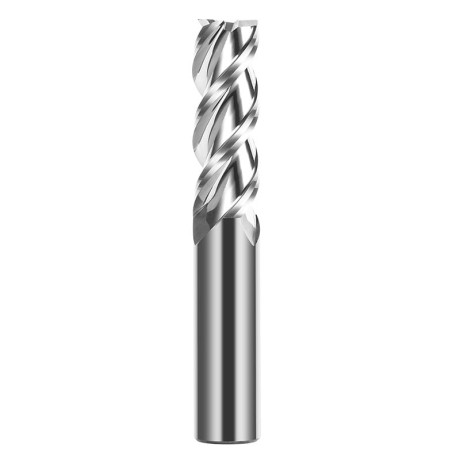
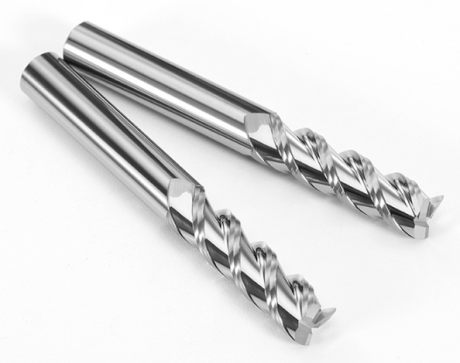
3-Flute Carbide End Mill VHM Z-3 for Aluminium| TriMill AL
Ø1x3xD4x50L Ø1.5x5x4Dx50L Ø2x6x4Dx50L Ø2.5x8x4Dx50L Ø3x9x3Dx50L + 41 morePrice €5.10Price €4.15without VAT -
Bestseller
 Countersinks 0.00
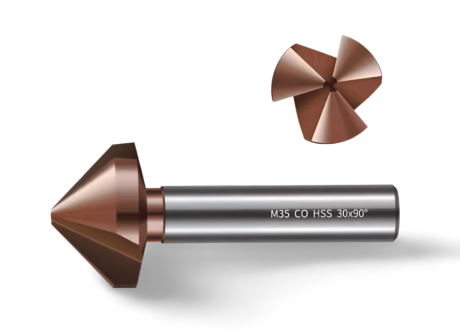
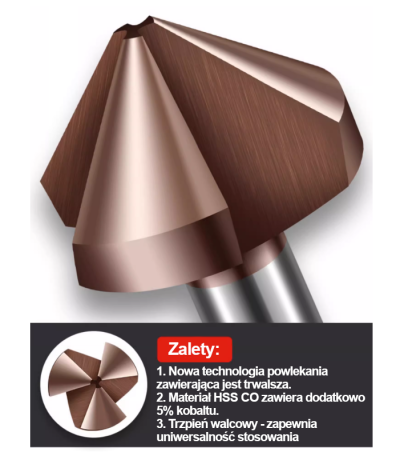
3-Flute Countersink Fi4.5-fi60, 90° - HSS-CO - 5% Kobaltu | Straight Shank
Ø4.5 x 4 x 90° x 40L Ø5 x 5 x 90° x 45L Ø6.3 x 5 x 90° x 45L Ø8.3 x 6 x 90° x 50L Ø10.4 x 6 x 90° x 50L + 12 morePrice €4.81Price €3.91without VAT -
Bestseller
 3-Flute End Mills 0.00
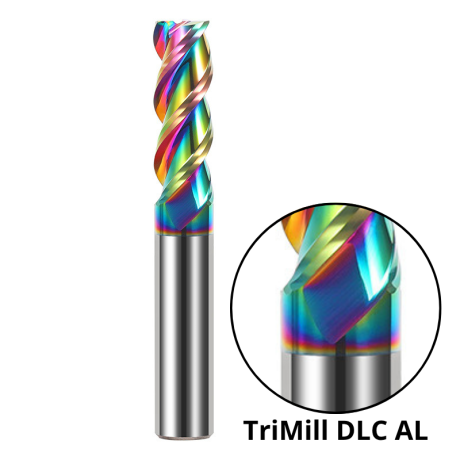
3-Flute DLC Coated Carbide End Mill | TriMill DLC AL
Ø1x3x4Dx50L Ø1.5x5x4Dx50L Ø2x6x4Dx50L Ø2.5x8x4Dx50L Ø3x8x3Dx50L + 38 morePrice €5.07Price €4.12without VAT